

What advantages does RWA have that could let a sector that barely existed three years ago approach $40 billion in 2026? RWA.xyz data shows that by the end of September 2026, the global tokenized asset market reached $38.6 billion, up 51% from $25.5 billion at the end of 2025, while in 2023 it was only $1.7 billion—a more than 20x surge in less than three years. Next, we break down the five major advantages of the RWA sector—scale, yield, institutions, efficiency, and access—using the latest data.
Table: Overview of Latest RWA Sector Data
| Data Metric | Value |
|---|---|
| Total RWA Scale | Approx. $39 Billion |
| RWA Holder Addresses | 5.51 Million, up 7.74% in 30 days |
| Tokenized US Treasury Scale | Approx. $14.2 Billion, with over 85,000 holders |
| Total Market Cap of Tokenized Stocks | $1.7 Billion, with Binance leading at $1.4 Billion |
| Solana On-Chain RWA Scale | $5.12 Billion, up 17.65% in 30 days |
| Solana RWA 30-Day Transfer Volume | $16.2 Billion, up about 80% monthly |
| BlackRock BUIDL Scale | Approx. $2.08–$2.17 Billion |
| Token Terminal Broad-Scope Tokenized Assets | $46.1 Billion, up about 920% in three years |
| RWA Penetration in DeFi | Approx. 13.9% |
| Tokenized Private Credit Yield | 8%–15%, with a scale of approx. $35.9 Billion |
Note: The above content is compiled and summarized by CoinMeta based on public market data. Please refer to actual data if there are any fluctuations.
What Is RWA?
RWA, or real-world asset tokenization, refers to converting the ownership or beneficial rights of traditional assets such as bonds, funds, private credit, real estate, and gold into on-chain digital tokens through blockchain technology, enabling issuance, fractionalization, trading, and settlement on-chain.
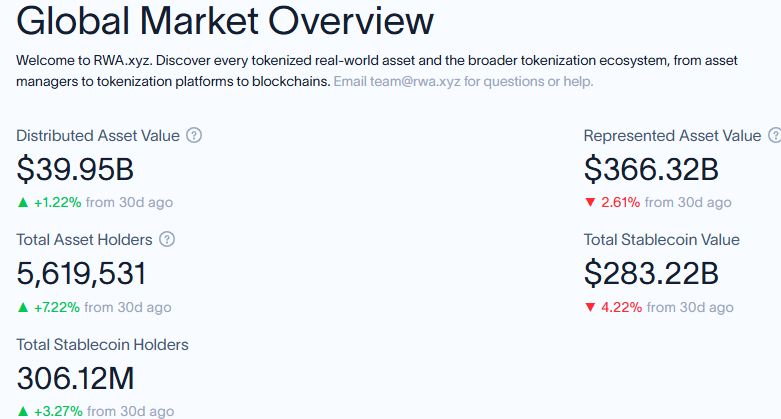
Image: Latest RWA Sector Data
According to RWA.xyz data on November 4, on-chain distributed RWA assets stood at approximately $39.27 billion, up 0.63% over 30 days. Among them, tokenized US Treasuries and linked funds remain one of the largest segments, with a scale of about $14.2 billion as of November 3-4, 2026, covering about 120 financial instruments and more than 85,000 holder addresses. Tokenized stocks issued by Binance bStocks, Robinhood, and Coinbase have a combined market cap of $1.7 billion, with Binance leading at $1.4 billion.
Scale Advantage: Over 20x Growth in Three Years
According to RWA.xyz data, by the end of September 2026, the global tokenized asset market reached $38.6 billion, up 51% from $25.5 billion at the end of 2025, while in 2023 the figure was only $1.7 billion—a more than 20x surge in less than three years. By early November 2026, this scale had further risen above $39 billion, with more than 5.5 million addresses holding tokenized financial instruments.
In addition, non-stablecoin RWA still grew 13.3% in the first half of 2026. We can analyze that its growth was not inflated by stablecoins, but the result of real traditional financial assets moving on-chain.
Yield Advantage: A Complete Yield System
First, what is "yield tiering"?
Think of it like supermarket shelves:Low-risk shelf: Treasury tokens, around 3.3%;High-risk shelf: Private credit tokens, 8%-15%.Previously, many on-chain assets either had high volatility or single yields. RWA brings the entire traditional finance "risk-based pricing" shelf system on-chain.The specific results presented on-chain by RWA are as follows:
Tokenized US Treasuries: Yield of about 3.3%, equivalent to an "on-chain time deposit." Backed by US government credit, low risk means low interest. If you invest 1 million yuan, you earn about 33,000 yuan in interest per year, seeking stability.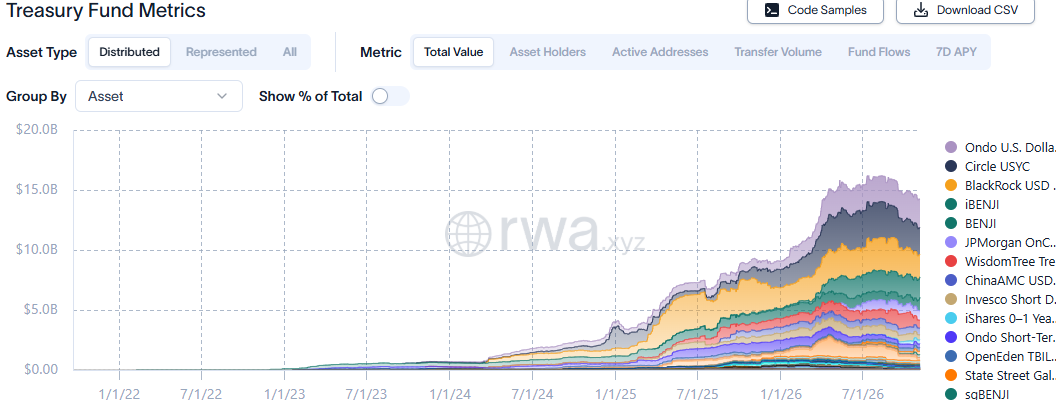
Image: Tokenized Treasury Scale
Tokenized private credit: Yield of about 8%-15%, equivalent to "on-chain private lending." Money is lent to enterprises at high interest, but enterprises may default. If you invest 1 million yuan, you may earn 80,000-150,000 yuan in interest per year, but you also bear default risk.
This spread is the most direct attraction of RWA for on-chain capital seeking yield.
Institutional Advantage: BlackRock and Others Are Running It
The third advantage of RWA is that institutions are no longer just doing PoCs; they have proven on-chain fund flows in actual business.
For example, BlackRock's BUIDL fund transferred $441 million on-chain in June 2026 alone, has a daily $1 billion redemption mechanism, and has been accepted as collateral;
JPMorgan's Kinexys platform added $105.1 million during the same period, and Franklin Templeton's OnChain US Government Money Fund has net assets of about $721 million.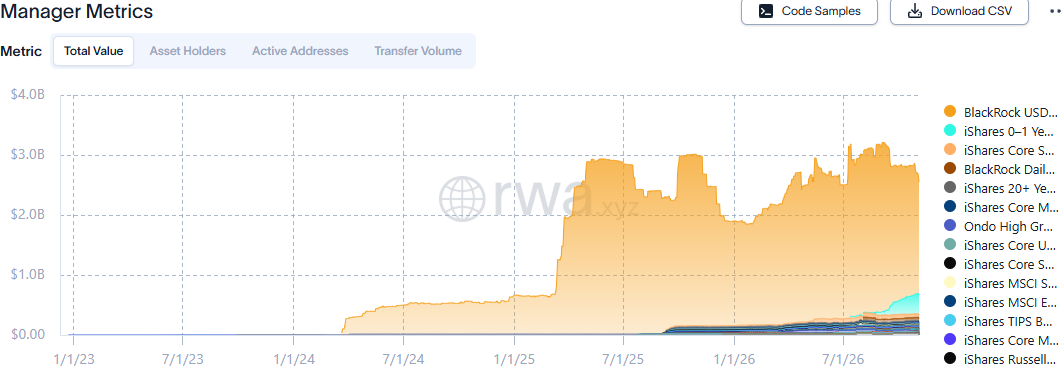
Image: BlackRock Fund Scale
In our view, the advantage of institutional participation in RWA is that funds generate repeatable subscriptions, redemptions, and collateral calls on-chain, which is more meaningful as a signal than any single issuance size
Efficiency Advantage: The Settlement Cost Curve Steeply Shifts Down
In a traditional bond or cross-border transaction, money and assets pass through custodians, settlement agents, reconciliation, and multiple other steps, often taking several days, and post-trade processing costs alone can account for 30%-40% of total costs.
RWA's efficiency advantage is reflected in: assets and cash settle simultaneously—either both complete or neither happens—with no manual reconciliation needed in between. Costs do not decline slowly; they cut out entire intermediate layers such as reconciliation, clearing, and correspondent banks.
For example: a batch of HK$20 billion in green bonds in Hong Kong required 5 business days for settlement in the traditional process, but was compressed to 1 day after settlement with tokenized deposits. Settlement costs for tokenized securities on Solana are even less than 1 cent, while traditional wire transfers can cost tens or even hundreds of dollars.
In one sentence: traditional settlement is people running processes, RWA is code execution; the fewer the processes, the closer marginal costs approach zero, and the curve naturally shifts down.
Access Advantage: Lowering the Barrier
In tokenized stock trading, fractional shares can be bought for as little as $5. Franklin Templeton's BENJI tokenized money market fund has a minimum investment threshold of about $20, and real estate tokenization platform Lofty has a minimum investment of about $50. By contrast, the threshold for traditional private funds or commercial real estate investment is usually in the tens of thousands to millions of dollars.
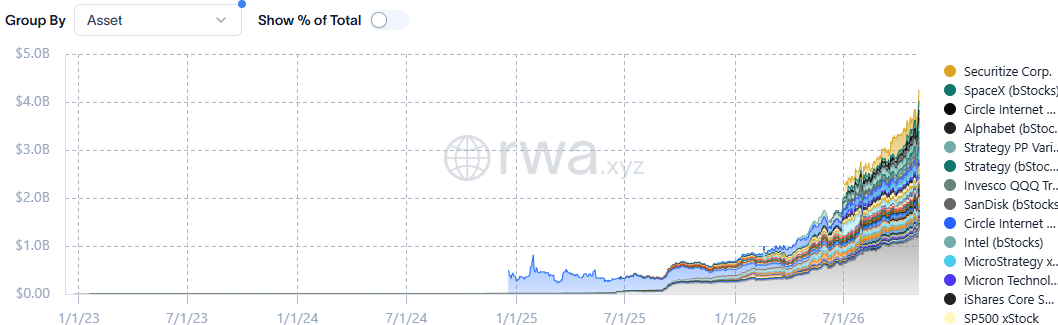
Image: Tokenized Stock Scale
Previously, small amounts of money were too small for institutions to serve. Now RWA automatically pools small money into large money, and retail capital can be used at low cost for the first time.
RWA Future Outlook
Looking ahead to the rest of 2026 and 2027, the future of RWA hinges on three things: whether it can be used, whether it can be sold, and whether it can be trusted.
From "Issuing On-Chain" to "Using It"
The future competition is not about who moves more assets on-chain, but whether on-chain assets can be used as collateral to borrow and called by lending protocols. Currently, only about 10% of RWA has entered DeFi. Whoever cracks this step will revitalize the assets
Secondary Market Liquidity Determines Survival
In our view, RWA issuance is no longer difficult; the difficulty is having buyers after issuance and being able to sell at any time. Tokenized private credit is large in scale, but most of it is locked and cannot be traded. In the future, whoever builds a compliant, deep secondary market will gain pricing power.
Compliance and Authenticity Verification Become the Entry Ticket
Compliance is the entry ticket for RWA. On-chain tokens must correspond to real assets that have not been double-pledged. Whether custody is segregated, and whether there are regular audits and proof of holdings, will determine whether institutions dare to hold long term.
FAQ
Q1: What is RWA?
RWA is the sector that converts traditional assets such as bonds, funds, and real estate into on-chain tokens. It does not create new assets; it changes how assets are issued, fractionalized, and settled.
Q2: Where does RWA yield come from?
RWA yield comes from the underlying assets themselves. Tokenized US Treasuries yield about 3%-5%, corresponding to government credit; tokenized private credit yields about 8%-15%, corresponding to borrower default risk and liquidity premium.
Q3: Can ordinary people buy RWA?
Yes, but it depends on the product type. Tokenized stocks allow fractional shares from as little as $1-$5, and some tokenized funds have a minimum investment threshold of about $20.
Conclusion
Looking back at the question "what are the advantages of RWA," it cannot be summarized with a single metric: scale is validating real demand for the sector, yield is being tiered, institutions are running it through, efficiency is improving, and access thresholds are falling. But DeFi penetration of only about 10%, and the fact that most assets beyond private credit still lack active secondary markets, remind the market that the five advantages are not being realized evenly. In RWA's next stage, the competition is not about who moves more assets on-chain, but who can make on-chain assets truly usable.
Disclaimer: Readers are strictly advised to comply with local laws and regulations. This article is compiled based on public market data for reference and educational purposes only, and does not constitute investment advice.