On November 5th, the price of Bitcoin rose above $80,000, rebounding from a seven-week low. New inflows of funds into the spot ETF market, the rise in U.S. stocks, and a large number of short sellers closing their positions all contributed to this round of recovery.
During the U.S. mid-term elections on November 3, the price of Bitcoin fell to around $75,600, before rebounding above $80,000.
U.S. spot Bitcoin ETF recorded a net inflow of $74.6 million on November 4th, reversing the capital outflows that occurred for three consecutive trading days prior to that.
Among them, FBTC of Fidelity attracted $236.7 million in capital inflows, while IBIT of BlackRock saw $201.2 million in capital outflows, indicating that the flow of institutional funds remains divergent.
Short squeeze accelerated this rebound, with nearly $378 million of bearish crypto positions being closed within an hour.
Bitcoin is currently facing resistance around the $81,300 to $82,000 range, while analyst CryptoZeno warns that the market correction may not be over yet.
According to the data from Farside Investors, on November 4th, there was a net inflow of $74.6 million in spot Bitcoin ETF in the United States, which drove this round of recovery. Fidelity led the buying orders, while traders who bet on a decline in Bitcoin suffered significant losses as prices rose.
According to crypto.news market data, as of press time, BTC was trading at $80,320, representing a rise of over 3% within 24 hours. During the announcement of the U.S. mid-term election results, it briefly fell to $75,600 before rebounding above $81,000 and then stabilized around $80,000.
At the same time, the cryptocurrency market as a whole also saw a rebound. Ethereum (ETH) rose by nearly 6% to around $2,425; XRP rose by 3% to $1.31; Solana (SOL) rose by 4% to $96; BNB rose by 2% to around $710.
It is worth noting that among the major cryptocurrencies, Zcash ( ZEC ) led the gains, with a rise of over 7%, reaching nearly $1,320, and its trading volume in the past 24 hours reached $1.2 billion.
Bitcoin price rises after capital inflows return to ETF
After there was a outflow of funds from spot Bitcoin funds in the United States for three consecutive trading days, institutional investment flows turned positive on Wednesday.
However, IBIT of BlackRock recorded a capital outflow of $201.2 million, which partially offset the inflow of funds into other funds.
The total amount of capital outflows in the previous rounds includes: $643.2 million on October 30th, $398.6 million on November 2nd, and $115.6 million on November 3rd.
As previously reported by crypto.news, despite a reduction in selling pressure during the election counting period, Bitcoin still found it difficult to recover.
Data from ETF on November 4th indicates that new net investments have returned, although the scale of inflows has not yet fully made up for the funds that flowed out in the previous trading days.
The results of the U.S. mid-term elections and the closing of short positions boosted Bitcoin.
As financial markets stabilized after the Democratic Party gained control of both chambers of Congress, Bitcoin's rebound momentum strengthened.
The election results initially caused concern among cryptocurrency traders, as Democratic lawmakers might adopt a tougher stance on digital asset legislation under consideration.
However, subsequently the U.S. stock market rebounded, with the S&P 500 index rising by about 1.6%, and investors began to assess the election results.
During the same period, oil prices fell significantly, while a weakening dollar and declining yields on U.S. Treasury bonds supported demand for risk assets.
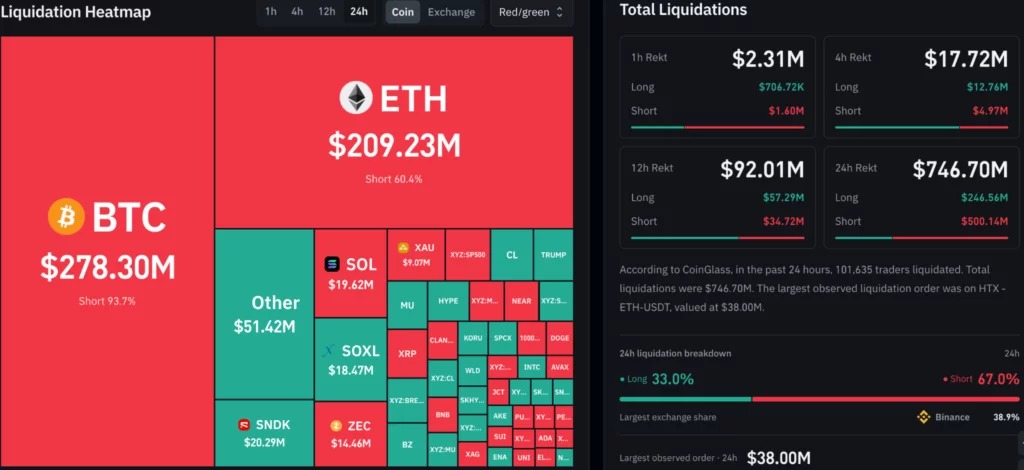
The rebound in Bitcoin prices also coincided with the liquidation of approximately $378 million in short positions in cryptocurrencies within an hour.
As of press time, data from CoinGlass shows that the total settlement amount during this period approached 747 million US dollars. Short covering refers to the exchange's forced closure of leveraged short positions in a certain asset, and when traders are required to cover their positions, it creates additional buying pressure.
Therefore, the rebound of Bitcoin from around $75,600 to above $80,000 occurred due to a combination of improved market sentiment and leveraged traders being forced to buy.
Bitcoin Price Prediction: Can BTC Rise to $82,000?
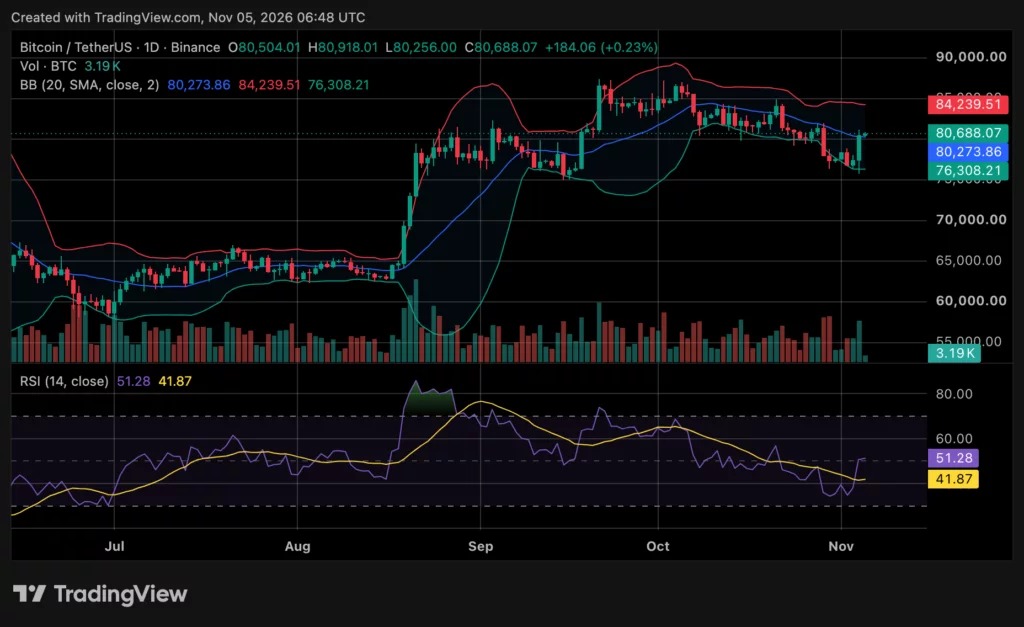
From the daily chart, Bitcoin shows signs of improving momentum after recent declines.
BTC reports around $80,688, above the midline of the Bollinger Bands at $80,273.86, once again standing above a short-term trend indicator that is often watched.
Relative Strength Index (RSI) RSI rebounded to 51.28, above its moving average of 41.87, indicating an improvement in buying momentum.
However, RSI is still near the middle of the range, which means there is still room for price fluctuations upwards or downwards.
The current resistance level for Bitcoin is around $81,300 to $82,000. If it can remain above this range, it might bring the upper band of the Bollinger Bands, which is near $84,240, into view.
On the downside, the midline around $80,274 provides initial support, followed by the lower line near $76,308.
Cryptography analyst Ted believes that Bitcoin's ability to absorb negative news indicates that "the bottom has already appeared."
However, he still estimates that the probability of Bitcoin reaching a new historical high in July 2027 is only 16%, and believes that a potential record high might appear later that year.
His predictions are merely opinions and are not supported by an independently established probability model.
CryptoQuant Warning: Bitcoin's pullback may continue
CryptoQuant Author CryptoZeno made a more cautious assessment. He believes that the market cycle of Bitcoin has not yet reached the conditions that are typically associated with confirming a bottom.
He stated that the 30-day moving average of Bitcoin Cycle Extremes Index has dropped to 15.8%.
This reading puts the market in what he calls the “Watch / Mild Pressure” range, which indicates that speculative activity has cooled down, but it is not yet possible to confirm the end of the pullback.
His Cycle Extreme Oscillator is still below the threshold of 1.0, whereas in previous cycles, more robust market activity was usually associated with this level.
CryptoZeno indicates that before a sustained rebound occurs, the market may still experience further consolidation or another decline.
He believes that only when both indicators continue to rise can it be considered necessary evidence of an improvement in the market environment.
Disclosure: This article does not constitute investment advice. The content and materials on this page are for educational purposes only.