On November 5th, the 9th China International Import Expo opened in Shanghai. Unlike previous editions of the expo where humanoid robots were displayed for performances such as dancing and boxing, this year, humanoid robots began to truly undertake some practical tasks: taking photos of visitors, delivering photographs, brewing kung fu tea, and even playing table tennis with humans on-site.
On November 4th, reporters from Yicai News visited the site of the China International Import Expo in advance and observed that the way humanoid robots were displayed was changing. They no longer just demonstrated their ability to walk, jump, and perform complex movements; instead, they began to try to understand human needs, operate real tools, and interact with their surrounding environment.
Silicon-based humanoid robots are beginning to serve carbon-based humans, and behind this is a technological breakthrough that has moved from the laboratory to the real physical world.
Humanoid robots have taken on delicate tasks
“Click!”
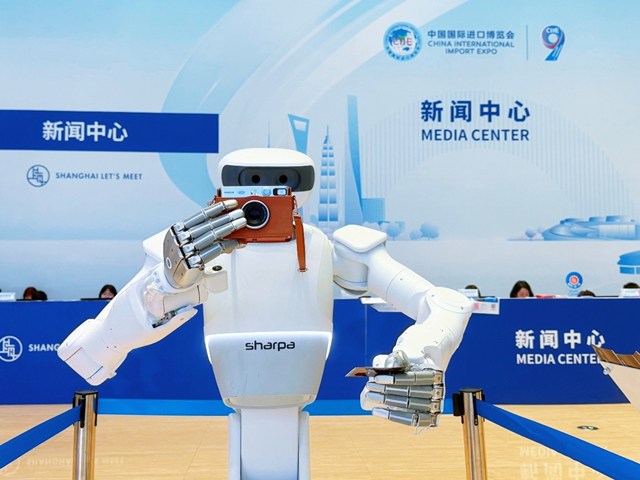
As soon as the reporter entered the press center of the 9th China International Import Expo, a special “photographer” raised a instant camera and gently pressed the shutter to take a commemorative photo of the reporter.
This "photographer" comes from Sharpa (the Great Rift Valley). At this year's CIIE, their task was to capture exclusive images of the event for media journalists from around the world.
On-site staff told reporters that completing a photography task is not as simple as just pressing the shutter button. The robot needs to perform a series of consecutive operations in sequence, including picking up the camera, adjusting the grip, aiming at the subject, and pressing the shutter. The operational error must be controlled within 2 millimeters, and at the same time, it is also necessary to dynamically adjust its movements according to the position of the camera and the state of force applied.
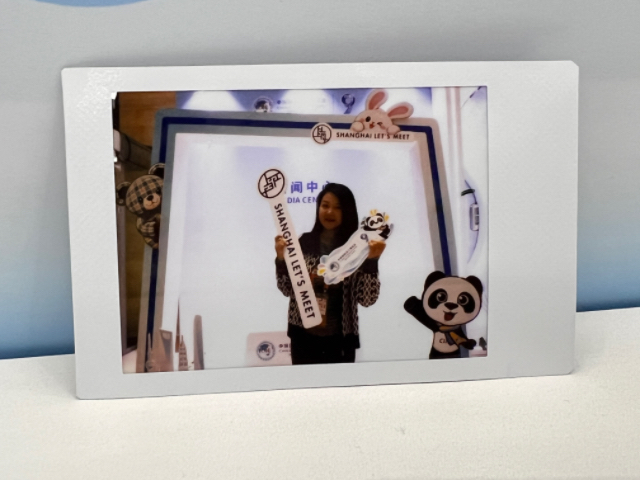
This places higher demands on the perception and operational capabilities of robots. They need to use visual recognition to identify the position of the camera and the object being photographed, to achieve hand-eye coordination, and then to adjust the gripping force and the range of motion according to the contact status during the operation.
What truly tests the dexterity is that after taking a photo, the robot also needs to hand the thin sheet of photographic paper to the reporter. Unlike grasping an object with a fixed size and regular shape, paper is light and easy to bend. Therefore, when grasping and delivering it, it is necessary to ensure stability without applying too much force. How to control the contact force between the fingers and the object, as well as how to maintain the object's posture during delivery, are both issues that a dexterous hand needs to solve.
In the rest area of the news center, another “tea artist” also caught the attention of the reporters. A humanoid robot from Zhiyuan prepared gongfu tea on the spot, providing tea to the visitors.
Making tea may seem simple, but it is actually a task that involves multiple steps of precise operation. From picking up the tea set and controlling the posture of the teapot, to tilting the spout and regulating the flow of water, and then pouring the tea into the cups, each step requires the robot to coordinate the movements of its arms, wrists, and fingers.
From taking photos to making tea, for embodied intelligence, this means that they are moving from relatively closed and standardized action demonstrations towards task scenarios that require continuous interaction with real objects.
Playing table tennis against humans tests robots' millisecond-level decision-making abilities.
At this year's CIIE Technology and Equipment Exhibition Area, the booth of the global physical intelligence open-source platform Hitch Open stood out prominently. Here, humanoid robots competed in table tennis with the staff.
Reporters also engaged in a match with humanoid robots on site. The robots were able to judge the direction of the balls coming from the reporters and swing their rackets in time, continuously exchanging more than 40 strokes back and forth.
At this year's CIIE, Hitch Open will make the global debut of an open-source platform designed for physical intelligence competitions such as robot table tennis, and will also showcase AI autonomous decision-making robot table tennis matches that require no remote control, no scripts, and no human intervention.
Compared to relatively controllable tasks such as taking photos or passing water, table tennis is a highly dynamic sport full of uncertainties. The speed, spin, and landing point of the ball in flight are constantly changing, and robots must complete visual perception, trajectory prediction, motion planning, and shot control in an extremely short amount of time.
Specifically, the robot first needs to capture the position and motion state of the table tennis ball through its visual system, determining its speed, direction, and possible landing point; subsequently, the system must predict the ball's trajectory, calculate the appropriate timing for hitting the ball and the angle of the racket face, and then convert these decisions into coordinated movements of the arms, torso, and even legs.
This not only tests the hand-eye coordination of robots but also their overall body movement control.
More importantly, these actions must be continuously adjusted in real-time feedback, rather than having a set of fixed actions predetermined in advance. Even a slight change in the ball's landing point requires the robot to re-evaluate and plan its next move.
Therefore, table tennis is also considered one of the more challenging comprehensive test scenarios in the field of embodied intelligence. In the past, artificial intelligence made breakthroughs in virtual environments with relatively clear rules such as board games, whereas physical activities like table tennis require AI to truly control the body and take action in constantly changing real-world environments.
Hitch Open Global Chairman Tang Minqin told Yicai News that the table tennis robot on display this time uses the Zhiyuan Expedition A3 humanoid robot body. The humanoid robot table tennis system HITTER, developed by the FHL Vive Virtual Reality Center at the University of California, Berkeley, has already achieved 106 consecutive strokes of play between the humanoid robot and a human opponent.
In addition to on-site interactions, this year's CIIE also showcased more application ideas for humanoid robots in production and daily life scenarios.
In the technical equipment exhibition area, Tesla showcased a new generation of humanoid robots. Through scenario models such as moving luggage, walking dogs, and factory sorting, the booth demonstrated the potential applications of these robots in future home and production environments.
According to Tesla employees, the company is building a "Humanoid Robot Academy" where robots' ability to complete practical tasks is gradually improved through human-operated data training, simulation environment practice, and real-world scenario exercises.
For humanoid robots to move from laboratories to factories and homes, one of the core challenges is how to enable them to truly learn human movements. Humans can master a skill through observation and imitation, but robots also need to convert visual information into executable actions and correct errors through continuous attempts. Human demonstration data, simulation training, and feedback in real environments are all important components of this learning process.
At the Lingang exhibition area, Zhiyuan ( AGIBOT ) further extended the application scenarios of humanoid robots to hotel services.
A full-size humanoid robot, A3 Ultra, serves as a "hotel butler," capable of greeting guests, engaging in conversations, delivering drinking water, and performing precise tasks such as data entry and handing out room cards. This is the world's first demonstration of a future hotel scenario on-site, where the robot will showcase its services including check-in assistance, wayfinding guidance, routine inspections, and product recommendations.
Compared to single-action demonstrations, hotel services place more comprehensive demands on robots. They not only need to understand the verbal instructions of guests but also must be able to recognize the surrounding environment and objects, determine what task should be performed next, and coordinate both hands and body to complete the operation.
This also means that whether humanoid robots can truly enter scenarios such as hotels, shopping malls, and factories in the future depends not only on their ability to perform a single action, but more so on their ability to stably complete a series of tasks in an open environment.
From instant photographers to table tennis trainers, from tea art masters to hotel butlers, the humanoid robot demonstrations at this year's China International Import Expo (CIIE) have shown a noteworthy change: robots are moving from demonstrating "moving like humans" to attempting to "work like humans."
Article Author
Post-00s hold a robot party, welcome to join! | Generation Z of Science and Innovation
Tech Weekly Report | iPhone Duo The profit margin for scalpers is shrinking; even celebrities are difficult to hold accountable AI "Face-stealing" for product promotion
Embodied Intelligence Financing Cools Down: Investors Are No Longer Enthusiastic.
Chinese robots, gathering the strength of the world
The evolution of humanoid robots requires close cooperation among companies from various countries to quickly address their shortcomings.
The number of users of our country's generative AI has exceeded 700 million, with over 70% of users asking AI to "answer questions".
Over the past year, generative AI has transitioned from "generating information and conducting conversations" to "delivering work results directly."
Humanoid Robot Industry: Mass Production Accelerates, but Commercialization Remains at a Crossroads
In 2026, although the humanoid robot industry has seen explosive growth in shipments, it is still deeply troubled by multiple structural contradictions, including the asynchronous development of hardware and intelligence, the misalignment of the value of humanoid forms between industrial and domestic scenarios, the uncertainty of the path for transitioning from training to inference paradigms in physical AI, and the shift of the value chain towards intelligent cores.