

The mid-term elections in the United States not only changed the power dynamics in Washington but also had an impact on the business empire of Elon Musk, the world's richest man. After the Democratic Party gained control of both houses of Congress and won key elections in Texas, the stock prices of Tesla and SpaceX under Musk came under pressure, resulting in a reduction of his personal wealth by over $60 billion.
Tesla and SpaceX both fell by approximately 5.7% and 7.6% respectively during pre-market trading on Wednesday. Based on the equity held by Elon Musk in related companies, this round of market fluctuations resulted in a reduction of his wealth by over $60 billion. As stock prices continue to fluctuate, related valuations may change further.
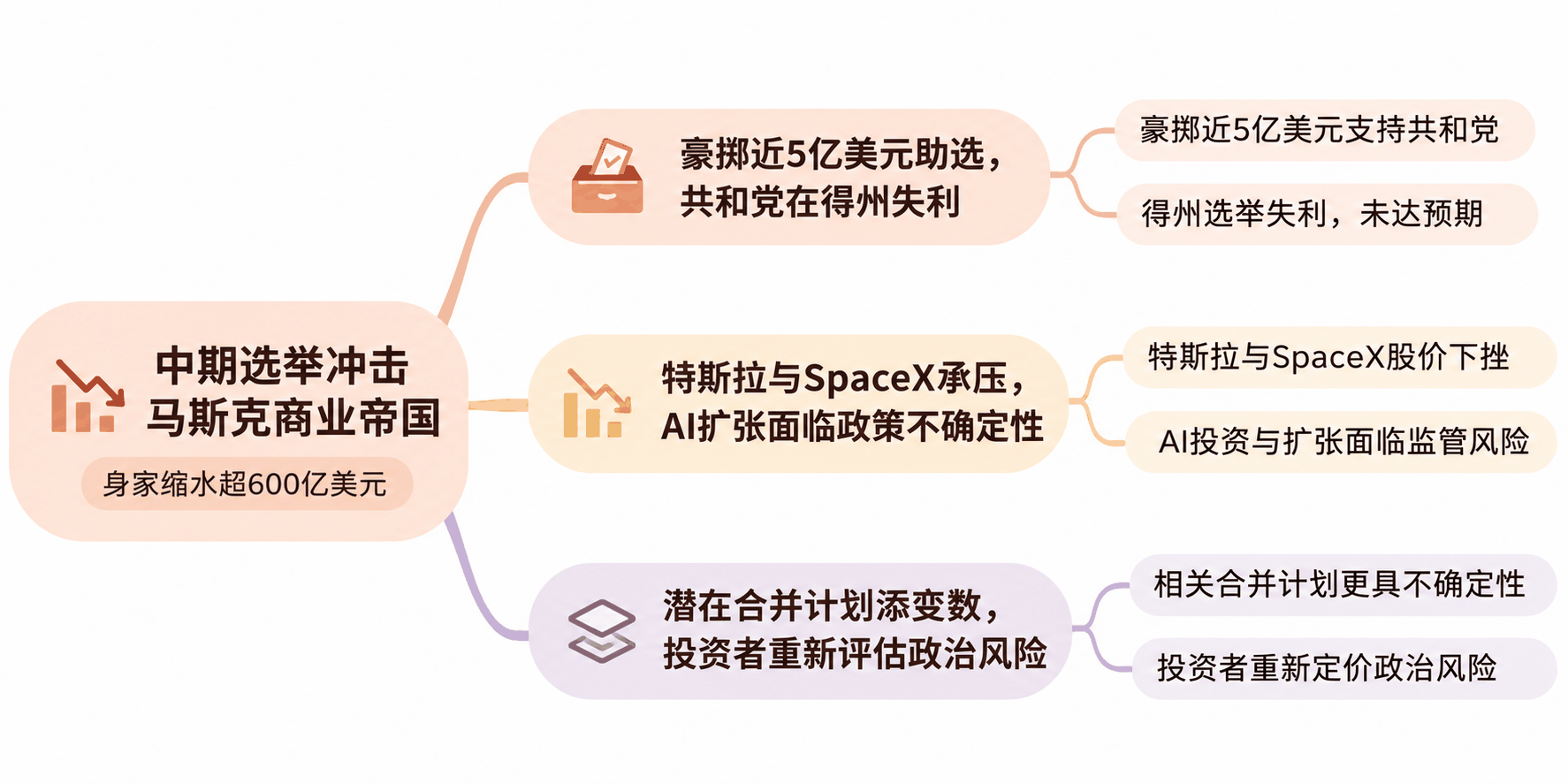
Spending nearly $500 million on campaigning, the Republican Party suffered a defeat in Texas
In these mid-term elections, Musk was one of the most important individual political donors to the Republican Party.
According to statistics conducted by CNBC based on data reported by the United States Federal Election Commission, Musk invested at least $474 million during the 2026 electoral cycle, of which approximately $224 million went towards related campaign activities in Texas, accounting for nearly half of the total amount.
Elon Musk strongly supported the Republican Senate candidate Ken Paxton ( Ken Paxton ), and hoped that the Republicans would continue to control Congress and the government of Texas. However, the final outcome did not meet his expectations.
Democratic candidate James Talarico ( James Talar token issuance ) won the federal senatorial election in Texas, while Gina Inohosa ( Gina Hinojosa ) defeated the incumbent Republican governor, Greg Abbott ( Greg Abbott ).
Texas has long been dominated by the Republican Party and is also a key business base that Elon Musk has focused on in recent years. Both Tesla and SpaceX have established their headquarters in this state and have made large-scale investments in manufacturing and infrastructure there.
Previously, Musk moved from California to Texas, partly due to the state's relatively lenient business regulatory environment.
Therefore, this election not only failed to achieve the desired results for its political investment but may also change the future business environment for these two core companies.
Tesla and SpaceX under pressure, AI expansion faces policy uncertainty
The market's concerns regarding the election results mainly focus on three aspects: artificial intelligence investment, government contracts, and corporate regulation.
Firstly, Greg Abbott, the newly elected governor of Texas, takes a more cautious approach to large-scale data center projects. She advocates for suspending the approval of new data center construction projects until local governments improve regulatory rules regarding power consumption, water resource usage, and the protection of community interests. At the same time, she opposes granting excessive tax incentives to large technology companies.
This may affect the expansion plans of Musk's companies in Texas. Tesla is advancing its artificial intelligence computing, robotics, and autonomous driving businesses in the region, and SpaceX also plans to increase investment in semiconductors and AI infrastructure.
According to Reuters, SpaceX is seeking to accelerate the expansion of the computing power of AI, and its related business has become an important source of revenue growth. If the approval process for data center construction becomes stricter, some projects may face delays, increased costs, and postponed realization of expected revenues.
Secondly, after the Democrats take control of Congress, the relationship between Musk and his companies and the U.S. government may face stricter scrutiny.
Some Democratic members have previously called for an investigation into the government contracts obtained by SpaceX, the layoffs of federal employees during Musk's tenure leading the government efficiency department, and the national security controversies involving satellite communication services.
However, the enhanced scrutiny by Congress does not mean that the relevant contracts will automatically terminate. Trump still controls the executive branch and retains the presidential veto power, and the important position of SpaceX in the field of American space launches may also limit the extent of policy adjustments.
Potential merger plans add variables; investors reassess political risks
The election results may also affect the merger plan between Tesla and SpaceX that Musk previously discussed. According to Bloomberg, the two companies have explored potential merger arrangements, but the transaction is still in its preliminary stages.
This plan may combine Tesla's autonomous driving and robotics technologies with SpaceX's satellite communication and AI's computing services to form a larger technology enterprise.
However, as the Democratic Party assumes control of both chambers of Congress, major transactions involving giant tech companies may face more political scrutiny. Market observers point out that Congress may not be able to directly prevent corporate mergers, but it can increase the uncertainty of these transactions through hearings, investigations, and policy oversight.
At the same time, investors have also begun to re-evaluate Musk's massive capital investment in the AI business, as well as whether these projects will be able to achieve the expected returns in the future.
After the election, Musk responded in a joking manner on social media, saying that space data centers now seem more attractive, alluding to the concept of orbital computing facilities proposed by SpaceX against the backdrop of stricter regulation for ground data centers.
However, space data centers still face technical and commercial challenges such as heat dissipation, maintenance, and construction costs, making it difficult to directly replace ground-based facilities in the short term.
Overall, the impact Musk is facing this time has a dual nature.
On one hand, hundreds of millions of dollars in political investment failed to achieve the goal of maintaining Republican control; on the other hand, the stock prices of two key publicly traded companies fell, further magnifying the fluctuations in their personal wealth on paper.
For investors, what is more noteworthy is not the scale of daily wealth shrinkage, but rather changes in Texas regulatory policies, the supervision efforts of the U.S. Congress, and the prospects for AI capital expenditures.
These factors will determine whether the impact of the mid-term elections will remain limited to short-term market fluctuations, or whether it will further affect the long-term valuation of Musk's business empire.