The mobile phone business of Qualcomm, a major American chip giant, still faces pressure.
On November 4th local time, Qualcomm announced its financial results for the fourth quarter and the full year of fiscal year 2026. In the fourth fiscal quarter, the company achieved revenue of $10.322 billion, a year-on-year decrease of 8%; based on non-U.S. Generally Accepted Accounting Principles (GAAP), revenue was $10.442 billion, a year-on-year decrease of 7%; adjusted earnings per share were $2.17, a year-on-year decrease of 28%, which was slightly higher than market expectations.
Although the overall revenue and adjusted earnings per share exceeded analysts' expectations, the revenue from mobile chips, which is a core business for Qualcomm, saw a significant decline. In the fourth fiscal quarter, Qualcomm's mobile chip business revenue was $5.137 billion, a year-on-year decrease of 26%, lower than the analysts' forecast of $5.25 billion.
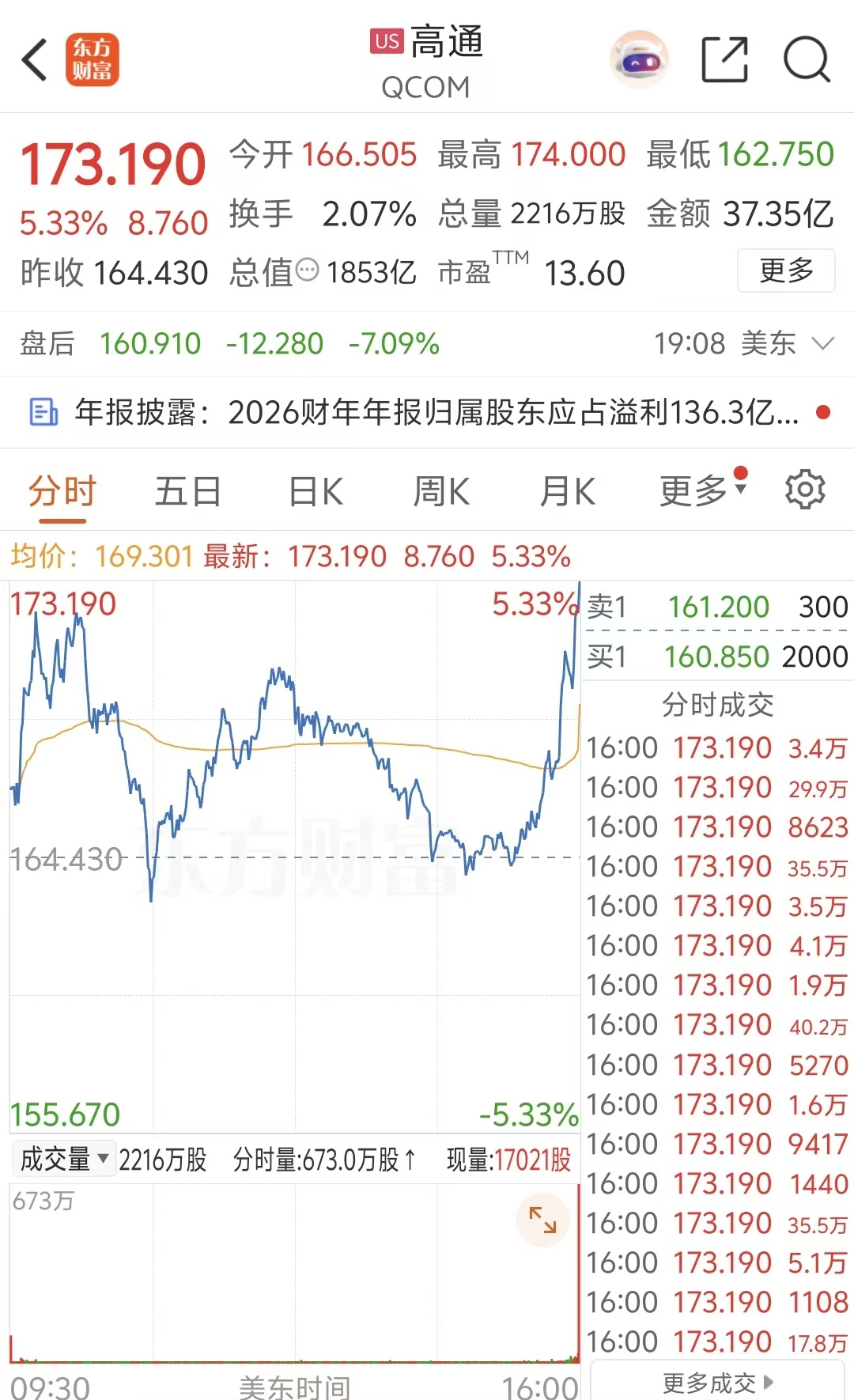
After the financial report was released, Qualcomm's stock price fell by more than 7% during after-hours trading. Concerns about the prospects of its mobile phone business, as well as the pressure from rising costs in the semiconductor industry chain, became important factors affecting investor sentiment.
Mobile chip revenue declines by 26%, rising storage prices exacerbate industry pressure
From a business structure perspective, the weakness in the mobile phone market is directly affecting Qualcomm's chip business.
Qualcomm primarily generates revenue through its chip business ( QCT ) and technology licensing business ( QTL ). In the fourth fiscal quarter, QCT business revenue was $9.015 billion, a year-on-year decrease of 8%; QTL business revenue was $1.304 billion, a year-on-year decrease of 7%.
In the fourth quarter, mobile chip business revenue dropped to $5.137 billion, compared to $6.961 billion in the same period of the previous year, a decrease of 26%. In contrast, automotive chip business revenue reached $1.990 billion, a year-on-year increase of 89%; IoT business revenue was $1.888 billion, a year-on-year increase of 4%.
Currently, the mobile phone business remains the largest source of revenue for Qualcomm's chips, and the growth of its automotive business is not yet sufficient to offset the decline in the mobile phone business. In addition, the rising prices of memory chips have also brought new pressures to the mobile phone industry chain.
As the demand for high-bandwidth storage chips in artificial intelligence data centers continues to grow, the prices of memory chips have risen, further driving up the costs of consumer electronics products. Counterpoint Research data shows that in the third quarter of 2026, global smartphone shipments decreased by 20% year-on-year, reaching the lowest level for the same period since 2012.
Apple's self-developed baseband chips are also affecting Qualcomm's mobile phone business. As Apple gradually shifts to its own solutions, Qualcomm's revenue from Apple is declining. Cristiano Amon (Cristiano Amon) of Qualcomm stated that in the company's performance guidance for the first quarter of fiscal year 2027, potential sales revenue from Apple is no longer included.
However, regarding the industry prospects, Ammon stated that the sales volume of Android phones has hit rock bottom and is beginning to recover gradually. He also mentioned that Qualcomm has already prepared in advance for the increase in storage chip prices, and currently, the Android phone business is starting to show month-on-month growth.
Reduce dependence on mobile phone chip business
While facing pressure in the mobile phone business, Qualcomm is accelerating its expansion into non-mobile markets such as automotive, the Internet of Things, and data centers in order to reduce its dependence on the smartphone business.
The automotive business was the most prominent growth segment this quarter. In the fourth fiscal quarter, Qualcomm's automotive business revenue reached $1.99 billion, a year-on-year increase of 89%, and for the first time it came close to $2 billion in a single quarter. For the entire fiscal year 2026, automotive business revenue amounted to $6.004 billion, a year-on-year increase of 52%.
Data centers are the key markets that Qualcomm will focus on in the next phase of its development strategy.
Qualcomm previously announced a multi-generation product collaboration with Amazon to expand its artificial intelligence data center chip business. The company stated that the fiscal year 2027 will be an important phase for growth in its non-smartphone business, with non-smartphone business revenue expected to increase by more than 60% year-over-year, and reiterated its goal of achieving $5 billion in data center business revenue for the fiscal year 2027.
According to Qualcomm's earnings guidance for the first quarter of fiscal year 2027, the company expects revenue to range from $10.4 billion to $11.2 billion, and non-GAAP earnings per share to range from $2.15 to $2.35. Among these, the median revenue guidance is higher than market expectations, but the median adjusted earnings per share guidance is slightly lower than what analysts anticipated.
However, rising costs will become the biggest challenge Qualcomm will have to face next.
Qualcomm stated in its financial report that the semiconductor industry is facing generally rising costs across multiple segments, including wafer manufacturing, assembly, testing, advanced packaging, memory chips, and other materials. The company has already taken measures to adjust product prices, and it is expected that the benefits of these measures will be fully reflected in the gross margin of its QCT business in the second half of the 2027 fiscal year.