

Micron (NASDAQ : MU), Sandisk (NASDAQ : SNDK), and SK Hynix (NASDAQ : SKHY) continued to rise after the close on Tuesday, following increases of 2.6%, 4.8%, and 2.1% respectively during regular trading hours. With AMD and ultra-small computers releasing encouraging earnings after the close, investors have yet another reason to believe that AI infrastructure spending remains strong.
AMD announced a 97% year-on-year increase in data center revenue, reaching $8.5 billion; the quarterly sales of supermini computers nearly quadrupled to $19.95 billion. The server manufacturer also raised its full-year revenue forecast to a high of $82 billion, indicating that customers have not slowed down their purchases of computing devices. These developments are encouraging for storage chip manufacturers, which provide key components for these systems.
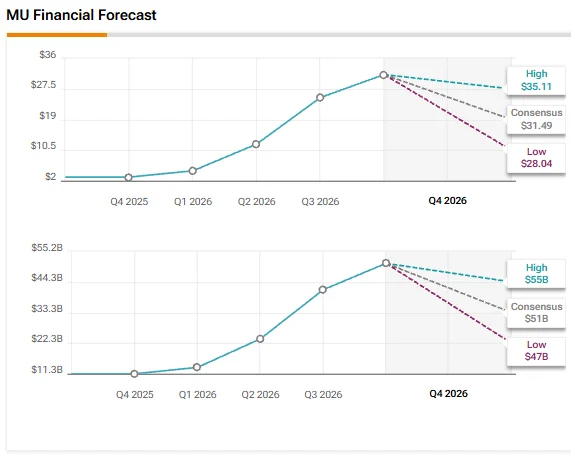
Micron's storage boom has impressed Wall Street even more.
Micron is working hard to protect itself from the unpredictable price cycles that have plagued storage chip manufacturers throughout history. The company has increased the number of long-term customer agreements from 16 three months ago to 26, and these contracts currently cover more than 35% of its expected revenue through 2030. Many of the contracts include minimum pricing commitments, and the updated agreements reflect higher market prices, which may help Micron maintain stronger profit margins even as the industry eventually cools down.
Meanwhile, Micron's production of its next-generation HBM4 continues to expand. The manufacturer has already signed agreements for most of the high-bandwidth memory it plans to supply in 2027, at significantly higher prices. The company is also collaborating with NVIDIA to customize HBM4E technology for future AI processors, which could further solidify its position in the market where customers are competing for limited production capacity.
In addition, the shortage may persist longer than investors had previously anticipated. Micron expects that the supply situation of DRAM and NAND to become more strained in 2027 and 2028. More than 75% of next year's production has already been reserved, and customers are even discussing purchases that extend into 2031. This gives the company greater visibility into future sales, but expanding production will require significant investment.
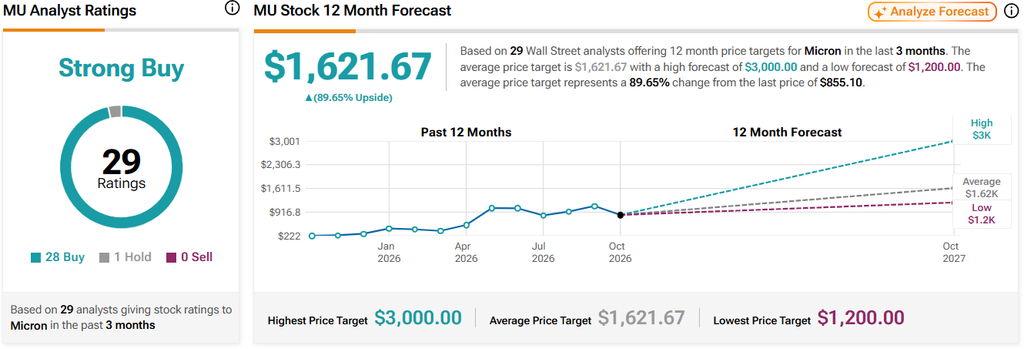
Wall Street seems to believe that there is still more room for Micron's stock price to rise, and analyst data also shows strong confidence. Among the 29 analysts covering the stock, 28 recommend buying, with only 1 holding a wait-and-see attitude, thus forming a "strong buy" consensus rating. The average target price is $1,621.67, which represents a potential increase of about 90% from Tuesday's closing price. (See MU Stock Forecast)
Sandisk's explosive growth comes with a warning
Data center customers have made a significant contribution to performance, with revenue in this business segment growing by 61% month-on-month to reach $4.8 billion. Subsequently, the company expects sales in the second fiscal quarter to be between $12.2 billion and $12.6 billion, and has announced a 1-for-8 stock split to be conducted later this month.
However, strong financial performance has not dispelled investors' concerns about whether the soaring price of NAND can be sustained. Disappointing guidance from Japan's competitor Kioxia has exacerbated these concerns, and despite Sandisk's positive prospects, it still triggered selling earlier this week.
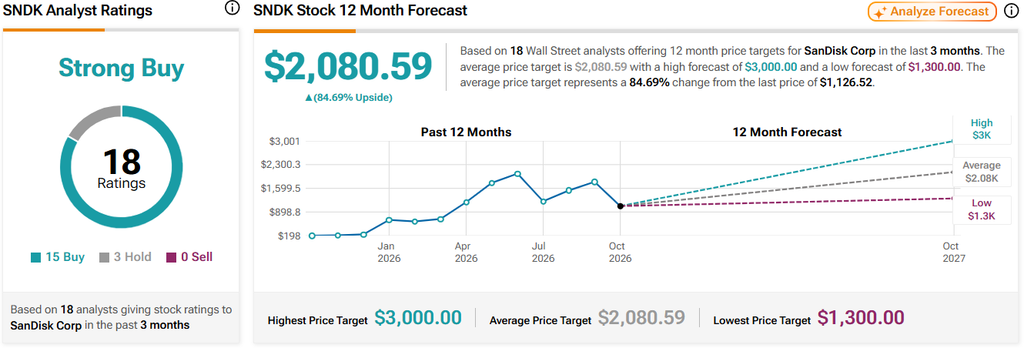
However, Wall Street still believes that there is significant room for further increase. With 15 buy ratings and 3 hold ratings, SanDisk has received a consensus rating of "strong buy." The average analyst target price is $2080.59, which indicates there is about an 85% potential for increase from Tuesday's closing price. (See SNDK stock forecast)
SK Hynix expects storage shortages to continue for many years
SK Hynix recently announced record revenue of 104.62 trillion Korean won in the third quarter, with operating profits reaching 83.33 trillion Korean won. The strong demand for advanced storage used in the AI system supported these achievements and also reinforced expectations for continued growth in the industry.
More importantly, this South Korean manufacturer expects the supply shortage to continue until 2030, which means that customers may face limited supplies in the coming years. Long-term agreements have already covered more than half of their planned production capacity for 2027 and 2028, providing visibility for future sales.
Meanwhile, SK Hynix continues to increase the production of HBM4, and it is expected that this updated technology will exceed HBM3E in terms of shipments and revenue in the fourth quarter. This transition should enhance its position among suppliers to developers of advanced processors and high-performance computing systems.
Disclaimer and Disclosure Report Issues