After the initial instability in the crypto market following the results of the U.S. mid-term elections, the price of Bitcoin has recovered to the $78,000 mark, having previously fallen to a seven-week low near $75,600.
After briefly falling to $75,600 during the U.S. mid-term election results, the price of Bitcoin has once again risen above $78,000.
The Democratic Party has won control of both houses of Congress, raising questions among outsiders about U.S. President Donald Trump's agenda on cryptocurrency legislation.
Ali Martinez indicates that $75,875 in short-term holdings could represent a support level for Bitcoin.
US spot Bitcoin ETF recorded a net outflow of $115.6 million on November 3, bringing the cumulative withdrawal over three trading days to over $1.15 billion.
Analysts are watching to see if Bitcoin can maintain its rebound and regain the resistance level near $79,500.
According to crypto.news market data, BTC rebounded to around $78,300 on November 4th, gaining nearly 1% after wiping out previous losses. This rebound occurred following a period of intense volatility, during which Bitcoin briefly fell below $76,000 before buying interest returned.
As the Democratic Party takes control of both houses of Congress, Trump will face a divided government for the remaining two years of his term.
Despite Bitcoin rebounding from its intraday lows, this cryptocurrency remains below the resistance level of $79,500 that traders have been closely monitoring recently.
After the uncertainty of the U.S. mid-term elections subsided, Bitcoin rebounded.
When the election results showed that the Democratic Party had won a majority of seats in both the House of Representatives and the Senate, Bitcoin initially came under pressure.
After failing to hold above the support level of $77,000, this cryptocurrency fell to $75,600, hitting its lowest level since September 17th.
Similar selling pressure was also observed in U.S. stock index futures, with the Nasdaq 100 index futures falling as investors assessed the election results. In the initial market reactions, U.S. Treasury yields and the dollar weakened.
Democratic control of Congress could make it more difficult to advance some of Trump's cryptocurrency agenda, including legislation aimed at establishing clearer rules for the digital asset market.
The election results mean that the Republican Party has failed to gain a majority in Congress, but Trump still retains the power to veto bills passed by Congress.
Despite an initial decline, Bitcoin quickly rebounded above $77,000, and then surpassed $78,000, with financial markets gradually stabilizing as well.
The continuation of the rebound on Wednesday pushed prices to around $78,300, however BTC is still below the recent trading range of nearly $80,000.
Cryptography analyst Micha ël van de Poppe describes this rebound as a possible 'sell expectations, buy facts' reaction after the election.
He wrote, "I am extremely bullish on the current #Bitcoin."
van, de, and Poppe believe that the recent decline may have formed a local bottom. If Bitcoin creates a lower low after rebounding on Wednesday, they expect it to rise further.
Bitcoin analysts point out that $75,875 may represent a potential support level.
Cryptography analyst Ali Martinez considers the price achieved by short-term holders to be an important level after Bitcoin's recent decline.
Martinez pointed out that Bitcoin has fallen to $76,195, approaching the price at which short-term holders would realize a profit of $75,875.
This indicator represents the average purchase cost of Bitcoin held by investors who bought it recently.
In March 2023, Bitcoin hit a bottom at $19,979, with a corresponding realized price of $19,794.
A similar trend occurred in June 2023, when Bitcoin fell to $25,130 but was traded at $25,600.
The analyst also cited another example from May 2024, when BTC fell to $58,325, while the realized price was $58,570.
Based on these comparisons, Martinez indicates: "The bottom of Bitcoin has been reached. It's time to continue moving upwards."
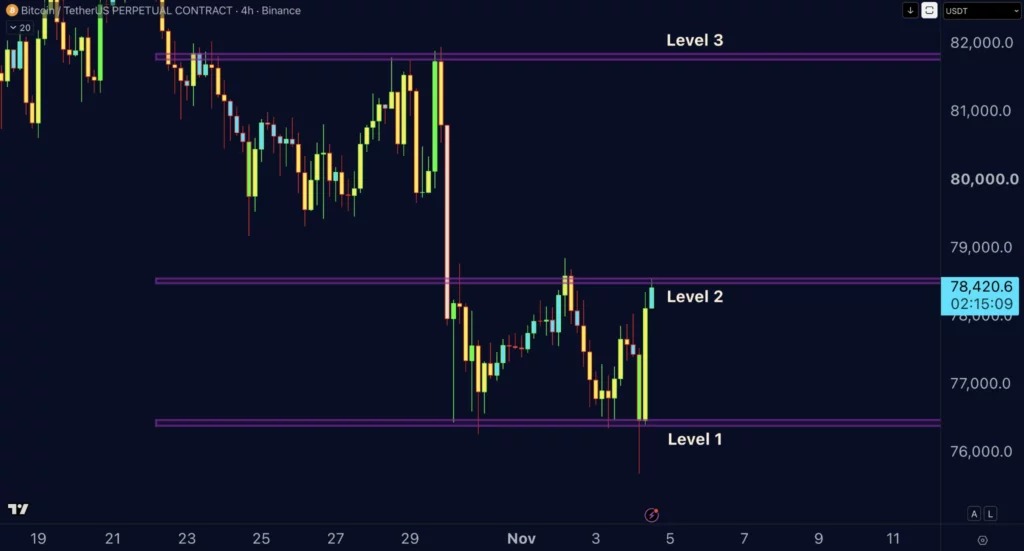
In addition, analyst Doctor Profit stated that after the Binance hack caused market turmoil, Bitcoin is testing what he refers to as the “Level 2” resistance zone, around $78,400.
He believes that if Bitcoin manages to close above this level on a daily chart, it will more strongly demonstrate that buyers have regained control of the situation.
Bitcoin ETF Capital Outflow
As reported by crypto.news earlier today, these funds lost a total of approximately 115.6 million US dollars on November 3, experiencing capital outflows for the third consecutive trading day.
Fidelity's FBTC and Bitwise recorded small net inflows, but their buying momentum was not sufficient to offset the withdrawals from other products.
Although the overall figure is still a net outflow, the data on November 3rd is significantly lower than that of the previous two trading days.
The previous sell-off occurred on October 30th, after the outflow of funds from ETF. At that time, investors withdrew the largest amount of funds in a single day since June.
After the $630 million hacker attack on Binance disrupted cryptocurrency trading, Bitcoin rebounded to around $78,000 on November 2.
Market analysts regard $79,500 as the next significant resistance level, followed by the psychological barrier of $80,000. Meanwhile, the range between $75,600 and $76,000 remains the recent support area formed during the selling pressure on Wednesday.
Disclosure: This article does not constitute investment advice. The content and materials on this page are for educational purposes only.