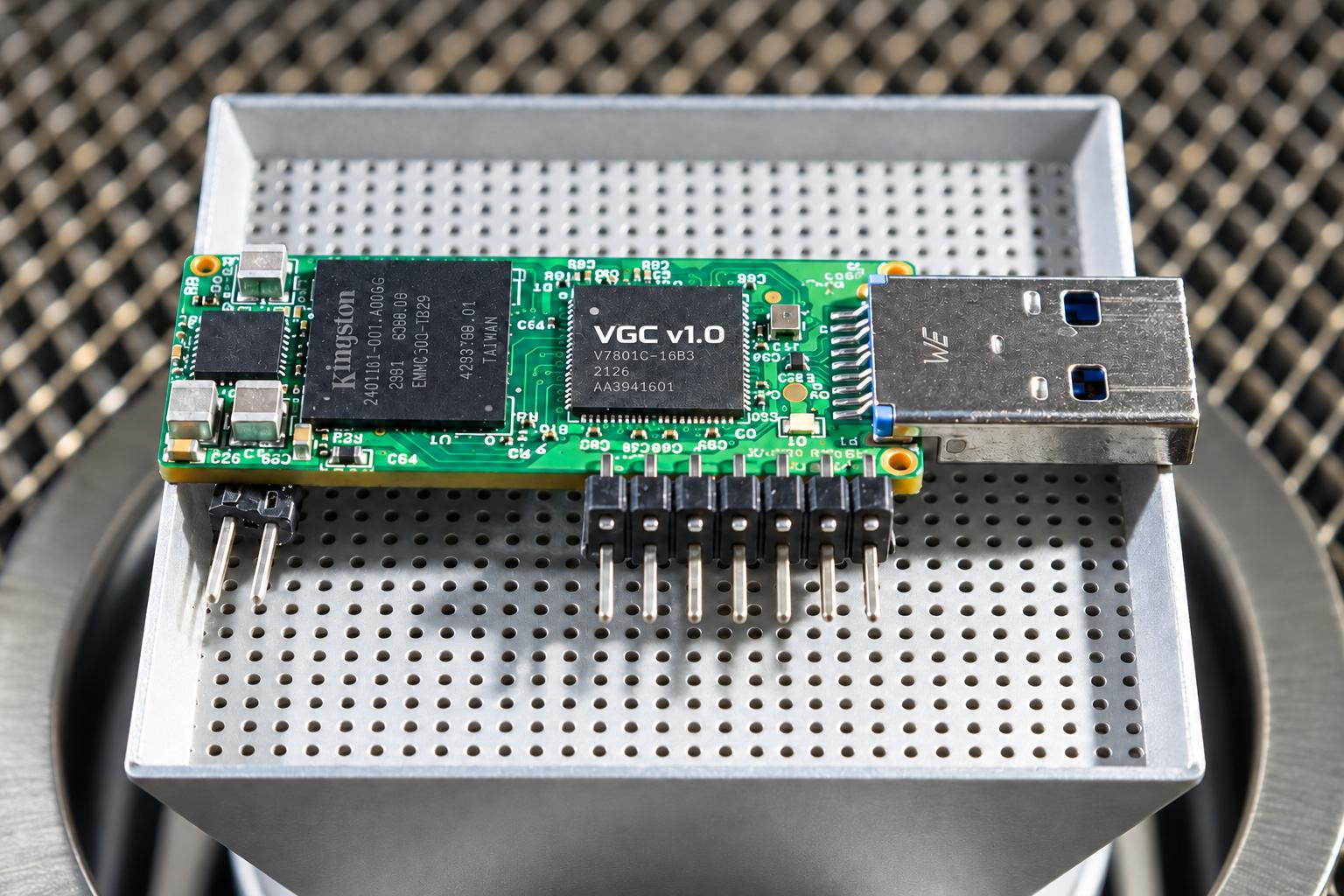
Hanoi, Vietnam, November 3rd / PRNewswire / -- The Vietnamese Government Cryptography Committee and the Vietnamese Military-Industrial Telecommunications Group ( Viettel Group ) have released VGC v1.0, which is a security chip that directly integrates locally developed cryptographic algorithms into silicon wafers. At the same time, they have also launched the country's first independently designed security semiconductor platform.
The project aims to address concerns regarding data exposure that may arise from reliance on imported chips. The Vietnamese Government Cryptography Committee and the Vietnam Military-Industrial Telecommunications Group stated that by directly embedding cryptographic functions into hardware, Vietnam hopes to strengthen control over the technical design and verification processes used to protect sensitive information.
VGC v1.0 is manufactured using a 28-nanometer CMOS process, containing 300 million transistors, with a package size of 10×10 millimeters. In performance tests, its encryption and decryption speeds are approximately 15 times faster than those of software solutions performing the same tasks. The first batch of products has passed technical testing and obtained socio-economic application certification in the first quarter of 2026. To prevent information leakage and reverse engineering, technical protection measures were also taken before the chips were manufactured.
The M2 department of the Government Cryptography Committee is responsible for establishing security requirements, developing cryptographic algorithms, and defining evaluation standards, while the Viettel Sem token issuance nductor Center are in charge of chip design and implementation. This underlying platform is based on an open-source RISC-V instruction set architecture, which facilitates Vietnamese engineers to modify processor designs and allows for the reuse of existing verification processes across future generations of chips.
VGC and v1.0 have been deployed first in secure USB drives for party and government agencies as well as national defense organizations. The planned applications also include support for Vietnam's national digital signature authentication system, which currently has over 2 million digital certificates in circulation. Other potential uses include the protection of financial data, networked cameras and sensors, as well as critical infrastructure systems such as power, water supply, oil and gas, and telecommunications. Products used to protect state secrets will need to undergo further testing and certification according to applicable standards.
Vice General Tao Desheng, Chairman and CEO of Vietnam Military Industry and Telecommunications Group, stated: "Researching, designing, and developing secure semiconductor chips is a formidable challenge that requires years of accumulated expertise, technical capabilities, and high-quality talent. However, we believe that starting late does not mean we have to rely on others. As long as our strategy is sound, resources are focused, and there is continuous investment, we can steadily narrow the gap and move towards mastering technologies that are strategically important for our country."
At the press conference, the Vietnamese Government Cryptography Committee signed an agreement with the Vietnam Military-Industrial Telecommunications Group, covering mass production plans, multi-core security chips, professional talent training, and testing on real devices. Viettel is also building a semiconductor manufacturing factory in Le Thanh as part of its broader efforts to develop local capabilities in chip design, manufacturing, and packaging.
In addition to the first chip, this project also lays the foundation for future generations of security hardware, supporting Vietnam's long-term reduction of technological dependence and strengthening control over key digital technologies.