

Blockchain investigator ZachXBT claims that an unidentified entity within the European Union may have lost over $106 million from accounts on multiple cryptocurrency exchanges on Sunday.
ZachXBT reported on Monday that the funds suspected to have been stolen were first withdrawn using USDC and USDT, and then transferred through various cryptocurrencies and blockchains.
This suspected attacker exchanged USDC for Ethereum (ETH), utilizing instant exchange services that included WellWallet and Kyrrex, and then converted the funds into Monero (XMR) through the exchange service Wagyu.
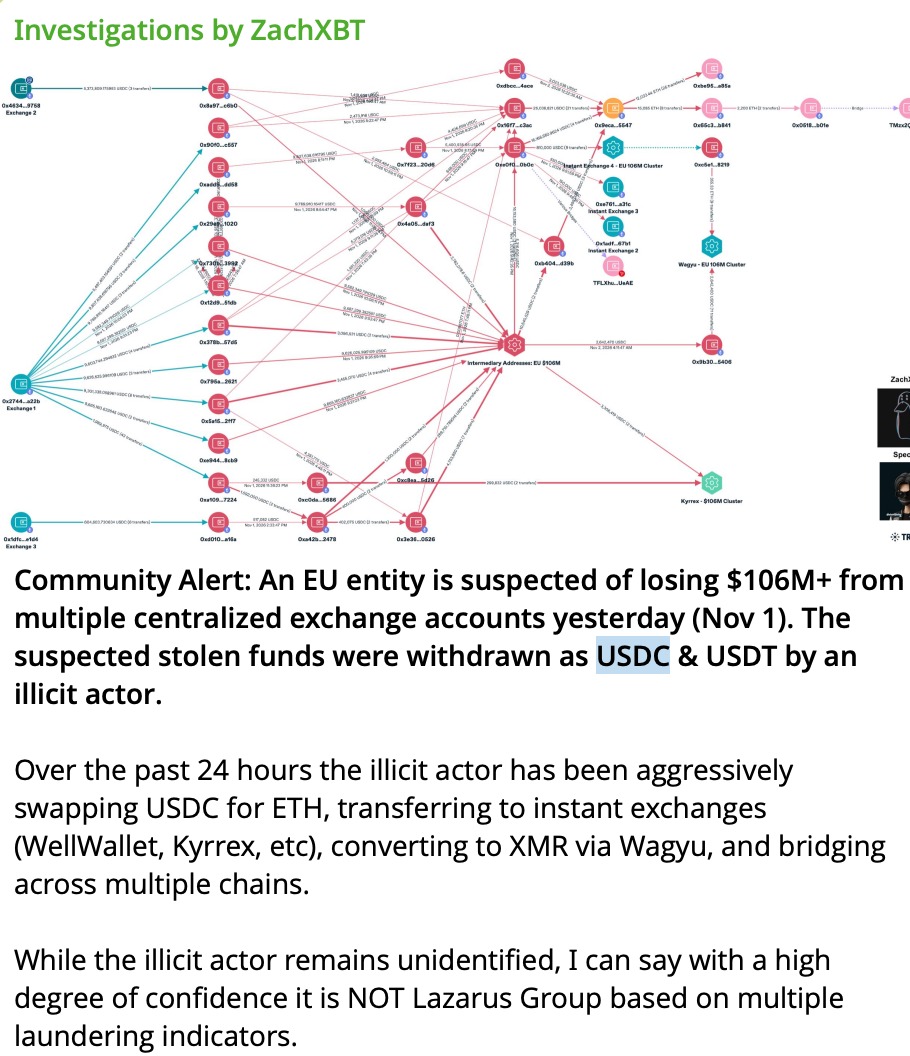
ZachXBT indicates that although the flow of funds suggests a low likelihood of association with North Korea's Lazarus Group, the identity of this suspected attacker remains undetermined. The affected entities and the exchanges involved have not yet been publicly disclosed.
ZachXBT identified 11 wallet addresses related to these funds.
This alleged theft incident occurred on October 29, following a $6.3 billion hacker attack on Binance. The Federal Bureau of Investigation (FBI) has attributed the incident to North Korean hackers known as “TraderTraitor”, which is associated with Lazarus. This attack is considered the largest cryptocurrency theft case on record.
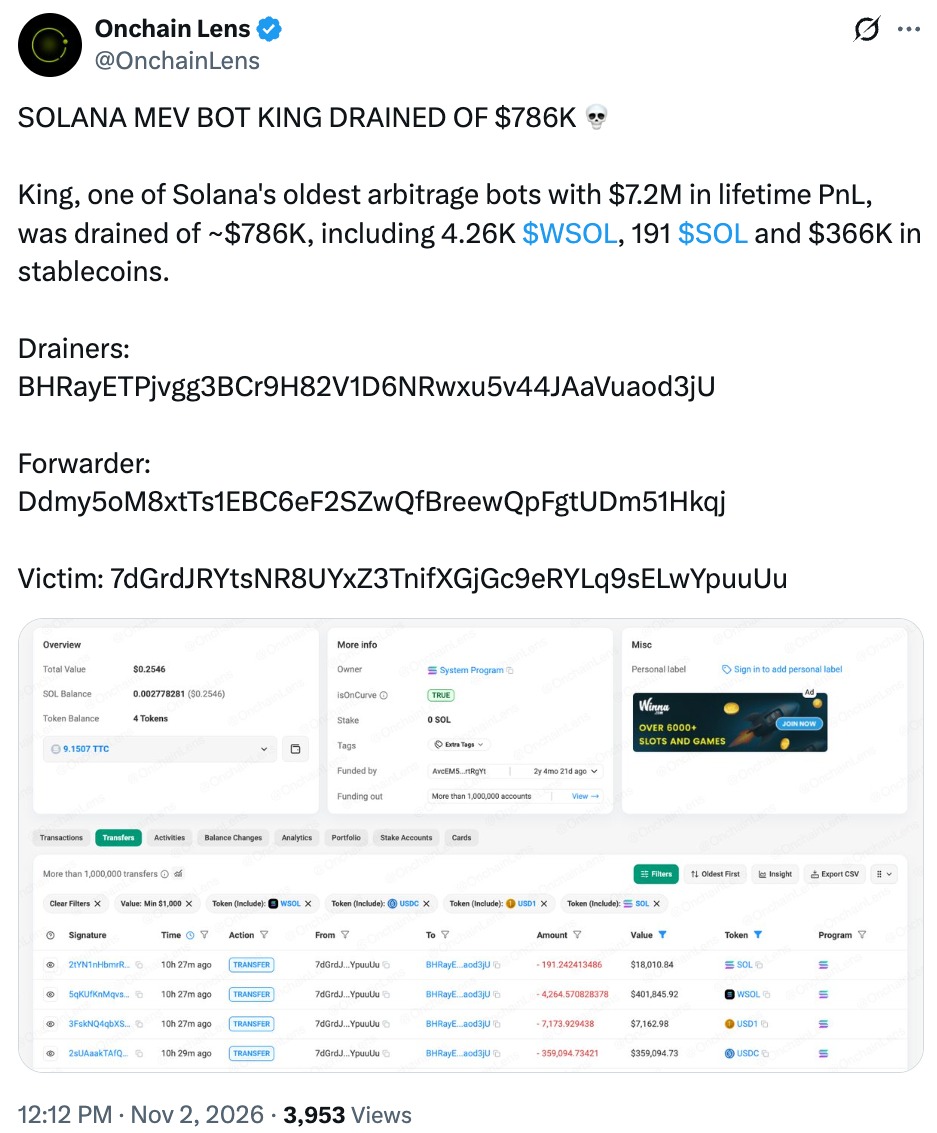
Wallets associated with the Solana arbitrage bot may suffer losses of up to $786,000.
According to the pseudonymous online monitoring account Onchain Lens, a wallet associated with the automated trading bot King on Solana may have lost approximately $786,000 on Monday.
King is an arbitrage bot, which is a type of software that automatically buys cryptocurrencies in one market and sells them in another to profit from the price difference. Onchain Lens tells Cointelegraph that these funds passed through multiple Solana wallets before being transferred to Ethereum via a service used for cross-chain asset transfers, Mayan. This account indicates that such rapid transfers suggest an attempt to conceal the source of the funds, and there may be a possibility of wallet intrusion.
The operator of King has not yet confirmed whether an intrusion has occurred.
"Our report is based on abnormal capital flows, rapid transfers, and subsequent cross-chain fund movements. We believe this indicates that someone is attempting to conceal the origin of the funds," Onchain Lens told Cointelegraph. "This pattern strongly suggests that there may be a wallet intrusion."
Magazine: Binance Hackers raced against time to transfer billions of dollars before their funds were frozen