Welcome back to TechCrunch Mobility. This is your window to understand the future of transportation and the role that AI plays in it today. If you want to receive this content directly in your email, you can register for free – just click on TechCrunch Mobility.
I once joked here, as well as on the podcasts Equity and Autonocast, that the autonomous driving industry is very similar to 2016 in many aspects, at least judging by the popularity of this field at that time.
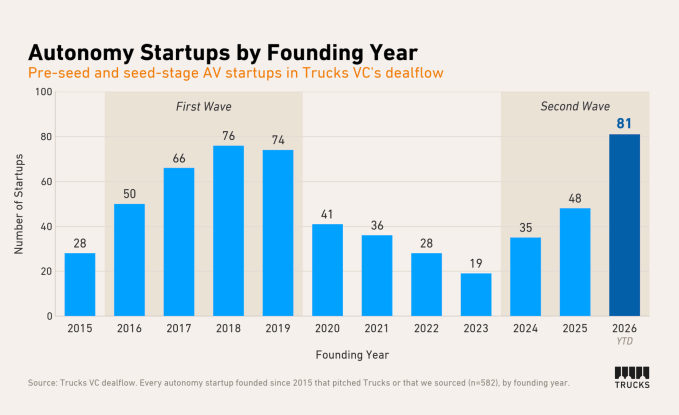
But a recent conversation I had with Trucks VC and my partner Puneeth Meruva made me rethink this comparison. There are signs that the hype in 2026 could even be higher – at least based on certain indicators – surpassing that of the hot trading years in 2016 and 2017.
Focusing on early-stage investments, Trucks VC has so far this year reached out to 81 new autonomous driving startups – two-thirds more than last year, a number that surpasses that of the boom period ten years ago. In a new blog post, the venture capital firm stated that we are in the midst of a second wave, and even a larger one, of autonomous driving, with technological breakthroughs being the driving force behind it. That's right, I'm talking about AI.
Meruva told me: "For a long time, autonomous driving companies have been striving to move from what is known as AV 1.0 to AV 2.0, which is a kind of end-to-end architecture for autonomous driving. I believe that today's base models provide a technical architecture that makes these end-to-end systems possible."
These basic models are particularly adept at generalization across different environments and scenarios, which could make autonomous driving systems cheaper and faster to deploy. With the emergence of powerful open-source models such as NVIDIA's Alpamayo and Qwen's general vision-language-action models, it has become easier for startups to get off the ground.
The barrier to entering this field is lower than ever before. Meruva says that Trucks often sees startups complete their deployments within a few months without raising more than 1 million dollars. (Although Meruva is reluctant to name them, the institution has indeed invested in some of these companies.)
Among these 81 startups that submitted proposals to Trucks VC, I initially assumed that most of them would apply autonomous driving technology to the fields of construction, warehousing, agriculture, and mining. Indeed, those areas are indeed included. However, to my surprise, an increasing number of companies are focusing on pure robot taxi services, and many of them position themselves as direct competitors to Waymo.
This might sound crazy, even a bit like "galactic fantasy," but Meruva believes that there is still room for small players to survive.
He said, "In this world, smaller and more specialized autonomous driving companies can compete. Perhaps they don't compete with Waymo on a global scale, but they may compete in specific regions or for certain types of routes."
Meruva also does not believe that this pace will slow down. He expects that more autonomous driving startups will submit proposals to the institution next year.
Trade!

Massachusetts-based manufacturing accelerator Re : Build raised $2.1 billion to "expand the capacity to manufacture high-tech products Re : Build and to incubate new industrial startups." This round of financing was led by General Catalyst and Strategic Investment Group under JPMorgan Chase. Other investors were not disclosed.
The company was co-founded by former Amazon CEO Jeff Wilke and positions itself as the "American version of Shenzhen's answer."
Other transactions...
Bedrock Robotics raised $600 million in financing, with a post-investment valuation of $4.1 billion. CapitalG and Emergence Capital co-led this round of Series C financing. New investors US Innovative Technology Fund ( USIT ), Bessemer Venture Partners , and Temasek also participated in this round of financing. Existing investors 8VC, Georgian, Valor Equity Partners, Xora, Eclipse, Perry Creek Capital, and Nvidia also joined in.
DoorDash has agreed to acquire Instacart for $17 billion. Meanwhile, DoorDash mentioned in its third-quarter financial report that, as of now, it has only received a few hundred orders from AI's agents.
San Francisco-based startup PreScalar, which develops factory software and testing infrastructure, has raised $7 million in a seed round of financing. The round was co-led by Dynamo Ventures and BMW i Ventures, with Blue Wire Capital, Uplift Ventures, and Antler also participating in the investment. The company was founded last year by three founders who previously held positions at Cruise, Google, Rivian, and Waymo.
Elroy Air, a startup company that develops autonomous heavy-duty cargo drones for national defense, rapid response, and commercial logistics, has hired Jeremy Hux as its Chief Financial Officer in preparation for an IPO.
Ford announces the launch of two new electric vehicle chargers, which will enable its upcoming Fathom pickup trucks to be used as batteries to power homes or the grid.
General Motors has now begun to embrace hybrid vehicles. Times have indeed changed! This American automaker is also trying to move on from the data sales controversies of a few years ago. GM has agreed to reach a settlement of $220 million with 36 states, following its previous settlement with California and the United States Federal Trade Commission, aimed at resolving allegations of illegally selling private driving behavior and location information to data brokers.
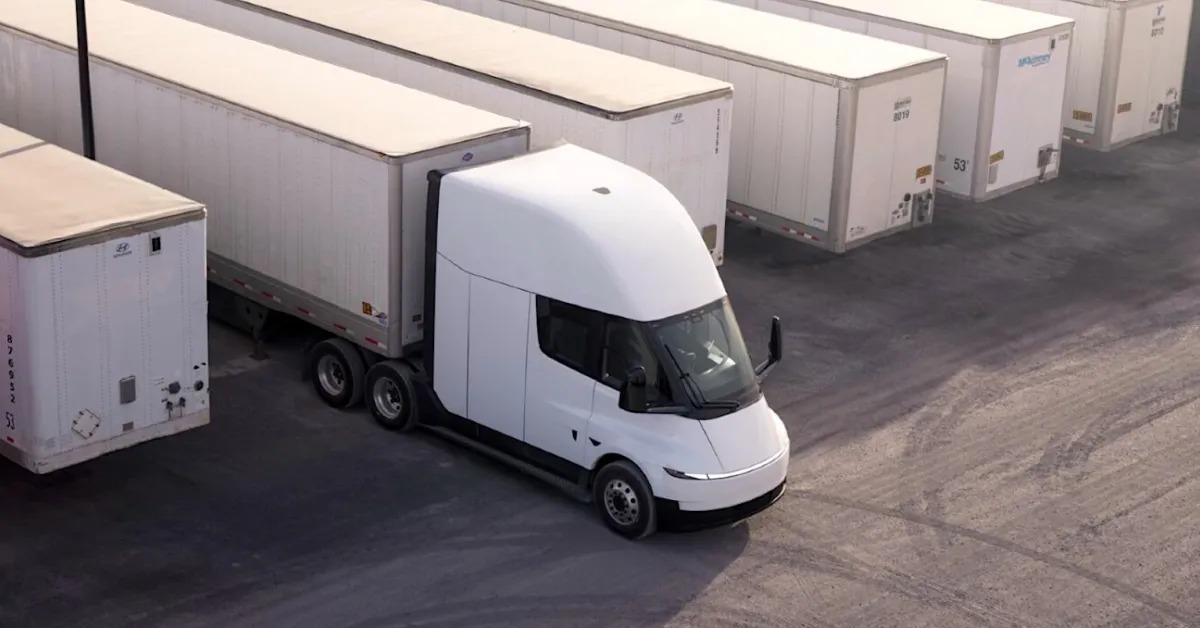
Kodiak AI will begin delivering 75 autonomous trucks to freight company DTL Transport starting from 2028. This is the company's first binding commercial agreement involving driverless heavy trucks that can operate on public roads.
Rivian released its third-quarter financial report, which contains several noteworthy points. Firstly, the performance of the new R2 has been strong enough for the company to raise its delivery forecast for 2026 by several thousand units. Rivian previously estimated that it would deliver 65,000 to 70,000 electric vehicles this year, but now has raised the lower limit to 67,000 units. However, there is another potentially more profitable development: the joint venture with Volkswagen Group, valued at $5.8 billion, is expanding and will include the assistance of AI. As for whether this means that Volkswagen will invest more funds in Rivian, there is no information available yet.
Tesla is shifting towards Turo in order to promote the widespread adoption of its Full Self - Driving (Supervised Version).
Waymo has finalized a manufacturing partnership with Toyota, officially moving from the "we're just talking" stage to the next step. Toyota will produce bZ4X models in its Japanese factories that are compatible with autonomous driving, and integrate Waymo's autonomous driving system. These vehicles will be used for robot taxi services in Japan, the UK, and other international markets. Notably, both companies hinted that this could ultimately lead to an licensing agreement, allowing Waymo's autonomous driving technology to be used in privately owned vehicles.
One more thing...
Finally, a reminder: For founders, investors, and builders in Boston and the surrounding areas, Founder Summit will be held in Boston on November 4th for one day, and I will also be there! This event is mainly targeted at startup founders, potential founders, and investors. Attendees will have the opportunity to hear advisory speeches from venture capitalists and serial entrepreneurs, as well as numerous social networking opportunities.
For readers of TechCrunch Mobility, tickets are available at a 30% discount. Click this link and use the discount code mobility30.