

Sandisk delivered financial results that far exceeded expectations, yet its stock price tumbled by 8% before the U.S. market opened on Friday. The problem lies with its Japanese wafer factory partner, Kioxia ( Kioxia ): the latter's profit forecasts fell short of expectations, and it warned that the trend of rising flash memory prices driven by AI is beginning to cool down.
Sandisk's post-market report on Thursday was almost flawless: revenue and earnings per share exceeded expectations, with a gross margin of 85%, and guidance was higher than Wall Street's forecasts. Additionally, the company announced plans to repurchase $5 billion in shares and a 1-for-8 stock split. However, the stock price remained unchanged after the market closed.
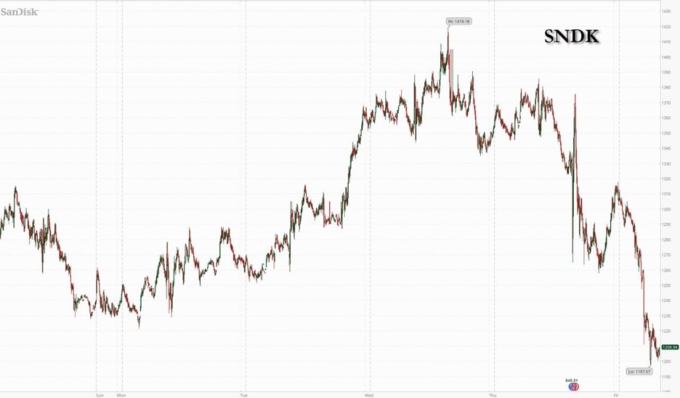
At 5:54 a.m. Eastern Time on Friday, Bloomberg reported Micron's guidance. SanDisk's stock price fell to as low as $1,197.57 before trading, representing a 16% decline from its high of $1,419 on Wednesday, and Micron Technology also saw its stock price drop accordingly.
Some analyses point out: "In the storage industry, the only important number is the second derivative." In other words, what the current market is concerned about is how fast prices rise.
Data shows that the average selling price of NAND flash memory increased by about 25% in the three months up to September, with the increase in the previous quarter being 70%.
Kai Xia: The soaring prices are beginning to stabilize.
KaiXia expects its operating profit for this quarter to be 2 trillion yen (about 12.7 billion US dollars), which is significantly lower than the market's forecast of 2.35 trillion yen.
The just-concluded September quarter was still impressive: operating profit increased by 22 times year-on-year, reaching 1.99 trillion yen, in line with expectations; revenue was approximately 2.48 trillion yen, a 40% increase from the previous quarter. The company also distributed interim dividends for the first time, at 90 yen per share.
Trouble lies in the next quarter. Based on the above analysis, the 2 trillion yen guidance implies almost zero growth in operating profit for the December quarter compared to the previous quarter, while the September quarter saw a 57% increase, and market consensus had originally factored in an approximately 18% increase. Bloomberg's analysis suggests that Kioxia's outlook indicates the unprecedented price surge of the past year or so is beginning to stabilize.
In other words, prices are still rising, but at a rate that is only about one-third of what it was three months ago. Analysts believe that for stocks priced in a manner that assumes the “curve will only become steeper,” this is sufficient to constitute a negative factor.
Customers are also starting to find it unbearable. According to media reports, executives at铠侠 (Kioxia) have warned against excessive price hikes to avoid alienating customers. Intel expects that this year's PC shipments will decline by about 12%, and another 10% in 2027, with "limited storage supply" being one of the reasons; the company attributed the "unexpectedly severe PC adjustment" to storage prices, causing the stock price to plummet by 25% before trading began.
Selling pressure quickly spread. According to JPMorgan Chase's market intelligence team, the price of ETF ( DRAM ) fell by 5.6% before the market opened, reigniting concerns about the liquidity of AI, putting pressure on the entire semiconductor sector. Just two days ago, stock index futures were still rising amidst the "storage frenzy driven by SK Hynix."
KaiXia's own stock price has fallen by about 60% from its June high before the financial report. Goldman Sachs' Jay Narain pointed out that even so, its cumulative return since IPO in December 2024 is still 2400%.
SanDisk: Exceeded market expectations, but not buyers' expectations.
Just looking at the numbers, Sandisk has had a solid quarter. According to a summary from Goldman Sachs TMT, Sandisk's revenue was 11.03 billion US dollars, higher than the market expectation of 10.74 billion US dollars; the gross margin was 85.1%, slightly above the market expectation of 84.9%; and the non-GAAP earnings per share were 49.51 US dollars, higher than the market expectation of 46.73 US dollars.
The issue lies in the details of the guidance. Sandisk's revenue guidance for the next quarter is $12.4 billion, with non-GAAP earnings per share ranging from $55 to $57, which is higher than the market consensus of $12.08 billion and $52.94 per share, but significantly lower than Goldman Sachs' forecast of $13.55 billion and $59.71 per share. Analysts believe that Goldman Sachs' figures roughly represent the "whispered expectations" of buyers, that is, the level that institutional investors truly anticipate.
Management is quite optimistic about the data center business. Sandisk states that data centers already account for about half of the industry's bit demand, which was around 20% in 2020; the company expects that by 2030, KV cache (the cache that stores intermediate calculation results during large model inference) will account for approximately 35% of the AI data center market, and by 2027, data centers will account for over 55% of the NAND market.
Management also stated that many customers 'previously underestimated their demand for NAND', and Sandisk will supply goods at 'a newly negotiated higher price'. As for how much higher the price will be, Kioxia, which shares a wafer factory with Sandisk, has just provided an answer: it will be much less than before.
This scenario has already played out once in August; at that time, Sandisk also far exceeded expectations, yet its stock price still fell. According to the financial report analysis by Goldman Sachs analyst Jim Schneider, the long-term agreements currently cover approximately 50% of Sandisk's planned bit production capacity for the fiscal year 2027 and 65% for fiscal year 2028, which is the same as in August, despite the signing of two additional agreements since then (a total of 10 agreements have been signed with 8 customers so far).
The long-term agreement sets a price floor, which can serve as a buffer. However, as the analysis above indicates, this means that half of the production capacity next year will still be subject to fluctuations in contract market prices, and GigaDevice has just clarified the direction of the contract market.
Schneider remains bullish. He believes that the supply increment in the NAND market is "very limited in the foreseeable future," and has raised his earnings per share forecast for 2026 to 2028 by about 7%, noting that the company still has $10.5 billion remaining in its share repurchase authorization. He wrote on Thursday evening, "After expected strong quarterly results, I expect the stock price to rise moderately." This judgment only held true until 5:54 a.m. on Friday.
Cycle inflection point, or just a chance to catch our breath?
NAND There are two types of prices: the spot price, which is the transaction price in the spot market and reacts quickly; the contract price is renegotiated regularly between manufacturers and major customers, with some lag in adjustments. The aforementioned analysis pointed out as early as June 25th, on the day when storage transactions peaked, that the spot price had stopped rising since March. Since then, the contract price has risen for another two quarters, and now the time difference between the two is narrowing.
Supplies are still increasing.铠侠 (Kioxia) plans to invest over 5 trillion yen in expansion with SanDisk in Japan over the next six years, with some of the funds coming from a ADR issuance in the United States next year, which could raise at least 10 billion US dollars. Micron is building a $24 billion NAND factory in Singapore; Yangtze Memory Technology has secured 13% of the global NAND market share, on par with SanDisk; DRAM leader ChangXin Memory also entered the flash memory market in September.
Samsung's NAND business also fell short of expectations. Goldman Sachs' Giuni Lee stated that its NAND profits were "slightly below our expectations (both bit shipments and average selling prices were slightly lower)."
Storage price increases have been transmitted to PC, mobile phones, and servers. Goldman Sachs' Rich Privorotsky indicates that Intel's PC business is shrinking due to "storage inflation driving up hardware costs." A slowdown in NAND price increases is good news for CPI and PC manufacturers, but it is bad news for storage stocks that have been pricing according to the logic of rising prices.
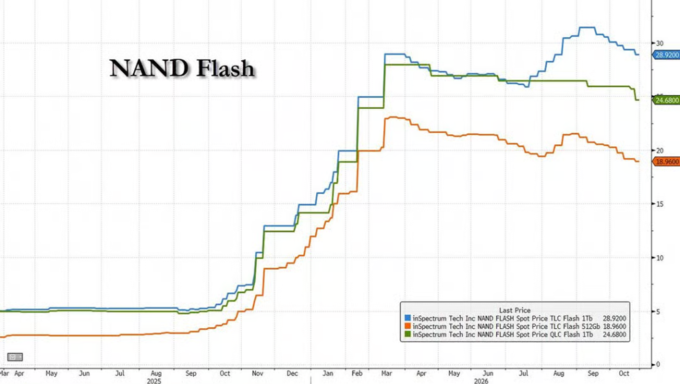
Short sellers analyze that storage is essentially a cyclical industry, yet over the past year they have convinced themselves that it is structural in nature. Spot prices peaked in March, and the increase in contract prices dropped from 70% to around 25%.铠侠 (Kioxia) claimed that its profits remained flat while investing 5 trillion yen in capacity expansion, yet it also reduced shipments because its largest buyers could no longer afford the chips. According to Bloomberg, large technology companies' $750 billion in AI expenditures are colliding with slower growth in their core businesses. Many investors believe that the ultra-large cloud providers, which should be able to absorb this additional capacity, may also start to negotiate more aggressively.
Bulls believe that a quarterly increase of around 25% is still a rare sign of a strong market, and the demand for data centers is structural. It is possible that the management of GigaDevice is deliberately conservative.