Microsoft, backed by its scarce AAA credit rating and impressive financial reports, successfully completed a bond issuance worth $25 billion, creating one of the most sought-after transactions in the history of the U.S. corporate debt market. However, behind this grand occasion, the selective differentiation in the bond market towards AI, a super-large-scale cloud computing provider ( hyperscaler ), has become increasingly clear.
This issuance attracted peak orders of over $115 billion, with a subscription multiple of 4.6 times. The underwriting team was led by Wells Fargo, JPMorgan Chase, and UBS, and they narrowed the yield spread on the longest-term bonds by up to 30 basis points from the initial guidance price.
Microsoft Chief Financial Officer Amy Hood stated during this week's earnings conference call that the company will proceed with further financing "when it deems the time is right."
However, market observers warn that Microsoft's success does not mean that other tech giants will receive the same warm reception. Recent concerns regarding the spending and profitability of AI have put high-risk tech bonds under pressure, with the credit default swap costs for Broadcom and SpaceX once reaching record highs.
Natixis Investment Managers Solutions Multi-Asset Portfolio Manager and Chief Strategist Jack Janasiewicz stated: "The credit market is undertaking a significant task of identifying winners and losers. The market remains open to issuances, but not to everyone."
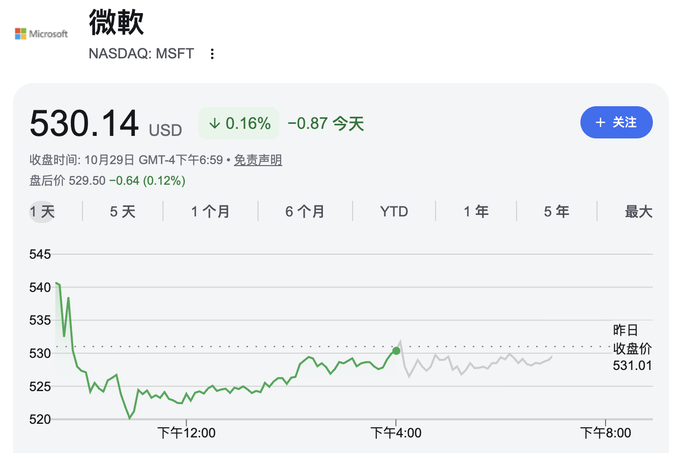
Microsoft closed down 0.16% on Thursday.
AAA Rating Advantage: Microsoft's Rare Status
It has been nearly eight years since Microsoft last entered the U.S. investment-grade bond market; in 2017, it raised $17 billion in financing.
Ten bonds with different maturities have been launched this time, ranging from 2 to 40 years. The pricing spread for the 40-year bonds is about 105 basis points above the benchmark government bonds, which is significantly lower than the approximately 133 basis points for Alphabet bonds of the same maturity. Moreover, the rating of Alphabet bonds is also lower than that of Microsoft.
At the rating level, Microsoft is the only U.S. listed company, aside from Johnson & Johnson, to have received both Moody's and S&P's top-tier ratings AAA. This status gives it a natural advantage in the crowded tech debt market.
GW & K Investment Management, the combination manager Brett Kozlowski, stated: "The timing of this transaction seems to have a strong opportunistic element to it." The strong demand was within expectations, mainly stemming from the market's craving for "extremely rare long-term AAA bonds," coupled with a yield of over 6% that proved attractive.
Microsoft's financial quarter results announced this Wednesday also provided strong support for this issuance – cloud computing revenue increased by 48% year-on-year, and capital expenditures remained within a controllable range, alleviating investors' concerns about the substantial investments in AI.
Analysts from CreditSights pointed out in a report released on Thursday that the issuance of $25 billion in bonds will only slightly increase Microsoft's adjusted leverage ratio to 0.7 times, and its balance sheet remains healthy.
The debt market's capacity to absorb is approaching its limit; Microsoft's 30-year yield spread is higher than that of Procter & Gamble, which has a lower rating.
Despite Microsoft's smooth progress this time, the bond supply in the entire hyper-large-scale cloud computing industry has approached the upper limit that investors can bear.
According to data compiled by Bloomberg, as of Thursday, hyperscalers in cloud computing and data center developers have raised a total of over $313 billion this year through global investment-grade bond issuances, nearly tripling the amount for the entire year of 2025, and driving the total global bond issuance to a record high of $6.63 trillion.
Faced with market saturation, some large borrowers have begun to take a more cautious approach. As disclosed in the oracle bone texts this week, they have committed to a maximum net debt increase of $10 billion for the fiscal year 2030 to alleviate investors' concerns about their debt expansion; Meta has turned to the stock market and completed a $25 billion equity financing round.
Microsoft's own pricing also reflects the cautious sentiment of the market. Despite having a AAA rating, the yield spread on its 30-year bonds is 95 basis points above that of benchmark government bonds, which is actually higher than the 30-year bonds issued by Procter & Gamble in the same week. Procter & Gamble's bonds were priced with a yield spread of 60 basis points, marking the lowest premium since 2003.
Wealth Enhancement, Director and Senior Investment Strategist, stated: "For Microsoft bonds with a term of 5 or 7 years, I would subscribe without hesitation. However, once the term is extended to 30 years, the uncertainties at the business model level still need to be reflected in the pricing."