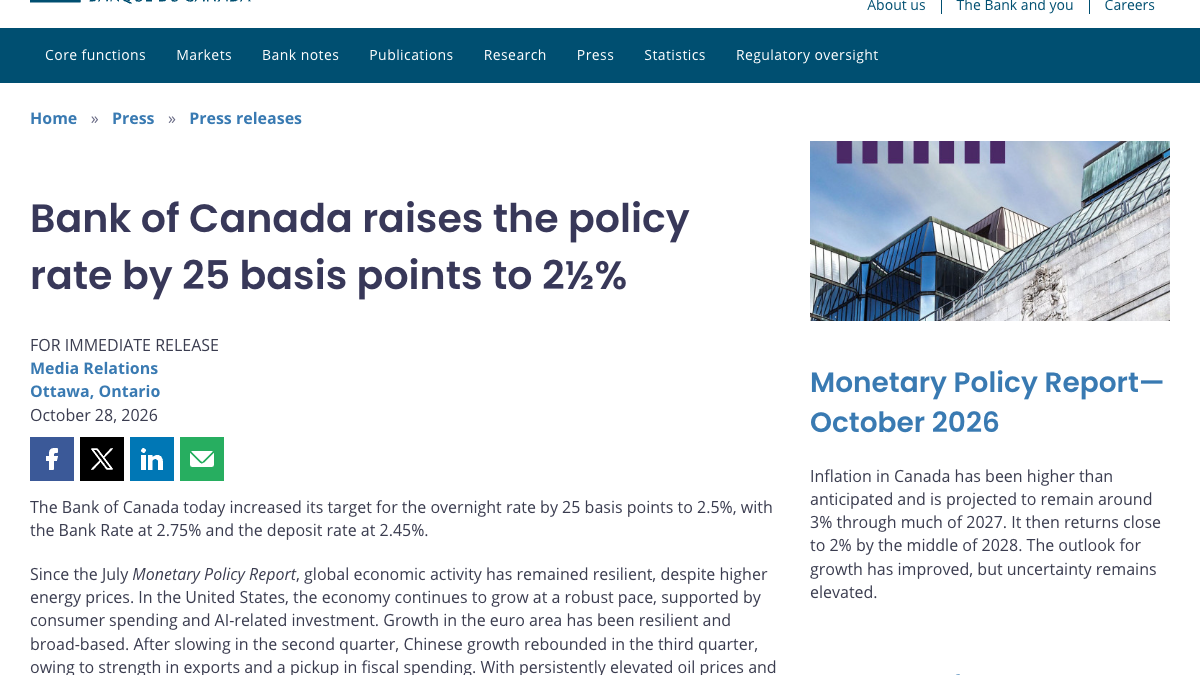


The Bank of Canada raised its overnight interest rate target from 2.25% to 2.50%. [Resolution on October 28th]( https :// www.bankofcanada.ca /2026/10/ fad-press-release-2026-10-28 /) also listed a bank rate of 2.75% and a deposit rate of 2.45%. These three figures serve different policy purposes; the mention of "raising rates by 25 basis points" in the news refers to the overnight rate target, and none of these figures should be considered as a uniform rate for all loans.
This decision can easily be interpreted as indicating that the economy has become fully overheated. However, the picture presented in the resolution is more complex: the unemployment rate has remained around 6.5% for several months, and a set of indicators still suggest that there is some excess supply in the economy. The central bank's decision to raise interest rates under such circumstances is key because its judgment regarding the duration of inflation has changed.
In September, inflation excluding gasoline was 2.2%, with the core indicator approaching 2%; meanwhile, the overall CPI has been around 3% since April, and the central bank expects it to reach about 3.5% by the end of the year. Each of these sets of figures has its own range; therefore, it cannot be concluded that "inflation excluding gasoline is close to the target" means that all price pressures have subsided, nor can the end-of-year forecast be taken as the newly announced actual figure.
Enterprises absorb costs first, and may then change their quotes.
Enterprise cost sides provide more specific clues. The central bank stated that higher fuel prices have pushed up production and transportation costs, as well as the prices of imported industrial and electronic inputs. To date, most companies have absorbed these costs internally, but surveys indicate that the extent to which these costs are passed on to selling prices may increase in the coming year.
Therefore, the policy rationale for raising interest rates is not only aimed at the current fuel bills but also at subsequent pricing. As long as the impact persists, the costs that were previously cushioned by corporate profits may be passed on to more goods and services. The central bank's response through interest rate adjustments is aimed at mitigating this risk of spread; however, the expectations conveyed in the surveys do not necessarily mean that companies have already universally implemented price increases.
Growth also makes choices more difficult. The resolution states that Canada's GDP grew by 3.3% in the second quarter, and recent indicators point to a growth of about 2% in the third quarter, both of which are stronger than previously anticipated. The figures for the third quarter mentioned here are estimates indicated by the indicators and are not the final GDP releases; moreover, the quarterly growth rates cannot be directly compared with the annual growth rate on the same basis.
The 25 basis points refer to the range of change in policy interest rates, not a fixed percentage that will inevitably increase on the next bill for households or businesses. How banks adjust their loan and deposit rates is also influenced by the product term, the method of contract repricing, credit conditions, and the cost of market funds. The resolution lists overnight targets, bank interest rates, and deposit rates, which clearly indicates that there are different operating prices within the policy framework. To observe the transmission effects, one should look at floating loans, fixed-term financing, and deposit returns separately, rather than applying a direct 2.50% increase to all financial products.
Policy decisions also have to account for time lags. Enterprises first absorb the costs of fuel and imported inputs before they may be able to adjust their selling prices; changes in interest rates affect borrowing, investment, and consumption, but these effects do not manifest on the same day. Therefore, central banks are concerned about broader price transmissions that may occur after the initial shock, rather than claiming that a single rate hike can immediately lower every price. If future data shows that cost transmissions are weaker than expected, or if growth significantly weakens, policy choices will also change; the cautious wording in the resolutions is precisely to leave room for such uncertainties.
Policy space is narrowing, and the subsequent path is not yet determined.
The central bank expects Canada's economy to grow by 1% in 2026, and by 2% each in 2027 and 2028. However, the housing market remains relatively weak, consumer growth is expected to slow down, and trade relations pose significant uncertainties. These factors remind borrowers that although the overall forecast has improved, it does not guarantee that their own industry or family's cash flow will also strengthen accordingly.
Inflation forecasts can better explain this move. The central bank expects the average inflation rate for CPI to be around 3% in 2027, which is one percentage point higher than the forecast from July, and it is not expected to return to 2% until mid-2028. The cost faced by policymakers has extended from short-term readings to longer-term pressures on purchasing power, and the wait itself has become expensive.
This also explains why an unemployment rate of around 6.5% did not prevent this action. The job market is still slack, and housing conditions are also weak, but there is both strong recent growth and more persistent price pressures. Policy is not about choosing just one number between “growth” and “inflation”; rather, it is about determining which type of risk continues to accumulate at a higher cost when both exist simultaneously.
The resolution retains the possibility of further interest rate hikes, while indicating that such moves will be made cautiously. A single increase does not commit to consecutive hikes, nor does it announce that inflation issues have been resolved. For households and businesses, what has changed are the policy conditions surrounding their financing decisions; for central banks, the resilience of growth has reduced the room to continue tolerating cost increases.