


Stop fixating on AI. Investors are starting to fear oil prices again.
If a storm is coming, where should one look for the bottom of Bitcoin prices?
The crypto market is facing the strongest macroeconomic pressures since June, which has forced market makers Wintermute to adopt a wait-and-see stance. This OTC trading desk stated: "We are not bearish, but we remain extremely cautious before the Federal Reserve meeting."
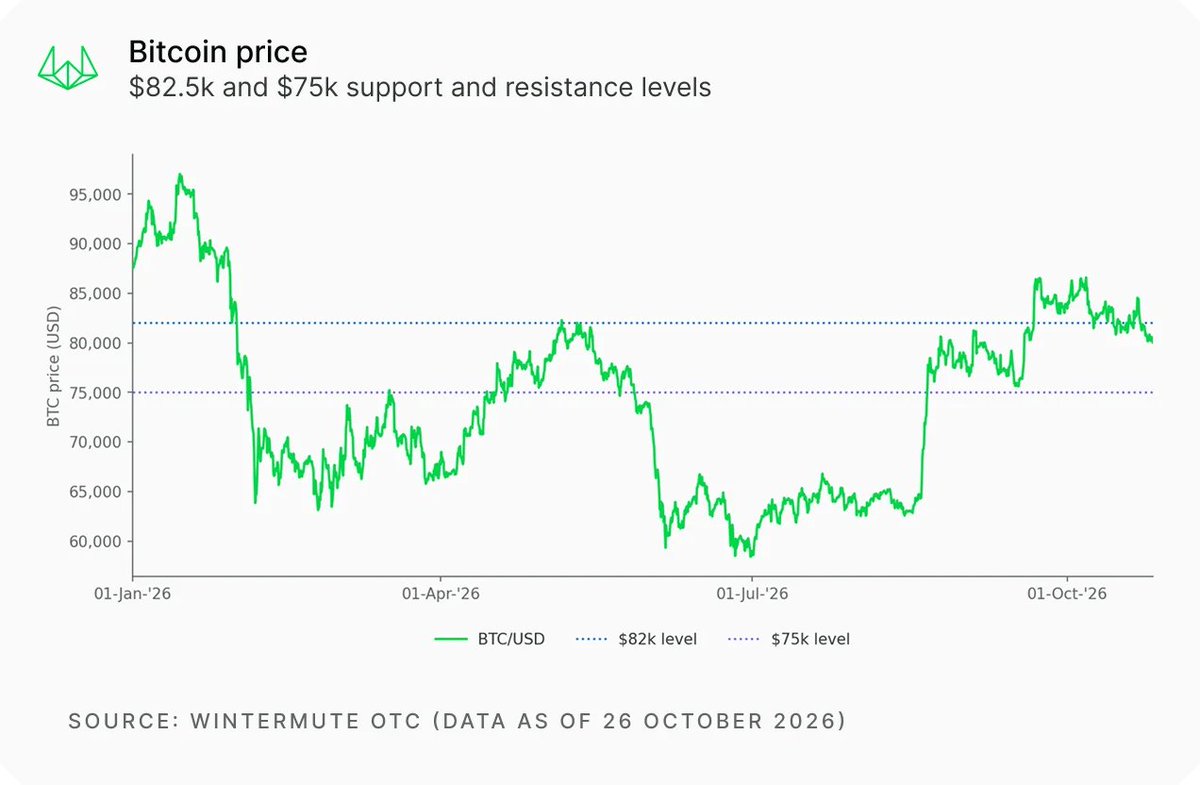
In the 43rd week of this year, Bitcoin fell for the third consecutive week, with a weekly decline of 2.43%. It lost its key support level of $82,500 and dropped to $80,500.
The main trigger for this decline was a sharp reversal in the US spot ETF sector: on Thursday, there was a net outflow of $636 million from these funds, while at the same time, the NASDAQ index fell by 2.6%.
Stop fixating on AI. Investors are starting to fear oil prices again.
The shift in market focus has determined the trend of assets. Investors' concerns about financing issues in the artificial intelligence industry have given way to concerns over the energy crisis. Against the backdrop of pressure on oil infrastructure, Brent crude oil rose by 5.66% to $116.72, becoming the main inflation risk facing Wall Street.
Wintermute emphasizes that the close linkage between cryptocurrencies and the macroeconomy has shattered the illusion of the BTC four-year cycle being independent. As retail funds and institutional ETF capital flows now follow the trend of NASDAQ, the crypto market has become vulnerable to the impact of stock market deleveraging, and U.S. stock market margin debt has currently reached a record $1.5 trillion.
This week's data shows that funds have shifted on a large scale towards defensive and commodity-related instruments. Driven by inflation concerns, Brent oil prices soared by 5.7% to $116.72; at the same time, the Russell 2000 small-cap index rose by 2.0%, indicating that overall risk appetite still exists.
Meanwhile, defensive U.S. Treasury bonds rose by 1.6%, with the yield on 10-year Treasuries settling at 4.99%. On the other hand, Ethereum followed the pullback in the U.S. tech sector, falling by 3.4% to $2,330, while gold declined by 4.0% to $4,008.
If a storm is coming, where should one look for the bottom of Bitcoin prices?
The results of this week entirely depend on today's decision by FOMC and Powell's statements. Analysts at Wintermute claim that as Brent oil prices exceed $100 per barrel, inflationary pressures are on the rise. This trading desk believes that $120 per barrel is a key level; once surpassed, a Fed interest rate hike in December will become the baseline scenario.
In this context, Wintermute presents two scenarios for Bitcoin:
- Bullish:Return and stabilize in the range of $82,000 to $82,500. If the Fed's wording is neutral, and there are no surprises in the PCE index report to be released tomorrow, this scenario is possible.
- Bearish:If it falls below the psychological barrier of $80,000, the price is expected to drop to the previous breakout point of $76,000, and there is a risk of further decline towards the region just above $70,000.
Wintermute summarized that currently, market participants lack a clear sense of direction and confidence. Taking on large-scale positions before key macroeconomic events materialize will involve higher risks.