

Morgan Stanley warns that the U.S. stock market may not have yet completed this round of adjustment. Three factors—pressure from artificial intelligence financing, mid-term elections, and ongoing tightening of financial conditions—may drive the S&P 500 index further down in the coming weeks. However, the bank still expects the market to rebound before the end of the year.
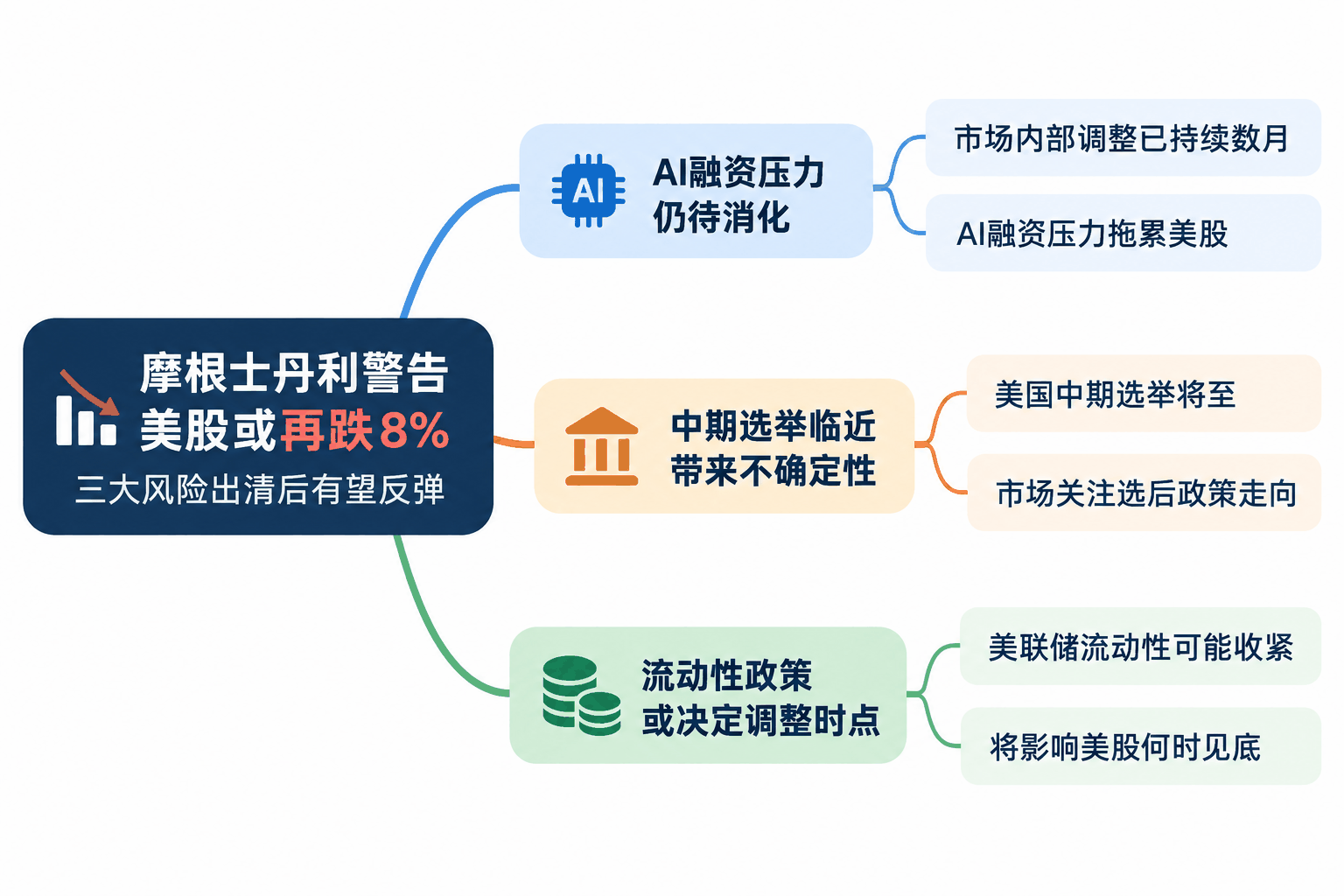
Morgan Stanley's chief U.S. equity strategist, Mike Wilson ( Mike Wilson ), pointed out in the latest client report that the S&P 500 index could fall to around 7,100 points in the short term, which would represent a decline of about 8% from recent levels, marking the largest adjustment since the market turmoil triggered by the Iran war this year.
Despite being more cautious in short-term assessments, Morgan Stanley still maintains its baseline forecast that the S&P 500 index will reach 8,000 points by the end of the year. If the index rebounds from around 7,100 points to this target, the increase would be approximately 12%.
Internal market adjustments have been ongoing for several months, and the financing pressures of AI still need to be addressed.
Wilson believes that the adjustment of the U.S. stock market, which began in June, has entered its final stage. Although the major stock indices have previously lingered near historical highs, a large number of individual stocks have already experienced significant declines.
According to Morgan Stanley's statistics, since the beginning of June, approximately 60% of the stocks in the Russell 3000 index have fallen by more than 20% from their peak levels, over a third of the stocks have seen a decline of 30%, and about one-eighth of the stocks have experienced a decline of more than 50%.
The adjustments within the technology sector are particularly evident. The data shows that approximately 96% of semiconductor stocks have fallen by more than 20% from their highs, and 87% of the stocks have seen a decline of over 30%.
Wilson believes that the gap between index performance and individual stock trends may ultimately be corrected through a further decline in the S&P 500 index. He has set a tactical downward target of around 7,100 to 7,200 points, which is slightly below the index's 200-day moving average.
Morgan Stanley believes that the prospects for investment and financing in artificial intelligence are the first risk that needs to be addressed in the short term.
Recently, investors have become skeptical about the return prospects of capital expenditures in artificial intelligence. At the same time, the credit spreads on bonds related to data centers have widened, increasing the financing costs for some companies.
As technology companies continue to issue bonds and stocks to raise funds, the capital market also needs to absorb a large amount of new securities supply. Rising financing costs and increased debt issuance pose a more complex funding environment for the artificial intelligence investment chain.
The credit status of some enterprises has also drawn attention. The debt of the artificial intelligence and cloud computing company CoreWeave has entered a difficult period this month, exacerbating market concerns regarding related financing risks.
Wilson predicts that financing issues for artificial intelligence may become prominent in the next three to four weeks, with the semiconductor industry at the center of this related pressure.
Morgan Stanley believes that the semiconductor sector may find temporary support around mid-November, but it is still possible to see a further decline of 10% to 15% before that time. The bank suggests that the end of this sector adjustment could coincide roughly with the time when concerns about financing ease.
U.S. mid-term elections approach, markets concerned about post-election uncertainties
The second potential liquidation event is the U.S. mid-term elections held on November 3rd.
Morgan Stanley pointed out that, based on historical data, the months leading up to mid-term elections are often a period of relatively weak performance for the U.S. stock market. Previous statistics from Goldman Sachs showed that in mid-term election years since 1974, the median return of the S&P 500 index from August 1st to the day of voting has been zero.
In contrast, historical performance after the election is usually more positive.
An analysis of market data from 1950 to 2022 by Morgan Stanley shows that three months after the U.S. mid-term elections, the S&P 500 index averaged an increase of about 8%; in the following six months, the average cumulative gain was approximately 15%.
This view holds that the election itself could become a turning point in eliminating political uncertainties in the market. Regardless of the specific outcome, the end of the election may reduce some policy risks that were previously difficult for investors to assess.
However, policy changes after the election remain an important variable.
Wilson mentioned in the report that the Trump administration had previously sent signals that it might expand military actions against Iran after the election. This related uncertainty has become one of the market risks that have been discussed recently in communications with clients.
Morgan Stanley stated that it is difficult to accurately predict the timing and actual impact of such unexpected events, therefore they have not designated a specific military escalation as a definite scenario.
The Fed's liquidity policy may decide when to end adjustments
The third risk comes from the continued tightening of financial conditions in the United States, and Wilson views changes in liquidity as a significant factor that could contribute to the final round of market declines.
In September, the Federal Reserve raised the target range for the federal funds rate by 25 basis points to 3.75% to 4.00%, followed by a noticeable increase in U.S. Treasury yields. High energy prices and a slowdown in the central bank's balance sheet expansion have also increased the pressure on risk assets.
Wilson pointed out that even if the Federal Reserve does not continue to raise policy interest rates, the rise in bond yields alone will tighten financial conditions by increasing financing costs.
This spontaneous tightening of the market may help the Federal Reserve to curb economic growth and inflation, but it could also put undue pressure on financial markets, prompting central banks to re-evaluate their policy stance.
Morgan Stanley believes that the market needs to closely monitor whether the Federal Reserve will send signals to increase liquidity. If financing pressures continue to expand, adjustments to monetary policy could become an important catalyst for the stock market to end its adjustment phase.
However, there are currently no obvious signs of tension in the money market that would force central banks to intervene immediately.
According to a report by Reuters on Wednesday, the market generally expects the Federal Reserve to maintain interest rates unchanged at its monetary policy meeting that will conclude on the same day. CME Group FedWatch tools show that the probability of the market pricing in an interest rate hold is about 90%.
In such a policy environment, Wilson believes that the market's previous adjustments have already absorbed some of the risks, but the main indices may still need to fall further in order to align with the more weak market breadth.
Morgan Stanley continues to prefer companies with higher profit quality and stable financial conditions, and believes that there may be a market environment more suitable for increasing risk exposure in the coming weeks.
It maintains the target of 8,000 points for the S&P 500 index by the end of the year and sets a basic target of 8,300 points for the next 12 months. Its judgment still depends on the gradual alleviation of financing pressures, the improvement of financial conditions, and the continued progress of corporate earnings growth.
Recommended Reading More
26 minutes ago, Anthropic is about to go public, but its prospectus reveals multiple conflicts with the Trump administration!
1 hour ago, preliminary results of the Israeli general elections were released: neither of the two major camps gained a majority, with the Likud Party maintaining its position as the largest party.
2 hours ago, Morgan Stanley warned that U.S. stocks could fall another 8%; there is hope for a rebound after the three major risks are cleared.
2 hours ago, Alphabet and Microsoft released their financial reports after the US stock market closed on Wednesday. Wall Street is closely watching AI's spending and the monetization of its cloud business.
2 hours ago, Zelenskyy spoke for the first time about Russia's security guarantees, emphasizing that Ukraine's needs must take precedence.