IT News on October 28th: According to a report by Bloomberg on October 25th, compared to a few years ago, the number of days Netflix users open the app each month has decreased, as has the average viewing duration per user.
According to the introduction, this trend began after Netflix started cracking down on password sharing in 2022. Initially, management thought it was just a short-term phenomenon, as the number of users per account decreased. However, this trend has continued since then. The reduction in user viewing time may indicate that they perceive the value provided by this service to have declined, or that they are spending more time on competitors' platforms.
According to sources, Netflix uses the QPD ( Qualified Play Days ) metric to measure the frequency of users' app usage. In the first half of 2026, the total usage time of Netflix increased by only a few percentage points, but this was mainly due to an increase in the number of users, rather than an increase in the viewing time per individual user.
To attract new users and retain existing ones, Netflix increased its content production budget and expanded into business categories such as podcasts and live sports broadcasts. However, Ted Salandos ( Ted Sarandos ), Co-CEO of Netflix, stated during a teleconference with analysts this week that the viewership in the US market "has not grown at the rate we could have expected, nor has it reached our expectations."
Data from market research firm Antenna shows that Netflix maintains a user churn rate of 2% in the US market, which is considered low within the industry.
A "Market Research Report" published by Nielsen in July 2026 ( The Gauge ) shows that YouTube leads with a 14.2% share of American television viewership, which is nearly twice that of Netflix (7.8%).
As user engagement declines, the stock price of Netflix has fallen by more than 30% this year, and investors' concerns about the company's slowing growth have intensified. Netflix's overall share in the US television viewing market has also stagnated, while free services such as YouTube are attracting more users.
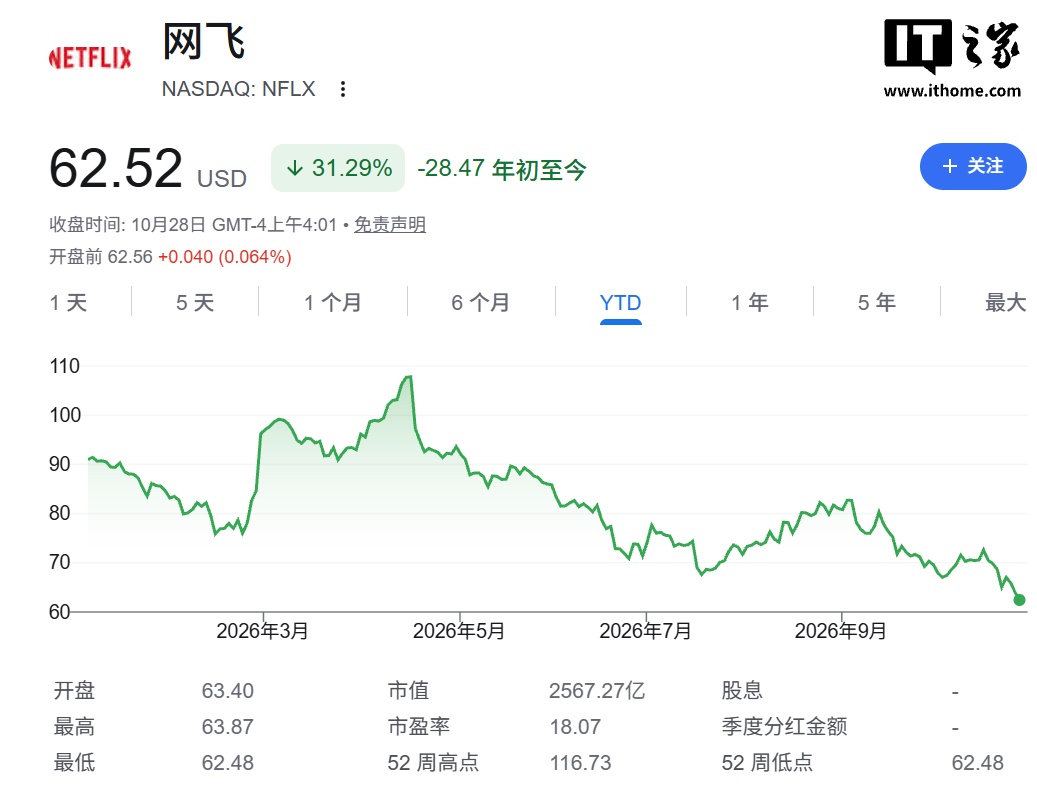
Financially, Netflix has seen a slowdown in revenue growth for three consecutive quarters, and it is expected that the revenue growth rate for this quarter will further decline. The company has also lowered its advertising sales forecasts for this year, anticipating that revenue will be about $300 million (Note from IT: Current exchange rate is approximately 2.004 billion RMB) lower than previously predicted, attributing this to the slower-than-expected launch of some new advertising products. According to a report by Reuters on October 20th, Netflix has reduced its advertising revenue forecast for 2026 from $3 billion (current exchange rate is approximately 20.043 billion RMB) to about $2.7 billion (current exchange rate is approximately 18.039 billion RMB).
Content presentation is also one of the challenges faced by Netflix. Compared to competitors such as Apple TV, the number of popular films and television works launched by the company in recent years has decreased, and it has become difficult to continue attracting viewers for the second and third seasons of some existing works. Management is considering various possible reasons, including a new version of the user interface, intensified competition, changes in content quality, and insufficient marketing outside of the platform.
Data from third-party mobile app tracking agency Apptopia also shows a similar trend. In the third quarter of 2026, among the Netflix subscription users in the United States, the proportion of users who did not open the app increased by 16.6% year-on-year. This data further reflects that the frequency with which some users use Netflix is declining.
In the face of growing concerns from investors, Salandos and Peters attempted to emphasize the company's operational performance and its reserve of future content. Last week, at a staff meeting, Peters stated that the company's business is still growing and remains profitable, while also acknowledging that there is still much more work to be done to drive further growth.
Netflix Recently, there have also been changes to the management of the content business. According to an official announcement released by Netflix on October 15th, former Disney executive Peter Rice (Peter Rice) will take on the role of Chief Content Officer starting from October 26th, replacing the departing Bella Bagaria (Bela Bajaria), and will be responsible for overseeing global content businesses such as television series, films, and live events.
Previously, the company also announced plans to cut about 6% of its staff and restructure management positions, including those responsible for its film business. At the time of these changes, Netflix was facing multiple pressures regarding content attractiveness, user engagement, and revenue growth.
Related Reading:
- In less than a week, two senior executives from Netflix have resigned one after another, putting pressure on the company's growth prospects.
- Netflix reported a net profit attributable to the parent company of $3.664 billion in the third fiscal quarter of 2026, a year-on-year increase of 43.86%.
- The largest round of layoffs since 2022: Netflix announces global layoffs of about 6%, affecting approximately 1,000 positions
- Netflix The Turkish region has seen another price increase after a year and a half: the lowest price is now 259.99 Turkish lira, representing an increase of about 36.8%, which is approximately 35.5 yuan per month.
- Report says Netflix Netflix adjusts original content strategy: reducing "well-received but not box-office hits," shifting resources towards projects with greater commercial value
- "Apple's Apple TV + 'Widow Bay' sweep 14 Emmy Awards, becoming the comedy series with the most awards in history in its first season"