New York, October 27, 2026 / PRNewswire / -- SaaS, a technology company focused on AI skin intelligence and personalized skincare, today released its skin foundation model Skin Foundation Model ( SkinFM ). This is an image-based AI foundation model trained using over 4 million real skin images, which will help the company develop customized skin measurement and analysis capabilities more quickly.
Haut.AI has also released SkinBench, which is a new public benchmark test. The company stated that the test revealed that six leading AI models, including those from Google, OpenAI, and Anthropic, often identified skin issues that did not exist, or were unable to identify actual problems. Haut.AI noted that although popular AI models can recognize faces and describe visible features, SkinBench results indicate that they may have difficulties in accurately assessing skin, which could lead to inaccurate skin evaluations and recommendations.
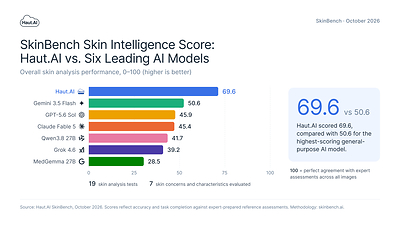
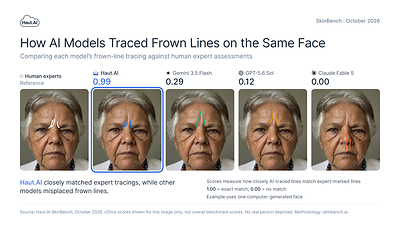
The performance of Haut.AI and six leading AI models on SkinBench
In the newly released SkinBench benchmark tests by Haut.AI, six leading AI models – including Google's general model Gemini 3.5, OpenAI's GPT-5.6, Sol, Anthropic's Claude Fable 5, xAI's Grok 4.6, Alibaba's Qwen 3.8 27B, and Google's medical-specific multi-modal AI model MedGemma (27B) – incorrectly identified eye swelling in approximately 95% to 100% of the images where no eye swelling was present.
These models also perform poorly in identifying wrinkles and determining skin type (such as dry, oily, or combination). When asked to mark frown lines on the face, one leading model marked the nose and mouth, while another did not draw any lines at all on the test images.
In contrast, the Haut.AI model identified 82% of deep forehead wrinkles, while the recognition rates of other models ranged from 15% to 60%; its balanced accuracy rate was 78%, compared to 37% to 58% for other models. The balanced accuracy rate assigns equal weight to each type of skin texture.
Overall, Haut.AI's technology scored 69.6 out of 100 in the SkinBench skin intelligence scoring system. This score measures the accuracy of skin analysis and the completion of tasks, with 100 points representing complete agreement with experts' evaluations of each image. In contrast, the highest-scoring general AI model, Gemini, scored 50.6 points.
Why is it necessary to use AI specifically designed for skin analysis in skincare?
As more and more enterprises shift to AI designed for specific industries and tasks, rather than relying solely on leading large models, these results have emerged accordingly. Gartner predicted in April 2025 that by 2027, the frequency of enterprises using small, dedicated AI models will be at least three times that of general-purpose large language models.
NielsenIQ has found that 49% of consumers have received beauty product recommendations provided by generative AI. The reliance on such tools is deepening: Accenture has found that 75% of beauty consumers are willing to accept a shopping experience driven by AI. This open attitude also extends to the skincare field. A survey of 1,238 American women by Haut.AI showed that 62% of American women are interested in using AI to get skincare or body care advice, or are already using it; half of the respondents stated that they would trust the body care product recommendations provided by AI.
Haut.AI CEO and Co-founder Anastasia Georgievskaya stated: "While AI is capable of recognizing faces, this does not mean it can accurately assess skin. Our research findings indicate that some of today's leading AI models often detect skin issues that are not present. As consumers increasingly rely on AI for skincare advice, this is indeed concerning. We developed SkinFM to make skin analysis more accurate; we created SkinBench so that the industry can see the true performance of different AI models."
The role of SkinFM: A basic skin analysis model for beauty brands
Unlike the traditional AI systems that require training separate models for different skin analysis tasks, SkinFM uses a single image-based AI base model to analyze various skin characteristics. This approach also enables Haut.AI to develop new skin measurement indicators more quickly and to create grading systems that can be customized to meet the needs of different brands. The technology of Haut.AI can evaluate over 230 skin measurement indicators and 48 biomarkers, including wrinkles, redness, pigmentation, and other visible skin features.
For beauty brands, this means that they can customize skin assessments based on their own products and customer needs, launch new measurement indicators more quickly, provide more targeted personalized recommendations, track visible improvements over time, and support skincare research and product development.
SkinBench Results: The performance of six leading AI models in skin analysis
SkinBench compares the dedicated skin analysis technology of Haut.AI with that of Flash, GPT-5.6, Sol, Claude Fable 5, Grok 4.6, Qwen 3.8 27B, and MedGemma 27B. This benchmark was developed by the data science team at Haut.AI and encompasses 19 tests focusing on seven common skin issues and characteristics: wrinkles, sunspots, redness, skin tone, skin texture, dark circles, and eye puffiness. Eleven of these tests are used to identify and grade visible skin features, while eight tests measure the accuracy of the model in locating these features. The results are then compared with reference evaluations prepared by experts.
The following five items SkinBench demonstrate how significant the performance differences are, and why these differences are important:
- The dedicated AI comes closest to human experts in a specific wrinkle assessment. Haut.AI scored 0.82 in the consistency of frown wrinkle severity evaluations with expert assessments, GPT-5.6 scored 0.73, while human graders scored 0.86. Based on 350 computer-generated faces, this result indicates that the dedicated AI can achieve a level of consistency close to that of humans in certain well-defined skin analysis tasks.
- AI often detects skin issues that do not actually exist. As shown by the results of eye swelling, inaccurate AI skin assessments can lead to unnecessary product recommendations, waste of spending, and undermine consumers' confidence in the personalized skincare services provided by beauty brands.
- Identifying wrinkles does not equate to accurately locating them. When asked to depict frown lines on 350 composite faces, Haut.AI scored 47.8 points, while GPT-5.6 and Sol scored 20.2 points each, making them the strongest competing models. The importance of this difference lies in the fact that brands need to know where the wrinkles are located in order to measure changes and evaluate the effectiveness of their products.
- The AI model has poor consistency in skin type classification. The Haut.AI model scored 77.8 points in skin type classification, while the strongest competing model scored 57.7 points. Incorrect identification of someone's skin type may affect the recommendations for moisturizers, cleansers, and other skincare products.
- There are differences in accuracy among different skin tones. The Haut.AI model performs at 50.9 points on various skin tones, while the sub-optimal general-purpose AI model scores 30.3 points. This evaluation focuses on the group of skin tones for which each model performs weakest, highlighting the need for brands to ensure that their technology is stable and reliable for consumers with different skin tones.
Haut.AI did not win in every test. For example, Gemini performed better (3.5), and Flash showed better results in wrinkle scoring (71.7 points versus 61.8 points) as well as in skin tone assessment (90.4 points versus 87.6 points). These results further illustrate that when evaluating AI tools, one should focus on the specific tasks they are intended to perform, rather than just looking at the overall score.
The public leaderboard for SkinBench provides separate scores for the analysis capabilities of different skins and their performance on various skin tones, facilitating companies to compare models based on their most relevant capabilities.
Haut.AI plans to continue expanding SkinBench, incorporating more AI models, and adding new tests to verify whether the models will produce consistent results when analyzing the same skin issues.
Georgievskaya indicates that as AI becomes increasingly common in the beauty industry, brands need to prove that the technology behind their recommendations can provide reliable results. Error detection is not only a technical issue; it can also lead to inappropriate product recommendations, unnecessary purchases, and a loss of consumer trust. Our goal is to provide brands with the necessary evidence to help them choose AI technologies that can win and maintain consumer trust.
The rankings, model comparisons, and testing methods of SkinBench can be found at skinbench.ai.
Graphic materials provided to the news media
Haut.AI provides supporting materials for the news media covering the benchmark testing of SkinBench, including graphics that showcase key findings and detailed descriptions of the performance of AI in specific skin evaluations in the HTML report:
- Graphics (4): Four graphics highlight the key findings of the benchmark test, including the performance of the AI model in identifying skin issues, detecting wrinkles, classifying skin types, and assessing the accuracy for different skin tones.
- HTML Skin Evaluation Examples (8 reports): Eight detailed HTML reports compare the performance of the AI model in evaluating specific skin issues, including fine lines under the eyes, crow's feet, dark circles, eye puffiness, forehead wrinkles, between-brow wrinkles, lip lines, and sunspots. Each report provides visual comparisons, performance indicators, and detailed results, showcasing the differences between different AI models.
All 12 resources are available for editing purposes and can be downloaded here.
About Haut.AI
Haut.AI is a technology company dedicated to AI skin analysis and personalized skincare. Founded by scientists and AI innovators, the company develops advanced skin intelligence technologies to help beauty and health brands measure and understand skin characteristics on different skin tones and body parts. Haut.AI's technology is based on over 20 million images, and its patented image anonymization technique retains the skin data needed for analysis while protecting identifiable facial information. Haut.AI collaborates with global leading brands such as Neutrogena, Beiersdorf, Ulta Beauty, Grupo Botic, and rio to provide science-based personalized skincare experiences, thereby enhancing consumer engagement and driving business growth. The company has received support from strategic investors, including the venture capital departments of Ulta Beauty's Prisma Ventures and Grupo Botic as well as LongeVC, and has participated in Microsoft, for, Startups, and Google's Gemini Startup Forum. For more information, please visit haut.ai.
Media contacts: Michael Tebo, Gabriel Marketing Group (representing Haut.AI), Phone: 571-835-8775, Email: [ email protected ]