


In the past week, the market focus shifted twice. At the beginning of the week, U.S. chip and AI concept stocks rebounded from sharp declines, and funds began to rotate into the healthcare and financial sectors; on Wednesday, after Meta announced a massive capital expenditure plan, concerns about the valuation and returns of AI were reignited; on Thursday, a wave of selling spread across the tech sector, with safe-haven funds flowing into U.S. bonds and the Japanese yen. On the same day, Houthi militants attacked Saudi energy facilities, pushing Brent crude oil to a five-month high.
The U.S. Dollar Index closed at 101.77 on Friday, marking the second consecutive week of decline. The yield on 10-year U.S. Treasury bonds fell below 5%, ending a streak of 19 consecutive trading days above 5%. As a result, the support for the dollar provided by high interest rates weakened.
Gold failed to benefit from the risk-aversion sentiment. Spot gold closed at $3,997.82 per ounce on Friday, down 0.69% for the day, and at one point dipped to $3,975.58, hitting a new low in over two months. The weekly chart showed a second consecutive week of declines. Silver experienced an even deeper decline, with concerns about the prospects for industrial demand further weighing on silver prices.
Crude oil saw an independent upward trend. Brent crude closed at $111.91 per barrel on Friday, up 2.58% for the week; WTI crude closed at $102.79 per barrel, up 4.18% for the week. Stimulated by Saudi Aramco's evacuation of its headquarters in Dhahran last Thursday and Houthi militants' attacks on Saudi targets, Brent crude briefly reached a five-month high during the trading session.
The main focus of the U.S. stock market over the past week has been on the return rate of investments in AI. The Dow Jones Industrial Average rose slightly by 0.41% for the week, the S&P 500 index fell by 0.47%, and the Nasdaq Composite Index dropped by 0.71%. After Meta reported negative free cash flow, the Nasdaq Composite Index experienced its largest single-day decline since June, with the semiconductor sector facing concentrated selling pressure.
In the foreign exchange market, the Japanese yen performed the strongest, recording the largest single-week increase since early September. The euro was constrained by fiscal and political risks in France, while the British pound was supported by high inflation and expectations of interest rate hikes by the Bank of England. The Australian dollar maintained its relative resilience.
The following are the key points that the market will focus on in the new week (all times are Beijing time; Europe has moved to winter time since October 25th):
Important Events:
With the mid-eastern turmoil still unresolved, how much higher can the risk premium on oil prices go?

After Trump repeatedly hinted that he would resume strikes against Iran following the U.S. mid-term elections on November 3, markets are increasingly concerned about the possibility of another escalation in the U.S.-Iranian conflict.
On Friday, Trump explicitly stated that there could be another small-scale "epic rage operation," or it's possible that Iran might agree to reach an agreement. "If they're smart enough, they'll just say: 'Let's get down to business.' But I doubt they will do that, because they might not be that smart."
According to Bloomberg, a source familiar with the thoughts of the UAE government revealed that officials from some Gulf countries are highly convinced that violence will reignite, and they express concern that the situation could be worse than before the pause. Bloomberg economic analysts wrote: "The current situation in the Middle East is strikingly similar to that before the Iran war in February. Although there are some differences, such as upcoming elections in the United States and Israel, severe instability in the Strait of Hormuz, and a more aggressive attitude from Iran, these factors suggest a higher rather than lower likelihood of another conflict breaking out."
In terms of crude oil transportation, despite Houthi militants continuing to attack Saudi Arabia and Saudi Aramco, as well as the constant turmoil in maritime routes, the actual crude oil exports from the Gulf region have not been interrupted. Kpler data shows that as of the week ending October 18th, the average daily exports from Gulf oil-producing countries (excluding Iran) reached 24.6 million barrels, which is actually higher than the pre-war level of 23.3 million barrels; Morgan Stanley estimates that this week's crude oil exports from the Middle East are around 17 million barrels per day, not far from the pre-war average of about 18 million barrels per day over the past 12 months.
Meanwhile, energy prices in the United States are becoming a thorny issue for voters. With diesel prices hitting record highs and gasoline prices remaining high, facing the midterm elections on November 3rd that are just around the corner, the Trump administration has not only reached a diesel import agreement with Russia this month but also proposed to release nearly one-third of the 1 million barrels of emergency heating oil reserves to lower prices through lending.
Analyst Tamas Varga pointed out that the negative impact of Gulf exports exceeding pre-war levels is being offset by the attacks on ships in the Strait of Hormuz and the attacks on Saudi energy facilities; the situation in the Middle East is unlikely to ease before the U.S. mid-term elections on November 3rd. Furthermore, The New York Times revealed that the U.S. and Israeli militaries have drawn up plans to strike Iran again after the mid-term elections, although these plans have not yet received final approval.
On one hand, there is the recovery of actual supply flows and the US government's all-out efforts to push down prices; on the other hand, there is a high premium for geopolitical risks. These two forces are moving in opposite directions, so next week, oil prices will most likely still be dominated by sudden news developments.
Britain and France face a major fiscal test
Next Wednesday, the UK Chancellor of the Exchequer will announce the autumn budget. Against the backdrop of tight public finances, markets expect the plan to impose additional taxes on the banking sector, maintain existing fiscal rules, and at the same time provide some relief for households and businesses squeezed by high energy costs.
HSBC described it as “a release that lacks drama”: As the truly difficult tax and spending decisions have been postponed, the direct impact of the budget on UK government bonds and the pound is expected to be limited. What the market needs to watch more closely is the debt issuance structure of the UK Debt Management Office, to observe whether the supply of long-term UK bonds will continue to shrink.
The crux of the problem in France lies in politics and deficits. The uncertainty of the budget and concerns about debt have pushed up the yield on French government bonds, leading to a widening spread between French and German bond yields, a factor that the European Central Bank (ECB) could not ignore during its interest rate meeting on Thursday. DBS Bank expects that the ECB will characterize the volatility of French government bonds as a domestic fiscal and debt issue, rather than a systemic risk for the entire eurozone.
Central Bank Dynamics: The 'Super Central Bank Week' is upon us, will Walsh provide any clues for December?
Federal Reserve:
At 02:00 on Thursday, the Federal Reserve FOMC announces its interest rate decision; at 02:30 on Thursday, Federal Reserve Chairman Powell holds a press conference on monetary policy.
The Federal Reserve will announce its interest rate decision at 02:00 a.m. Beijing time next Thursday. Half an hour later, Chairman Powell will hold a press conference. Since no quarterly economic forecasts will be released at this meeting, the information contained in the decision itself is limited; the focus will be on the wording of the policy statement and the statements made during the press conference. The next summary of economic forecasts will have to wait until the meeting on December 8th to 9th.
The market has basically ruled out the possibility of a rate hike this month. LSEG Federal Funds futures indicate that the probability of a rate hike this time is less than 10%, while CME the Fed’s observation tools show that the probability of no action is as high as 90.6%, with a probability of a 25-basis-point rate hike being only 9.4%.
On September 16th of this year, the Federal Reserve unanimously voted 12-0 to raise interest rates by 25 basis points for the first time since 2023. After the meeting, several officials repeatedly emphasized that there was no need to act hastily in a consecutive manner, and this stance remained unchanged despite the relatively high inflation levels in September.
In the last public conversation before entering a period of silence, Walsh refused to predict the outcome of the October meeting and emphasized that he would no longer provide forward-looking guidance in advance. Most analysts believe that his failure to send out hawkish signals after inflation exceeded expectations itself implies a stance of holding back for now.
Pacific Investment Management has listed three key issues for discussion at this meeting: How will Walsh define the nature of this pause? Will the majority of committee members still characterize the September interest rate hike as a 'risk management adjustment'? How many people will vote in favor of the rate hike?
The last time there was a voting disagreement at the Federal Reserve was on July 29: at that time, the meeting decided to keep interest rates unchanged with a vote of 9 to 3, with Harker, Kashkari, and Logan voting in favor of raising rates. Continuum Economics expects that there may be two to three hawkish votes against the decision at this meeting.
Compared to the less suspenseful October resolution, the market has already started trading on a December interest rate hike. SMBC's Alex Pelle indicates that the baseline scenario for December is a 25-basis-point hike, but the current risk is of a 50-basis-point hike, rather than no hike at all. Morgan Stanley's chief US economist, Michael Gapen, also believes that the risk leans towards a more substantial tightening than what the market expects in the end.
However, Walsh previously described the interest rate hike in September as "taking back some of the easing," indicating that he pays close attention to changes in financial conditions. According to the calculations of Federal Reserve staff, the actual 5-year forward rate has risen to around 3%, which is at a high level not seen since the early 2000s, and has increased by about 50 basis points since June, partially offsetting the wealth effect brought about by the rise in U.S. stocks.
In addition, there is also the factor of the presidential election at the time of the Federal Reserve's policy decision this time. There are only a few days left until the U.S. mid-term elections on November 3rd, and the crucial September PCE inflation data and third-quarter GDP figures will not be released until the evening of the resolution announcement (Thursday at 20:30). In the absence of core data such as CPI, PCE, non-farm payrolls, and GDP before the resolution, it is very likely that the Federal Reserve will maintain a restrained tone in its statements.
In the bond market, the yield on 10-year U.S. Treasuries has just fallen below 5%. If policy statements and the tone of the press conference are hawkish, yields on longer-term bonds may rise back above 5%; conversely, if Walsh emphasizes that rising long-term interest rates have tightened financial conditions, there is still room for further declines in U.S. Treasury yields.
Regarding gold, Phoenix Futures and Options President Kevin Grady stated that the price of gold still exhibits an inverse relationship with interest rate trends, but risks in the bond market and long-term high interest rates also affect market sentiment. Previously, the rise in gold prices attracted a large number of bulls into the market, but a new round of upward momentum has yet to emerge, forcing some investors to close their positions at low prices. He warned that if the gold price continues to fall below $4,000, it could trigger stop-loss orders, further exacerbating the downward trend.
The continuous decline in trading volume has made the gold market even more vulnerable. Grady points out that the current daily trading volume of gold futures is only about 129,000 contracts, which is far lower than the typical over 400,000 contracts seen after the adoption of electronic trading. With commercial institutions reducing their transactions and the market lacking liquidity, a concentrated sell-off could further amplify price fluctuations.
Regarding the Federal Reserve's decision next week, although the market generally expects interest rates to remain unchanged, Grady believes that the possibility of an unexpected rate hike cannot be completely ruled out. Considering that the Fed may send hawkish signals, as well as the uncertainty of geopolitical situations, professional traders are inclined to wait and see. He believes that current market liquidity is thin, and potential returns are no longer sufficient to compensate for trading risks.
Other central banks:
At 21:45 on Wednesday, the Bank of Canada announced its interest rate decision; at 22:30 on Wednesday, Bank of Canada Governor Mark Carleham held a press conference; at 21:15 on Thursday, the European Central Bank announced its interest rate decision; at 21:45 on Thursday, European Central Bank President Christine Lagarde held a press conference; on Friday, the Bank of Japan announced its interest rate decision; at 14:30 on Friday, Bank of Japan Governor Haruhiko Kuroda held a press conference.
Regarding other central banks, the Bank of Canada will be the first to announce its interest rate decision at 21:45 on Wednesday Beijing time. Currently, the market estimates that there is about an 81% probability that the bank will raise interest rates by 25 basis points to 2.50%, but there is significant disagreement among institutions: HSBC believes that rising long-term inflation expectations support a rate hike, while TD Securities is more cautious about this certainty. Continuum Economics even suggests that there may be no action this time, and it is not certain that any action will be taken in December as well.
As Europe transitions to winter time on Sunday, the European Central Bank (ECB) will announce its decision at 21:15 on Thursday, with Christine Lagarde holding a press conference at 21:45. The forecasts from DBS Bank, Deutsche Bank, and RoboBank are largely in agreement: the deposit interest rate will remain unchanged at 2.50%, with an expected further increase to 2.75% in December. The focus of this announcement is not so much on the interest rate itself, but rather on how the ECB assesses the widening yield spreads on French and Italian government bonds, as well as whether the minimum reserve requirement ratio will be raised from 1% to 2%.
The Bank of Japan will announce its decision on Friday, and the market is almost unanimously expecting the central bank to maintain the interest rate at 1.25% unchanged. The focus is on the quarterly outlook report to be released on the same day; there have been reports that inflation forecasts may be raised. Additionally, with the salary increase target for the spring 2027 negotiations set at 6%, this leaves policy room for the Bank of Japan to raise rates to 1.50% in December this year or January next year.
Important data: The U.S. third-quarter GDP and September PCE are both implemented on the same day. Will inflation exceed expectations again?
Monday at 17:00, Germany's October IFO Business Climate Index; Monday at 22:30, US Dallas Fed Business Activity Index for October; Tuesday at 07:50, Japan's September Corporate Service Price Index year-on-year; Tuesday at 20:30, US September Durable Goods Orders month-on-month preliminary; Tuesday at 21:00, US August FHFA Housing Price Index month-on-month, US August S&P/ CS20 Large City Housing Price Index year-on-year; Tuesday at 22:00, US October Conference Board Consumer Confidence Index, US September Total New Home Sales annualized, US September Richmond Fed Manufacturing Index; Wednesday at 08:30, Australia's third quarter CPI quarterly, third quarter CPI trimmed mean quarterly; Wednesday at 15:00, Germany's November GfK Consumer Confidence Index; Wednesday at 20:30, UK Autumn Budget, US September Wholesale Inventory month-on-month preliminary, US August Goods Trade Balance; Thursday at 18:00, Eurozone October Industrial Climate Index, Eurozone October Consumer Confidence Index final; Thursday at 20:30, US third quarter real GDP annualized quarterly preliminary, US September Core PCE Price Index year-on-year, US September PCE Price Index year-on-year, US initial jobless claims for the week ending October 24, US September Personal Spending month-on-month; Thursday at 22:00, US September Existing Home Sales Contracts Index month-on-month; Friday at 14:30, France's third quarter GDP year-on-year preliminary; Friday at 15:45, France's October CPI month-on-month preliminary; Friday at 17:00, Germany's third quarter GDP year-on-year preliminary; Friday at 18:00, Eurozone third quarter GDP year-on-year preliminary, Italy's October CPI year-on-year preliminary; Friday at 20:30, US third quarter Employment Cost Index; Friday at 21:00, Germany's October CPI month-on-month preliminary; Friday at 21:45, US October Chicago PMI;Friday at 22:00, the final value of the University of Michigan Consumer Confidence Index for October in the United States.
Next Thursday at 8:30 PM, the United States will release the preliminary figures for GDP for the third quarter. The market expects an annualized growth rate of 3.0%, compared to the previous value of 2.2%. At the same time, the U.S. will also announce the September PCE price index, personal income and expenditure, as well as the initial number of people filing for unemployment benefits, all of which will be released after the Federal Reserve's interest rate decision.
Economic growth remains strong, and Continuum Economics expects the U.S. economic growth rate to be 2.8% in the third quarter. The main drivers of growth come from the continued expansion of AI related investments and the still-resilient consumer spending of residents, which means that the argument that "more restrictive policies are needed for the economy" cannot be disproven for the time being on the growth side.
What truly determines the future policy direction of the Federal Reserve are inflation data. Markets expect the overall PCE in the United States to rise by 0.5% month-on-month in September, marking the largest single-month increase since March; the core PCE is expected to rise by 0.3% month-on-month. Based on this, the year-on-year growth rate of the core PCE is projected to rebound from 3.0% to 3.1%, but it is still far from the 2% target.
Chronologically, the Federal Reserve holds meetings first and then examines the data: once the core PCE year-on-year growth rate confirms 0.3% or even higher, a rate hike in December will become a market consensus beyond expectation; conversely, if the data falls short of expectations, Walsh's patience to wait and see will be supported by the data.
The number of initial jobless claims announced at the same time cannot be ignored either. Last week, the number of initial claims dropped to a three-month low, indicating that corporate layoffs have not spread along with the debates over AI capital expenditures; however, against the backdrop of slowing employment growth, any abnormal surge in this figure could be interpreted in a magnified manner.
For precious metals, the data from next Thursday evening is the key to this week's pricing. For every 0.1 percentage point that the core PCE exceeds expectations, the actual interest rate path has to be recalculated, and the tug-of-war around the $4,000 level for gold prices will also be prolonged as a result.
From the beginning to the middle of the week, there is also a wealth of data from the United States. The Dallas Fed Business Activity Index for October, released at 10:30 p.m. on Monday, and the Richmond Fed Manufacturing Index, released at 10:00 p.m. on Tuesday, can be used to determine whether traditional manufacturing sectors are following the AI investment recovery trend. On Tuesday evening, the U.S. will also release preliminary data for September's durable goods orders (expected to rebound by 0.6%), August's FHFA and S&P/ CS housing price indices, as well as the October Conference Board Consumer Confidence Index and September's new home sales (expected to be 660,000 units annually).
The preliminary figures for August's trade balance and September's wholesale inventories, released at 8:30 PM on Wednesday, will begin to outline the contribution of net exports and inventories to the third quarter GDP; while on Thursday at 10:00 PM, the September Existing Home Sales Index will be another test of real estate demand under high interest rates.
The focus on Friday is on salary costs and inflation expectations. The employment cost index for the third quarter is expected to fall slightly, and the Chicago PMI for October is expected to remain roughly the same as the previous value; the final reading of the University of Michigan Consumer Confidence Index for October, released at 10 PM, is expected to stay at the low level of 48, while its one-year inflation expectation (4.7%) and long-term inflation expectation (3.5%) are both at their highest levels since May.
On the European side, the data is mainly concentrated in the first and last two days. On Monday, Germany's October IFO business sentiment index is expected to fall slightly from a level above three years high, while on Wednesday, Germany's November GfK consumer confidence index is still expected to be weak; on Friday, France, Italy, and Germany will successively release the preliminary figures for October CPI. The market expects Germany's CPI to rise by 0.1% month-on-month and France's to rise by 0.2%.
The preliminary figures for the eurozone's GDP in the third quarter, released on Friday, were the main highlight of the European market. Market expectations were for a 0.2% quarter-on-quarter increase and a 1.1% year-on-year growth, which is lower than the 1.2% seen in the second quarter; among them, Spain is expected to continue to lead, while Germany and Italy are both projected to have a quarter-on-quarter growth rate of only 0.1%.
Company Financial Reports: Can the financial statements of these three cloud giants withstand the scrutiny regarding the valuation of AI?
After the U.S. stock market closes next Wednesday, Microsoft and Alphabet will be among the first to release their financial reports, followed by Amazon on Thursday. These three cloud giants have spent nearly $600 billion in capital expenditures this year, and there is only one answer that the market urgently wants to confirm: whether the actual revenue growth can keep up with the massive investment in computing power.
Last week, the financial report of Meta sounded the alarm for the market. Although its revenue in the third quarter increased by 26% year-on-year to $64.6 billion, exceeding expectations, its annual capital expenditure guidance of $130 billion to $145 billion led to a sharp decline and then a turn negative in free cash flow. The negative free cash flow directly triggered concerns about valuation and financing, dragging down the Nasdaq to record its largest single-day decline since June.
Microsoft's focus is on Azure growth and existing orders. The market expects its revenue for the first fiscal quarter of fiscal year 2027 (corresponding to the third quarter of the natural year) to increase by 17% year-over-year to $90.6 billion, with an adjusted earnings per share of $4.73. Azure is expected to grow by 44% to 45% when calculated at a fixed exchange rate. More crucial than the growth rate is whether its contract fulfillment balance of approximately $680 billion can continue to rise, as well as whether Copilot billed on a usage basis can be converted into substantial revenue.
The pressure on the expenditure side is also difficult to avoid. Microsoft's annual capital expenditure is approximately $175 billion. Goldman Sachs estimates that its free cash flow will decline from about $67 billion in fiscal year 2026 to $40.1 billion in fiscal year 2027, and may further drop to about $14.3 billion in fiscal year 2028. If Azure experiences a slowdown due to bottlenecks in computing power supply, its valuation will be the first to come under pressure.
Alphabet It will depend on whether cloud services or search advertising performs better. The market expects its revenue in the third quarter to grow by 24% year-on-year to $127.36 billion, with earnings per share at $3.04. Looking back at the second quarter, its cloud revenue increased by 82% to $24.8 billion, customer commitment orders reached $514 billion, and revenue from search and other businesses grew by 17% to $63.3 billion. YouTube Advertising revenue increased by 13% to $11.1 billion; however, at the same time, its annual capital expenditure guidance has been raised to $195 billion to $205 billion, and free cash flow in the second quarter recorded a negative of $5.8 billion.
The highlight of Amazon lies in the conversion of computing power capacity. Amazon's annual capital expenditure plan amounts to $220 billion, and its cloud revenue in the second quarter AWS increased by 37% year-on-year to $42.2 billion. CEO Jeff Bezos previously revealed in an interview that the company's main computing power capacity for 2026 has been sold out, most of the capacity for 2027 has been reserved, and a considerable portion for 2028 has also received customer commitments; the current real bottlenecks are in power supply and component availability, with some racks even remaining idle due to insufficient power.
The bullish camp still has data to support their position. Dan Ives provides two key figures: this year, the entire industry has spent approximately 850 billion US dollars on AI, while cloud business orders have exceeded 2 trillion US dollars, and the growth rate of these orders is faster than that of revenue. His conclusion is clear – what these giants lack is production capacity, not customers.
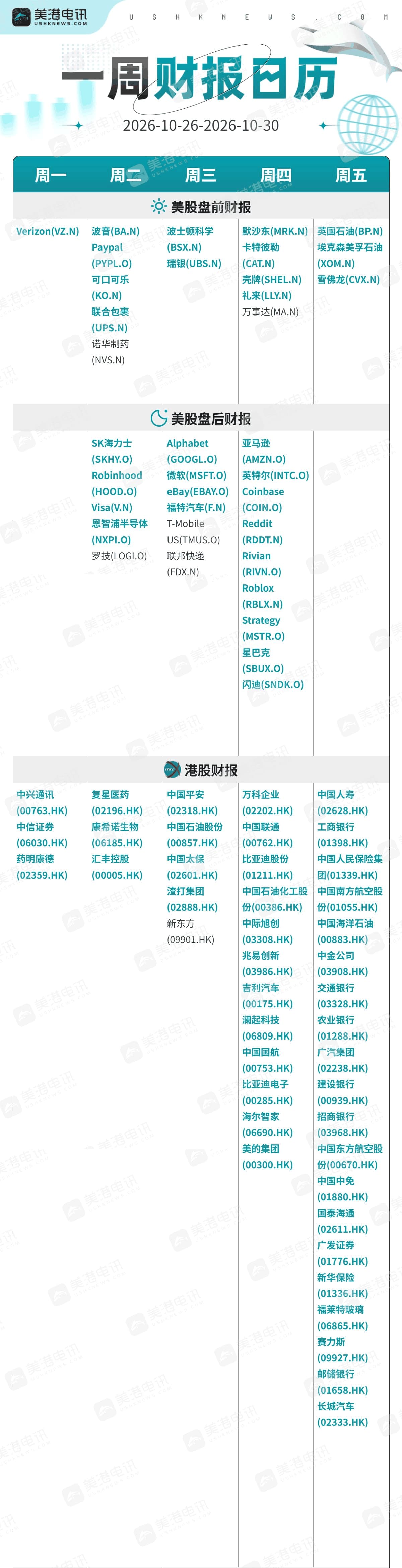
In addition to the cloud giants, there will be several chip and traditional industry leaders releasing their financial results next week on the U.S. stock market. On Monday, telecommunications giant Verizon will take the lead; on Tuesday, before the market opens, watch Boeing and Coca-Cola, and after the market closes, pay attention to Visa; on Thursday, before the market opens, there are Eli Lilly and Merck, and after the market closes, chip giant Intel; on Friday, before the market opens, it will be the three major energy giants: ExxonMobil, Chevron, and British Petroleum. The positive impact of high oil prices on upstream cash flows will be directly reflected in their financial report figures for that day.
In the end, the performance of the three major cloud giants may determine the direction of the US stock index next week: whether to increase capital expenditures and where to allocate them. If spending continues to rise while revenue realization lags behind, high discount rates and shrinking free cash flows will work together to suppress valuations; conversely, as long as order growth continues to outpace revenue, the core theme of AI may be able to hold on a bit longer.
Recommended Reading More
- 13 minutes ago: The more photovoltaic power, the more frequent negative electricity prices? Europe's insufficient energy storage is exacerbating intraday price mismatches.
- 1 hour ago, interest rate hike expectations collided with fiscal discipline: UK long-term government bonds showed resistance to decline. What is the market betting on?
- 3 hours ago, from selling tech stocks to widening credit spreads: Concerns about the return on investment of AI are entering the bond market
- 4 hours ago, copper prices approached record highs, yet South Korean smelters are considering reducing production: it turns out that the real shortage lies in copper concentrate.
- 5 hours ago: US life insurance AI investment increases to $85.2 billion: The real risks may lie beyond tech company bonds.