The latest conflict between Elon Musk and Ukraine has highlighted the key role of his company's Starlink satellite internet service in Kyiv's defense against the Russian invasion. Russia invaded Ukraine unprovoked in 2022.
This also exposes the disadvantages of relying on a single satellite internet provider, although currently, no other options can compare with SpaceX's Starlink and its military-grade Starshield services.
On October 14, Ukrainian officials accused SpaceX of weakening the country's self-defense capabilities.
They stated that SpaceX and the United States suddenly imposed speed restrictions on Starshield without prior warning. SpaceX described Starshield as a “security satellite network for government agencies” and claimed that it “utilizes Starlink technology.”
These changes have weakened the wireless internet connections for drones and other aircraft used by the Ukrainian military in combat against Russia, which can reach speeds of over 100 miles per hour. A senior Ukrainian commander told The New York Times that these restrictions have cost his forces over $1 million and delayed missions by three days.
Both Elon Musk and U.S. President Donald Trump have criticized Ukrainian President Volodymyr Zelenskyy, yet both have avoided taking responsibility for the communication disruptions in this war-torn country.
The Wall Street Journal reported on Tuesday that Musk personally ordered these service changes and had discussed them with Trump before implementation. Trump insisted on Wednesday that he “was not involved.”
Robert Wiseman, co-chairman of the watchdog organization Public Citizen, stated that this situation is "extremely dangerous" and has raised anti-monopoly and security concerns regarding Musk's control over "a key means of communication."
In an interview, Weisman said, "People are concerned about the political impact of oligarchy, as well as its economic effects, and this is an example of that. It's not just that Musk can suppress other voices; he can also cut off a country's communications under the guise of national security. No one should possess such power or authority."
These interruptions have prompted members of both parties in the United States to call for an investigation into Musk's actions, including requesting that he may testify under oath.
Texas Republican Senator John Cornyn told CNBC on Wednesday that he does not believe Musk would take action without at least the tacit approval of the White House, and called attempts to restrict Ukraine's Starlink services "frankly shameful."
Cunning said in the program “Squawk on the Street”: “There is a reason why Europe has maintained relative peace since World War II, and that is the alliance between the United States and its European allies. I believe that any action that weakens or damages this alliance is a major mistake.”
Washington State Democratic Representative Pramila Jayapal also called for an investigation into this matter, writing in a social media post on Wednesday: "No billionaire, especially those who have received massive contracts from our government, should have the power to unilaterally decide to cut off communications and weapons in a war that is crucial to both the United States and Ukraine."
During this week's financial report conference call, management did not mention this matter, nor did analysts ask any questions regarding it.
The dominant position of Starlink
There are not many options for governments or companies that wish to find alternatives to Elon Musk, SpaceX, and their satellite internet services.
Amazon's Leo also provides internet connectivity through a constellation of near-Earth orbit satellites, but despite seven years of advancement, the project has not yet been fully launched. Currently, only 390 satellites are in orbit.
In contrast, data tracked by astronomers Jonathan C and McDowell shows that there are over 11,000 satellites in orbit in the Starlink constellation of SpaceX. Gwen Shortwell, the CEO of SpaceX, stated during a financial report conference call on Tuesday that the Starlink connectivity service has been launched in 174 countries.
Jeff Bezos' space company Blue Origin launched a service called TeraWave in January this year, targeting corporate and government clients. The company plans to deploy the first batch of satellites in the fourth quarter of 2027.
France's Eutelsat is also a competitor to Starlink, with over 600 satellites in orbit. On October 14th, as reports emerged about Musk restricting Ukraine's Starlink services, the company's stock price rose by 23%.
Some countries are researching sovereign satellite communication systems. The European Union is building IRIS ², which is expected to cover hundreds of satellites, but the first batch of launches is not anticipated until 2029.
Independent satellite consultant Christian Freiherr von der Ropp stated that, compared to Starlink, most of these planned systems are unlikely to be “close” in terms of capacity, coverage range, resilience, or cost. He added that the cost, size, weight, and power consumption of the Eutelsat terminal make it particularly unsuitable for battlefield use.
Although SpaceX's connectivity business is already ahead of its competitors, the company also boasts a highly successful rocket launch service that sends satellites into orbit for many of its rivals.
SpaceX is currently gradually discontinuing its main Falcon 9 rocket services for commercial payloads, while simultaneously testing and developing its Giant Starship rocket.
Fon de Ropp stated that many new constellations "may therefore face significant delays and significantly higher launch costs."
This week, Ukrainian and European lawmakers began to explore alternative solutions to Starlink and regarded this issue as a matter of national security.
Fon von der Loppe said that they are concerned that the access to critical communication services could be "interrupted due to Musk's political agenda."
He said, "The level of soft power accumulated by SpaceX among enterprises, governments, and the military is quite considerable, and this is now very clearly evident. Inevitably, this is leading to distrust and accelerating the demand for alternative solutions."
Zelenskyy posted on X on Wednesday stating that he met with Norwegian officials and the Norwegian defense company Kongsberg to discuss air defense systems as well as "work to launch new satellite communication capabilities for our soldiers."
In the early stages of the war, Musk was highly praised for providing Starlink terminals and satellite internet services, but over time, the relationship between this world's richest man and Ukrainian officials has deteriorated.
According to a chapter in Walter Isaacson's 2023 biography of Elon Musk, Musk previously ordered engineers from SpaceX to shut down the Starlink satellite network over Crimea in order to thwart Ukrainian attacks on Russian warships. Musk has disputed this report. This revelation has drawn condemnation from Ukrainian officials, including a senior aide to Zelenskyy, who said that it resulted in the death of Ukrainian civilians.
Mykhailo Podolyak, a senior advisor to Zelensky, wrote on X: "This is the price paid for a cocktail made of ignorance and immense arrogance."
Musk has also repeatedly advocated that Ukraine should reach a "cease-fire" with Russia and cede the strategically important sovereignty of Crimea to Putin.
Elon Musk's attitude towards Ukraine also prompted Canada to decide to cut ties with Starlink. Officials from India and Taiwan have also expressed caution regarding Starlink due to concerns about national security, and tend to use public communication services that are not under the control of SpaceX.
Elon Musk also criticized India's "oligarchs" for slowing down the promotion of Starlink in that country.
He also targeted some potential corporate clients of Starlink.
Starlink has become the leading provider of satellite Wi-Fi services on aircraft, having signed contracts with dozens of airlines, including United Airlines, Alaska Airlines, American Airlines, and Southwest Airlines.
However, Delta Air Lines is one of the few airlines that have chosen Amazon's Leo service.
Earlier this month, Musk posted on X that Delta Air Lines CEO Ed Bastian would "lose his job" for not choosing Starlink. Previously, unverified claims circulated on X that Bastian said to employees, "We don't want to be with Elon Musk. Believe me."
Bastian denied having said such words and told CNBC on October 9th that he is a "loyal fan" of Starlink, and even drives a Tesla.
He said, "All this nonsense about it being just a personal grudge is completely not true."
– CNBC's Elsa Ohlen and Leslie Josephs have contributed to this report.
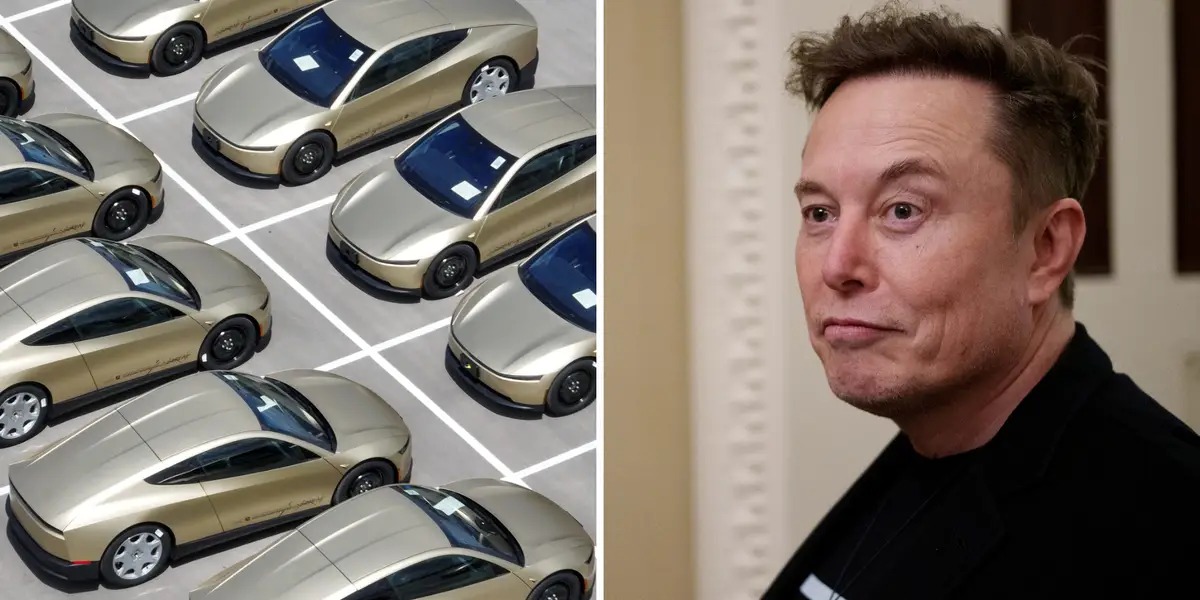
Reportedly, Musk ordered a slowdown in the services of Starlink in Ukraine.