

Either break free from constraints and be more daring, or there's a risk of completely losing the race in artificial intelligence.
This is the clear message that NVIDIA CEO Jensen Huang conveyed to European leaders during his visit to Europe over the past week.
In the past seven days, before the opening of NVIDIA's Berlin GTC conference on Tuesday, Jensen Huang visited France, Sweden, the United Kingdom, and Germany in succession.
During this period, he clearly stated that Europe needs to act more quickly in the field of artificial intelligence and reduce excessive regulatory reliance on this industry.
Jensen Huang most directly articulated this view during a public conversation with German Chancellor Friedrich Merz in Berlin on Monday evening.
When asked how Europe should regulate AI, Jensen Huang stated that security must be of utmost importance, but he also warned that policymakers cannot achieve technological leadership through regulation alone.
Jensen Huang said to Mertes, "If this industry cannot thrive and develop, then there is nothing to regulate." He believes that Germany needs to foster its own AI industry while ensuring that it develops in a safe and responsible manner.
He said that policymakers should focus on regulating AI applications, similar to the regulation of internet-based products, rather than attempting a one-size-fits-all approach to regulating the underlying technologies.
Jensen Huang said, "We should immediately start regulating applications."
Mertes responded that Europe is still working to find a balance between innovation and regulation. The German leader stated that he does not believe that "no regulation at all" is the correct answer, but overly strict rules are also not advisable.
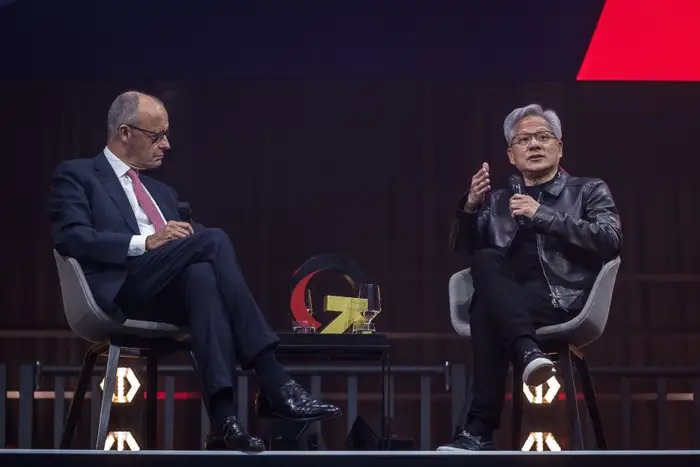
Jensen Huang's response was: "Give Germany a chance. Give this industry a chance."
At the time of this exchange, both Jensen Huang and Mertes viewed AI as a potential solution to Germany's economic downturn. Germany experienced recession in 2023 and 2024.
Jensen Huang stated that Germany's manufacturing industry, engineering expertise, and industrial technology accumulation are all national resources, and AI can help German companies transform these resources into advantages in the next phase of technological competition.
Jensen Huang said, “The next wave of AI is physical.” He refers to robots, manufacturing, automobiles, and heavy industry. “Electronics will never be able to replace atoms.”
This is just as urgent as the message he conveyed in London a few days ago. Jensen Huang told reporters last week that there is a “strange widespread behavior” in the UK.
He criticized the habit of Britons that he described as being prone to indulging in failure.
He said, "You have intelligent people, a great culture, young people, and you are full of vitality. But for some reason, if there are a million reasons to win, you always manage to find one reason not to do so."
He also added, "I think you're overthinking it too much."
These remarks highlight a familiar contradiction in Europe's approach to the AI path. Europe was among the first to establish comprehensive regulations for this technology, including the EU's Artificial Intelligence Act; whereas the United States and China are at the forefront in the development of advanced models as well as in the infrastructure necessary for training these models.
Jensen Huang's company dominates the advanced chip market that drives the craze around AI, so he is clearly not a neutral observer. If governments and companies around the world accelerate the construction of AI infrastructure and deploy its technology, NVIDIA will reap significant benefits from it.
However, regardless of his potential interests in the success of AI in Europe, the message conveyed by Jensen Huang is clear: if Europe spends too much time debating how to regulate AI, it may find that meaningful innovation has already taken place elsewhere.