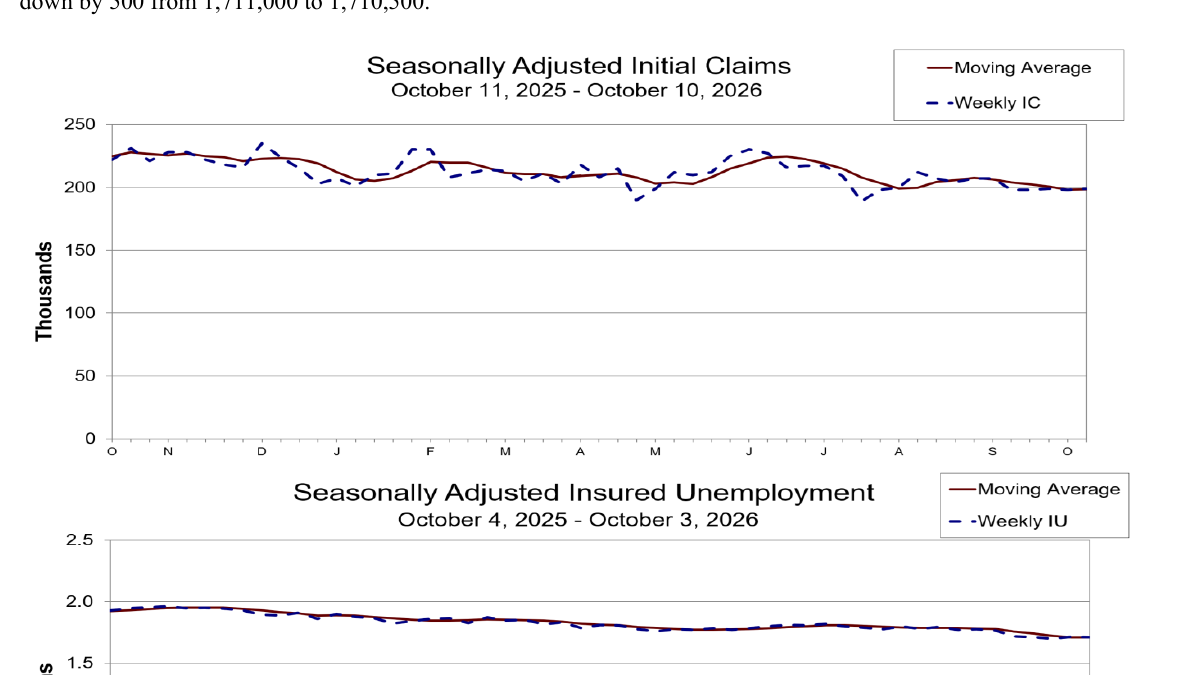


The latest unemployment insurance data released by the U.S. Department of Labor on October 15 did not show any dramatic increases: In the week ending October 10, the number of first-time unemployment claims adjusted for seasonality was 199,000, which is 1,000 more than the 198,000 in the previous week after adjustment; the four-week moving average was 198,500, an increase of 250 people. Compared to the same week a year ago, this week's initial claims are also lower than last year's. For the market, these numbers only support the observation that "the overall number of recent claims remains low" and cannot directly prove that every industry is hiring, nor can they be used to declare that the job market has accelerated again based on such a small change over one week.
There is a detail in the data that is often overlooked: the number of initial job applications from the previous week was revised upward from the initially reported 197,000 to 198,000. If one only subtracts today’s figure of 199,000 from last week’s initially reported 197,000, one would conclude an increase of 2,000 people; however, since the Department of Labor uses the revised base number, the official figure indicates an increase of 1,000 people. Initial job applications are revised at the beginning of each week, and when the headline figures change slightly, it is particularly important to check for changes in the base number. The four-week average smooths out fluctuations from single-week holidays and state-level reports, making it more suitable for observing trends than a single week.
Firstly, please report on layoffs; subsequently, please report on the speed of re-employment.
Initial claims refer to the number of people entering the unemployment insurance system for the first time and are often used as a frequent indicator of layoffs or work interruptions. The same report from the Department of Labor also provides the number of continuing claims for the week ending October 3rd, which, after seasonal adjustment, was 1.71 million, a decrease of 4,000 from the previous week's revised figure of 1.714 million; the unemployment rate among those covered by unemployment insurance was 1.1%, unchanged from the previous week. Continuing claims lag behind initial claims by one week, so it is not appropriate to confuse these two dates as representing immediate changes in the same group of people. A decline in continuing claims may indicate that some people have found jobs, their eligibility for benefits has ended, or there have been other changes in their status, but it is not possible to determine the reasons solely from the total numbers.
This is precisely the duality of initial job applications. The fact that companies are not laying off employees for now is good news for employment resilience; however, if recruitment also slows down, those who are already unemployed may take even longer to find suitable positions, which would present a different picture in terms of the duration of unemployment. Conversely, a surge in initial job applications in a given week due to weather, holidays, or a concentrated wave of applications from large corporations does not necessarily indicate a reversal in the national trend. Only by considering initial applications, continued applications, non-farm employment, job vacancies, and working hours together can one draw conclusions that are not easily influenced by short-term fluctuations in a single week.
The report also lists the unadjusted initial job applications: for the week ending October 10th, there were 190,626 applications, an increase of 19,456 from the previous week, which is about 11.4%. This seems much larger than the seasonally adjusted figure of “only an increase of 1,000 people,” but the Department of Labor explains that the model originally anticipated a seasonal increase of around 18,799 people during this period. The unadjusted figures and the adjusted figures answer different questions: the former represents the actual number of applications received, while the latter attempts to eliminate seasonal patterns for comparison. It cannot be concluded that “official data are contradictory” by comparing the two.
Low-level consolidation does not mean that it is easy for everyone to find a job.
Unemployment insurance claims statistics have a clear coverage range, and not all unemployed individuals are eligible or choose to apply; freelancers, those who have just entered the labor market, and certain circumstances of leaving jobs may not be included in the initial claims. Conversely, some short-term stoppages in work can also be recorded within the application system. Therefore, the number of 199,000 people does not represent the complete demographic of "only 199,000 new unemployed individuals in the United States this week." It is more like a timely alarm that can indicate whether there has been a sudden increase in layoffs, but it cannot provide a comprehensive assessment of the overall quality of employment in society on its own.
The reporting pace in different states may also disrupt the national figures. The Department of Labor lists the unseasonally adjusted applications for each state in an annex to its report, but since inter-state data is affected by population size, industry structure, and administrative processing methods, it is not appropriate to choose just one state with the largest increase to represent the whole country. To determine whether there is a systematic contraction in a particular industry, it is also necessary to consider corporate announcements, regional employment surveys, and subsequent weeks' data. A single-week increase of 1,000 people is very small on a base of nearly 200,000, and the interpretation of this increase should be restrained as well.
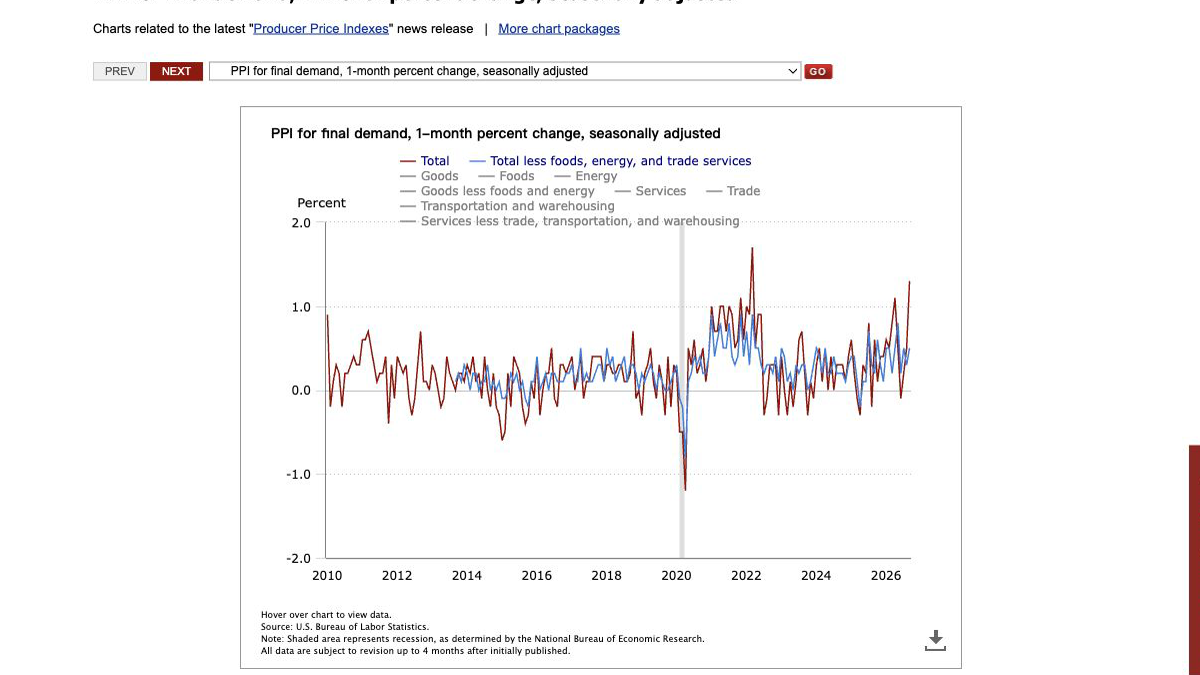
The same is true for discussions regarding interest rates and asset prices. It should be noted that there has not yet been a wave of large-scale unemployment insurance claims, but this does not offset the consumer inflation from the previous day or today's changes in producer prices, nor does it guarantee that wage pressures will remain unchanged. Policymakers focus on the combination of prices and employment, rather than directly inferring the outcome of a meeting from a single piece of high-frequency data. An economy can experience fewer layoffs by companies, slower recruitment, and some increases in living costs at the same time; these phenomena are not contradictory.
Readers should also note two key statistical time points: the initial figures refer to the week ending October 10th, while the follow-up figures refer to the week ending October 3rd; the report was released on October 15th. Presenting these figures as "Today, 199,000 people are unemployed, and 1.71 million people are still unemployed" confuses the dates and also blurs the distinction between the population covered by unemployment insurance and the total number of unemployed individuals. A more reliable approach is to use these figures as part of a weekly trend line, and to wait for subsequent reports and monthly employment data to emerge before assessing whether there is any continuous change.
Next, we should observe whether the four-week average continues to rise, whether there is a sustained change in the number of renewals, and whether next month's more comprehensive employment report will confirm the same trend. What can be confirmed today is that there were 199,000 initial job applications, a four-week average of 198,500, and 1.71 million job renewals, all within a relatively stable weekly range. It would be premature for the market to claim that the labor market has strengthened just because there was an increase of 1,000 people in one week, just as it would be premature to claim that a recession is approaching based on any small upward trend, as these conclusions go beyond the evidence provided by this report.