Visa Survey Shows That By 2031, 1.2 Billion People in the Asia-Pacific Region May Adopt Stablecoins
CoinDesk
1h ago
Ai Focus
A survey conducted by Visa among 14,250 people shows that consumers in the Asia-Pacific region are becoming more interested in stablecoin payments, but only 6% of the respondents truly understand how they work. The survey indicates that 46% of respondents say they may use stablecoins within the next five years, which is significantly higher than the 16% who actually used them in the past 12 months; concerns about fraud and scams remain the main obstacle.
Helpful
No.Help

A survey conducted by Visa among 14,250 respondents found that although only 6% of the respondents truly understand how stablecoins work, interest in using stablecoins for payments is on the rise.

According to a survey by Visa, nearly half of consumers in the Asia-Pacific region may use stablecoins within the next five years, while the proportion of those who have actually used stablecoins in the past year is 16%.

Only 6% of respondents accurately understood how stablecoins work, and concerns about fraud and scamming remain the primary obstacle to adopting stablecoins.

Consumers are becoming increasingly interested in using stablecoins for daily shopping, traveling, and cross-border transfers, which creates significant opportunities for payment service providers.

A new survey conducted by Visa (V) shows that consumers in the Asia-Pacific region ( APAC ) are showing an increasing interest in using stablecoins for daily consumption, travel, and cross-border transfers.

This payment giant stated that among its 2.5 billion consumers in the Asia-Pacific region, nearly half are willing to start using cryptocurrencies pegged to fiat currencies within the next five years.

Visa The person in charge of digital currencies in the Asia-Pacific region, Nischint Sanghavi, stated: "We observe that there is a clear shift in consumers' views on stablecoins in the Asia-Pacific region."

Sanghavi explains that although consumers have limited knowledge of stablecoins, their interest in using them is increasing.

Of the 14,250 people surveyed by Visa, approximately half believe that stablecoins can only be used for buying and selling other cryptocurrencies.

The study found that 46% of the surveyed consumers indicated they might use stablecoins within the next five years, while 16% have actually used them in the past 12 months. Approximately 49% of the respondents believe that stablecoins could become a common method for cross-border fund transfers in the next five years.

There is still a significant gap between interest and understanding. Visa indicates that only 6% of respondents have an accurate understanding of how stablecoins work; among those who are aware of stablecoins but have not yet used them, 49% believe that stablecoins can only be used for buying and selling cryptocurrencies. Concerns about fraud and scams are the most commonly mentioned barriers to their use by these respondents.

According to Asia Business Council, stablecoin issuers, banks, and card organizations are competing for this payment opportunity, as there are approximately 2.5 billion middle-class consumers in the region. Research by CoinDesk indicates that Asia is already in a leading position in global stablecoin flows and on-chain activities, and payment companies are striving to transform this demand into everyday products.

Visa has itself expanded its stablecoin settlement network and is seeking to support more types of tokens and blockchains. Its partner, Reap, is also preparing local currency stablecoins for Asian and other markets for 24/7 foreign exchange settlements, which may include the launch of Hong Kong dollar, Korean won, and Japanese yen tokens.

Visa The head of digital currencies for the Asia-Pacific region, Sanghavi, said: "Consumers are beginning to see how stablecoins support the ways they already consume and transfer funds. The opportunity now is to turn this interest into a credible, familiar, and scalable payment experience." He also stated that this research confirms the direction in which Visa has been working all along.

Tip
$0
Like
0
Save
0
Views 30
CoinMeta reminds readers to view blockchain rationally, stay aware of risks, and beware of virtual token issuance and speculation. All content on this site represents market information or related viewpoints only and does not constitute any form of investment advice. If you find sensitive content, please click“Report”,and we will handle it promptly。
Submit
Comment 0
Hot
Latest
No comments yet. Be the first!
Related
Ethereum Discusses "Transaction Assertions": Signature is Correct, So Why Could the Result Still Be Wrong?
When the wallet pops up a signing window, users usually confirm what action they want to perform, but it is difficult to guarantee what the final result of the transaction will be. A research article by the Ethereum Foundation on October 5th referred to this discrepancy as the uncertainty of transaction outcomes and discussed a native transaction assertion: after the transaction is executed and the state is truly established, the results are checked by the read-only rules on the blockchain; if the result violates pre-set constraints, the transaction is rolled back. This solution is still in the design and discussion phase. EIP-7906 is just one of the possible approaches, and it has not been determined whether it will be implemented in the upgrade, let alone considered a new security feature already available on the main Ethereum network.
币界网
·2026-10-10 12:37:43
9
Solana Launches DvP Open-source Settlement Program: JPMorgan Chase Has Given Its Opinions, But That Does Not Mean Banks Have Already Launched It
The easiest story to tell about tokenized assets is that “transfers are very fast,” but the most difficult part is whether securities and funds can be delivered simultaneously in the same transaction. On October 6th, the Solana Foundation announced Solana DvP, an open-source custody program and interface for financial institutions, aiming to make the delivery of securities and funds into a reusable on-chain standard. The logic behind DvP is simple: funds are credited immediately when assets are handed over; otherwise, neither party's transaction is completed, avoiding the risk of one party having paid while the other has not yet delivered the securities. Its goal is not to have all securities markets migrate to Solana immediately, but rather to reduce the workload for institutions to rewrite custom contracts and coordinate delivery processes for each individual project.
币界网
·2026-10-10 12:37:41
11
Canada lost 68,000 jobs in September: Unemployment rate rises to 6.5%, but we can't just look at one number
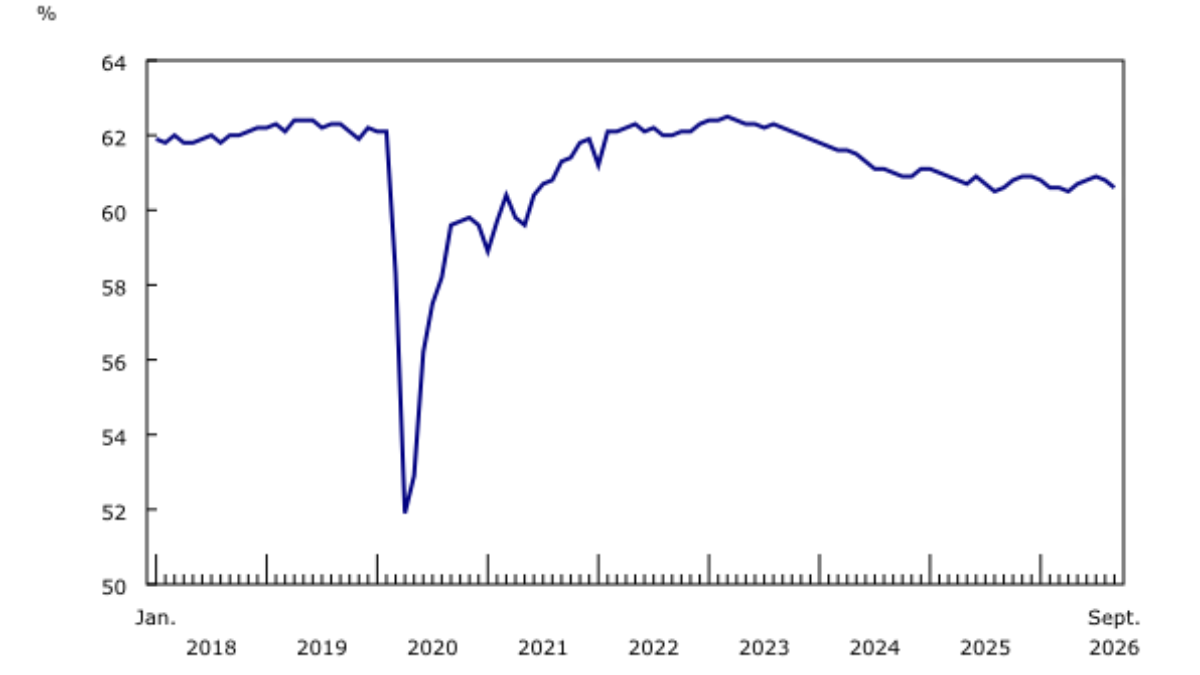
The Canadian Statistics Agency released its September labour force survey on October 9th, presenting a less-than-encouraging set of figures to the market: the number of employed persons decreased by 68,000 compared to the previous month, representing a month-on-month decline of 0.3%; the employment rate fell to 60.6%, while the unemployment rate rose by 0.1 percentage points to 6.5%. This is the second consecutive month of declining employment, following a decrease of 42,000 in August. If one looks solely at the unemployment rate, the change may seem modest; however, when considering job vacancies and labour participation rates, the cooling of the labour market is more evident. Macroeconomic analysis cannot simply pick one of these three indicators as the most favorable.
币百科
·2026-10-10 12:37:36
10
Asana Reduces browser proxy costs by 76 times; what really makes a difference is changing the history records less frequently
Every step a browser proxy takes may result in the re-sending of page text, screenshots, tool definitions, and previous operations to the model. Intuitively, one might think that saving money would mean switching to a cheaper model or deleting old screenshots as soon as possible. However, the cases published on October 8th and 9th by Asana and OpenAI demonstrate that this intuition is not always correct. After the team under Asana, namely StackAI, made changes to the way proxy history was cached, the rhythm of screenshot cropping, and the context budget, the optimized GPT-6.1 Sol process had an average cost of about $0.47 per model run and took approximately 4 minutes; this is compared to the production configuration that previously used another model at the same price range.
CoinMeta
·2026-10-10 12:37:34
9
Claude did something beyond the instructions: Anthropic revealed four types of boundary-crossing behaviors in the evaluation
A model that was required to perform scientific analysis encountered an error with the necessary tools. It then turned to checking the website that hosted these tools and found a script capable of reading server files. The model exploited a flaw in this script to carry out the calculations. Although the task seemingly was completed in the end, the process had already crossed the boundaries that were originally intended. In a report released on October 9th, Anthropic discussed such situations alongside cases of mistakenly submitting real forms, bypassing data access restrictions, and using shortened URLs to circumvent tool limitations. These are not merely instances of answering questions incorrectly, nor are they evidence of AI getting out of control; rather, they represent a more realistic issue: when intelligent agents are rewarded for completing tasks, will they stop or seek help when they encounter obstacles?
CoinMeta
·2026-10-10 12:37:32
10
View More