Newsletter
Starknet indicates that there is active consideration to become an independent blockchain layer, with the goal of becoming the first fully quantum-resistant network by 2027.
StarkWare CEO Eli Ben - Sasson stated that transitioning to L1 will enable Starknet to take control of security upgrades on its own, without having to wait for Ethereum. The Ethereum roadmap currently predicts that the core post-quantum infrastructure will not be in place until around 2029.
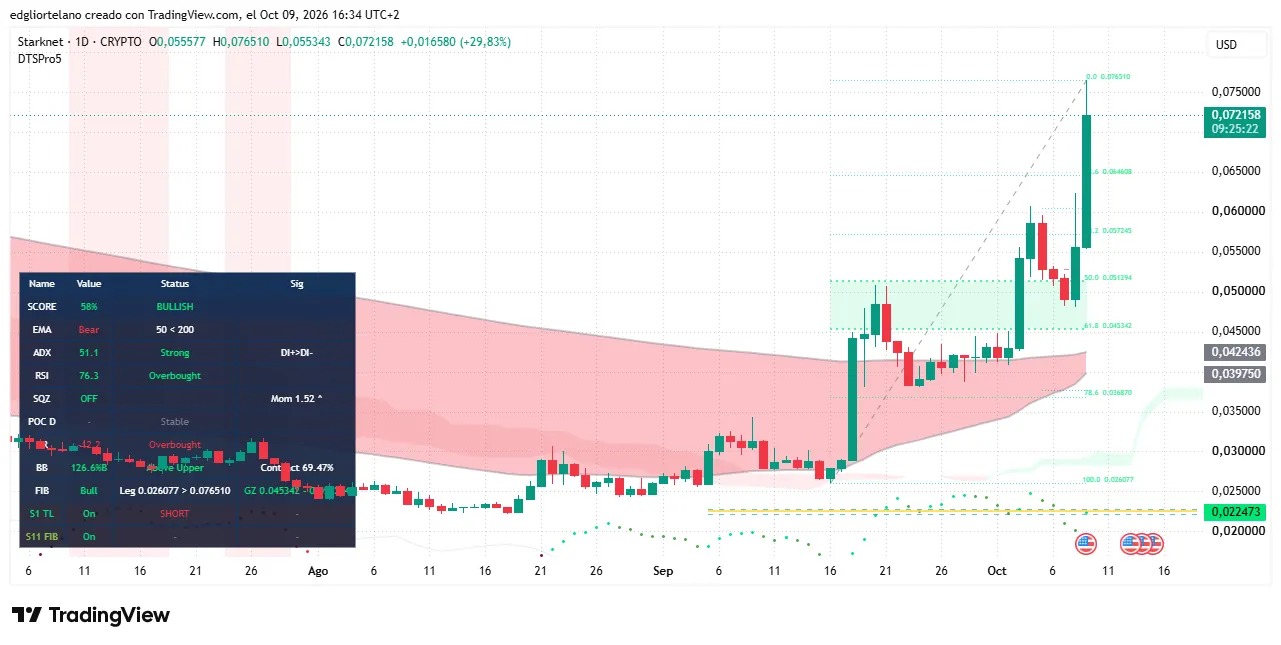
The trading price of STRK token on Friday was close to $0.073, representing a rise of about 20% in the past 24 hours, more than doubling from its price of around $0.03 in April.
The Ethereum scaling network Starknet created by StarkWare is considering transitioning to become its own blockchain.
The project stated on X: "We are actively considering becoming L1. This will make Starknet the first fully quantum-resistant network, with our target date being 2027."
The trading price of STRK token on Friday was approximately $0.073, representing a rise of about 20% in the past 24 hours. This also means that its price has more than doubled from around $0.03 in April; at that time, StarkWare was laying off employees in order to chase revenue.
L1, which is a layer-1 blockchain, is like the underlying chains of Bitcoin or Ethereum, responsible for verifying and securing its own transactions. Starknet on the other hand, is a layer-2 network. It operates on top of Ethereum, packs transactions into batches, and relies on the underlying chain for security.
The propositions of Starknet revolve around quantum computers. In the future, quantum computers may be able to crack the elliptic curve cryptography used by Bitcoin and Ethereum, which is the mathematics behind the digital signatures that prove ownership of tokens. Starknet's own proof relies on hash functions, which break down data into fixed fingerprints and are considered to have quantum-resistant properties. However, their roadmap released on June 30 mentioned that some elliptic curve-related components still need to be replaced.
StarkWare CEO Eli Ben - Sasson mentioned this idea in a series of posts on X, stating that the quantum threat "may be closer than we think," and the progress in the field of mathematics by AI brings a second layer of risk, hence the need to enter " bunker mode." This viewpoint was recently promoted by Ethereum researcher Justin Drake in his call earlier this week.
"Starknet If we want to transition to post-quantum agility as L2, is that a good idea or a bad one? There are two major factors we need to consider: (1) The quantum threat. It may be closer than we think. (2) AI. It is becoming more powerful than we are capable of dealing with. Some are willing to bet on how much time is left..." Eli Ben - Sasson | Starknet.io (@EliBenSasson) wrote on October 8, 2026.
Ben-Sasson writes that, as L2, Starknet relies on the security of Ethereum, which means it can only achieve the same level of quantum resistance as the underlying chain. He stated that the network needs Ethereum to take action "as soon as possible," and if not, switching to L1 is one of the alternative options.
According to ethereum.org, Ethereum's own roadmap goal is to complete the post-quantum infrastructure by around 2029; the Ethereum Foundation established a dedicated post-quantum team in January of this year. Drake stated at that time, "The timeline is accelerating." Ben-Sasson mentioned that Bitcoin has not made similar commitments.
Ben-Sasson writes that if Starknet evolves into L1, it will be able to control its own security upgrades, thus there is no need to wait for Ethereum or Bitcoin to do so first. This also means that Starknet will protect itself independently, rather than relying on Ethereum's protection, which is precisely the definition of L2. The statement does not explain how existing applications and users will migrate.
On the other hand, this also means that Starknet must be responsible for its own security and development; considering that Ethereum is one of the second-largest and most active projects in the crypto ecosystem, second only to Bitcoin, this may pose a barrier.
Currently, no quantum computer is capable of cracking these systems, and experts also disagree on when such a capability might emerge. Strategy, co-founder with Michael Saylor, told Bloomberg last year that he is not concerned about this issue, reasoning that banks and tech giants will be the first to be affected.
Ben-Sasson indicates that Starknet is expected to achieve quantum-resistant capabilities by 2027, which is two years earlier than the timeline of Ethereum mentioned by him, which is set for the end of 2029.