


After Micron Technology released another record-breaking set of financial results, investment bank DA Davidson significantly raised its target price from $2,100 to $3,000, setting the highest expectation on Wall Street. This target price implies a potential upside of about 176%, reflecting an extremely optimistic assessment that the super cycle in storage will continue until 2028, and that changes in the demand side will reshape the cyclical nature of the storage industry.
The core argument of DA Davidson, the head of scientific research at Gil Luria, is straightforward: Artificial intelligence infrastructure requires more memory than any previous technological cycle, and supply cannot keep up. Moreover, the demand for memory will exceed supply in both 2027 and 2028. He specifically pointed out that this time, the demand comes from the largest companies in the United States, such as Amazon, Microsoft, Google, NVIDIA, and Apple, rather than the small and medium-sized clients who often defaulted in previous cycles.
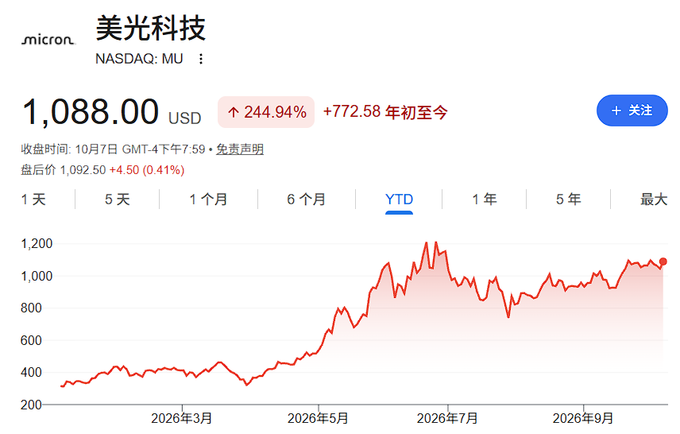
Since April last year, Micron's stock price has risen by approximately 1500%, and its target price of $3,000 is about 19 times its earnings forecast for the fiscal year 2027. In contrast, Morgan Stanley's target price for Micron is only $1,200, with a "overweight" rating, which is less than half of the DA Davidson target price. This significant difference in targets among investment banks constitutes a notable disparity in current market expectations regarding the "length and height" of the storage supercycle.
In the view of Luria, as competitors in the memory industry also shift to long-term contracts, the structural volatility of traditional storage cycles is generally decreasing. The underlying implication of this judgment is that the framework by which the market has previously priced Micron based on the logic of "cyclical stocks" may face a systematic re-evaluation.
Supply and demand analysis behind $3,000
The bullish stance on Luria is based on a technical fact: the importance of memory to the performance of the AI system is rapidly increasing. He wrote in his report:
"Memory is a key factor in improving the performance of artificial intelligence. Artificial intelligence models with more memory can produce better results, run faster, and have a longer context window."
DA Davidson asserts that memory demand will exceed supply in both 2027 and 2028, emphasizing that this is a structural shift rather than a cyclical increase.
Micron's own performance and statements corroborate this judgment. The company's management expects sales and prices to rise by 2028, stating that "Micron is on a growth trajectory for the next 3-5 years, which is precisely the part that the market has not yet recognized."
In the most recent quarterly financial report, Micron's revenue reached $54.2 billion, a year-on-year increase of 379%, and its gross margin soared to 87%. The company previously revealed that data center customers' purchasing intentions account for about 150% of the committed supply volume, and the tight supply-demand situation is expected to continue beyond 2027.
Demand-side transformation: from defaulting customers to tech giants
The most disruptive argument in the Luria report is the change in the structure of the demand side. He writes:
"Unlike in previous cycles, this time the demand comes from the largest companies in the United States – Amazon, Microsoft, Google, NVIDIA, and Apple – rather than those that frequently default on their obligations."
This change directly points to the root cause of the long-term pressure on valuations in the storage industry. Traditionally, storage chips have been regarded as typical cyclical stocks, with profits and stock prices fluctuating sharply with supply and demand cycles, and the market is only willing to assign lower valuation multiples to them.
If demanders shift from scattered small and medium-sized customers to technology giants with strong credit and clear capital expenditure plans, and if the industry generally moves towards long-term supply agreements, the predictability of profits will significantly increase. Micron has signed 26 strategic customer agreements ( SCA ), with remaining obligations of about 150 billion US dollars, and by 2027, over 75% of its output has been committed by customers.
Expectation Gap and Risk: Disagreements among Investment Banks over "Downgrading Specifications"
The current most apparent disagreement on Micron among Wall Street investors lies between the $3,000 target set by DA Davidson and Morgan Stanley's $1,200 target. If Luria's assessment of supply-demand imbalance holds true, there is still room for Micron's stock price to rise; however, if the capital expenditure race on the supply side leads to an earlier release of production capacity, the current stock price may have already factored in most of the positive factors. Manufacturers such as Samsung, SK Hynix, Micron, and ChangXin Technology are all accelerating their production expansions, and the timing of when this new capacity is released will be key to verifying the strength of this super cycle.
Luria specifically refuted the "downgrading" theory in the report – that is, chip manufacturers such as NVIDIA reduce memory usage on each AI processor, which was interpreted by some investors as a bearish signal. He used the automotive industry as an analogy:
If Tesla reduces the battery capacity of its vehicles by half due to a surge in demand but doubles sales, it could ultimately earn more. Under such a framework, reducing memory usage could lead to an accumulation of demand in future product cycles due to decreased performance.
In addition, the class-action lawsuits for price manipulation that Samsung, SK Hynix, and Micron are facing in the United States have also added uncertainty to the industry's supply behavior. In the future, we can pay attention to the progress of Micron's new production capacity expansion, as well as the mass production progress next year.