

Purchasing stocks, bond funds, or ETF has for a long time been the only way for most people to build their investment portfolios. BlackRock In collaboration with Ondo Finance, we now offer a preview of another approach: packaging an entire investment strategy into a blockchain token that investors can directly hold in their wallets, thus taking the tokenization of investment portfolios beyond the stage where they typically consisted of a single asset.
According to CoinDesk, the world's largest asset management company, BlackRock, has designed three model combinations for Ondo's Intelligent Portfolios product, and represents them on the blockchain as a single token, rather than a basket of assets that investors hold, manage, and rebalance separately.
BlackRock and Ondo Finance launch tokenized investment portfolios
The core of this collaboration is very simple: investors no longer need to purchase and rebalance various assets separately; instead, they hold a token that represents the entire strategy. BlackRock is responsible for designing the underlying portfolio, while Ondo tokenizes it.
Focus on a combination strategy of returns and growth
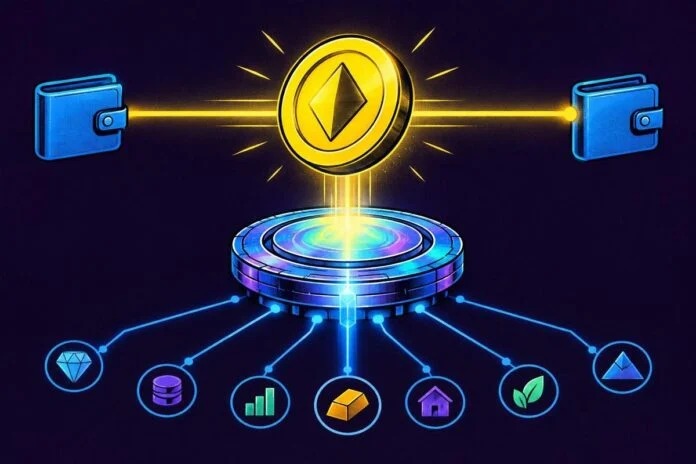
According to CoinDesk, these three tokenization combinations are built around high returns, decentralized growth, and high growth respectively. Crypto Briefing states that these products – High Income ( BLKHIon ), Diversified Growth ( BLKDIGon ), and High Growth ( BLKGRWon ) – are open to eligible non-U.S. investors and can be traded peer-to-peer between wallets, exchanges, and decentralized platforms including 1inch. Crypto Briefing also indicates that under this arrangement, BlackRock authorizes its portfolio construction schemes and charges fees from the underlying funds it sponsors, but does not directly assume obligations to token holders in the contract.
How Tokenization Enhances Portfolio Characteristics
Putting the portfolio itself on the blockchain, rather than just the assets within it, endows it with characteristics that traditional funds do not possess. CoinDesk states that such tokens can be transferred between wallets and platforms, maintaining their visibility on the blockchain, and in the future, they may be used as collateral for loans or integrated into other financial products.
Moving from the tokenization of a single asset to a higher level
To date, most tokenization activities have focused on a single asset class: government bond funds, private credit, stocks, and ETF. BlackRock and Ondo's products target different levels: they package these assets into a set of strategies and then tokenize the strategies themselves. According to CoinDesk, the crypto investment firm Pantera describes this shift as "moving from individual securities to online investment portfolios," and adds that for investors, the actual change is that they need to manage fewer positions and make fewer rebalancing decisions on their own.
There is already a considerable market behind this idea. According to data from Broadridge, as of June, model portfolios – that is, pre-built fund portfolios used by wealth management institutions – held approximately $9.8 trillion in assets. Lisa O, the head of Global Model Portfolio Solutions at BlackRock, summarized the collaboration with Ondo in a statement quoted by CoinDesk as follows: "Tokenization has created new ways to deliver portfolio strategies through digital infrastructure."
Other companies are also making similar attempts. In August, Bitwise and Coinbase, in collaboration with Glider supported by a16z, launched Automated Token Portfolios, which allows eligible non-U.S. investors to track a tokenized stock basket selected by Bitwise. The software from Glider automatically rebalances to maintain the target configuration. Ondo involves encapsulating exposures into a transferable token; Bitwise keeps individual tokenized stocks in investors' own wallets, with the software managing the portfolio proportions. Although the mechanisms differ, they both point towards the same outcome: portfolio management is becoming software that runs directly on blockchain assets.
Impact on the Future of Asset Management
The signal that these products truly convey may be a change in the composition of investment portfolios, rather than just a change in the method of purchasing. ARK Invest President and Chief Operating Officer Tom Staudt stated in an interview with CoinDesk that traditional investment portfolio models were born in an era when ordinary investors had far fewer options – private equity, private lending, and crypto assets were largely unavailable, and the barriers to entering international markets were also much higher. Tokenization may put more of these types of investments on the same digital track.
Staudt also mentioned the amplifying effect of artificial intelligence: “It’s of course great to have AI tell you about a perfect investment portfolio, but if you don’t have access to those assets, it doesn’t really make much sense,” he told CoinDesk, and added that blockchain and tokenization “will obviously open up funds, strategies, asset classes, and jurisdictions that are not currently available to everyone,” calling this an “upgrading of democratization to a new level.”
Ondo, the person in charge of portfolio products, described a more automated end state in an interview with CoinDesk in June: "Our ultimate state will be a portfolio that is professionally managed, runs in real-time, and adjusts according to market conditions and data changes." He stated that to achieve this, there is a need for a broader universe of on-chain assets, principal broker infrastructure, as well as asset management strategies that can run natively on blockchain networks.
The Chief Commercial Officer of blockchain Tempo, supported by Stripe, stated to CoinDesk that he expects the disruptive impact of tokenization to become apparent a few years later than that of stablecoins. Stablecoins have moved cash onto the blockchain; whereas tokenization is moving more investable assets onto the blockchain as well. He said that when the two are combined, developers can create "very interesting new financial experiences," and compared this moment to the era when new banks emerged after underlying payment infrastructure became more readily accessible.
This article was generated with the assistance of artificial intelligence and has been reviewed by an editorial team.