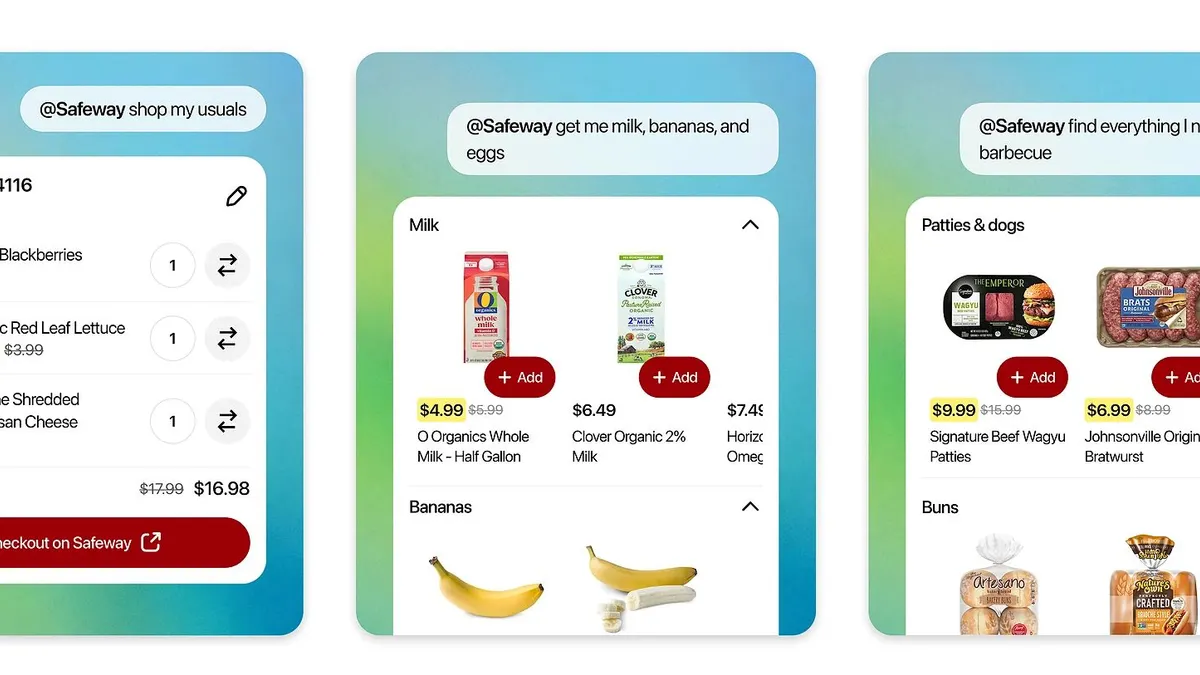


For a simple order like "Four of us are having pizza tonight," it's not difficult for AI to create a recipe; the challenge lies in finding ingredients in nearby supermarkets, adding discounts to the shopping cart, and then handing the order over to the actual delivery provider. On October 1st, OpenAI announced an expanded partnership with a US retailer Albertsons Companies, placing the consumer-facing Safeway shopping portal and the company's internal AI application within the same collaborative framework. The Safeway plugin wasn't just launched in October: Albertsons had already been announced for availability in August. Users can start by selecting items from recipes, photos, digital lists, or even a simple daily need. The system matches products and offers, ultimately redirecting them to checkout (Safeway). The final step is not the user's own payment (ChatGPT); this boundary determines where transaction responsibility lies.
Albertsons has multiple brands under it, including Albertsons, Safeway, Vons, Jewel-Osco, etc. The official claim is that there are over 2,200 stores, serving more than 36 million customers per week. The new experience will first be implemented in Safeway, with plans to extend it to other brands in the future; however, this does not mean that all stores and brands have been integrated yet. This collaboration covers both the internal ChatGPT Enterprise system and the consumer-facing shopping app, but the data, permissions, and metrics used by each are different, so it cannot be concluded that AI has fully taken over retail.
From the idea at the dining table to the product in the shopping cart, there are inventory, price, and alternatives in between.
Traditional searching usually starts with the product name: you first decide what you want to buy, and then search for it one by one on the page. For dinner scenarios, consumers often do the opposite; they know the number of people, budget, dietary restrictions, and time in advance, but haven't decided on the specific products yet. The new process described by OpenAI allows users to start with a requirement such as "arranging a pizza night for four people." ChatGPT then displays relevant products and available discounts, and helps to build a shopping cart, before proceeding to Safeway to complete the order. This approach hands over the initial demand expression and product selection to the dialogue interface, without changing the fact that the retailer is still responsible for processing payments, fulfilling orders, and providing after-sales service.
For shopping advice to be truly useful, it can't just seem knowledgeable in language like someone who knows how to cook. When a certain type of cheese is out of stock, is the substitute suitable in taste and price? Are coupons only valid for specific accounts? When a user uploads a photo of a recipe, is there any ambiguity in the system's recognition of the ingredients and portions? If the advice in the conversation is for one product, but another specification is displayed on the checkout page, the friction doesn't disappear; it just moves from the search stage to the verification stage. These issues cannot be automatically resolved by models that are "better at chatting"; they rely on real-time connections between retailers' products, inventory, promotions, and fulfillment systems.
OpenAI The announcement does not provide data on the conversion rate for this entry point, the increase in cart value, or the success rate of out-of-stock item replacements. Therefore, "helping users move from the idea of dinner to checking out" can be considered a demonstrated product process, but it cannot be directly claimed to have proven sales growth. To measure its effectiveness, at least three sets of figures need to be distinguished: how many people who initiated the conversation actually added items to their carts, how many of those who added items to their carts completed the checkout process, and the proportion of orders that encountered errors or post-sale issues. Retailers are more concerned with whether users ultimately obtain what they expected, rather than the number of conversation rounds.
Internal efficiency and external shopping are two different matters; they cannot be summarized by the same success story.
The other half of the collaboration comes from within the company. The selected team uses ChatGPT Enterprise and applications built on OpenAI API to explore scenarios such as retail technology development, product recommendations, and promotional insights. The announcements use phrases like "expanding usage," "exploring," and "establishing replicable practices in key areas," indicating that the deployment progress varies across different functions. To claim that a retail group with over 2,200 stores has fully completed the AI transformation is not only inconsistent with the disclosed information but also obscures the most complex implementation issues faced by chain retail.
Product recommendations particularly require a division of labor between predictive models and generative AI. The predictive system can estimate demand based on historical transactions, seasonal patterns, and store data, while the generative interface is responsible for explaining the reasons behind the recommendations, assisting employees in making inquiries, and organizing the presentation of these recommendations. If a promotional suggestion seems reasonable but factors such as profit margins, shelf life, or local supply constraints are not taken into account, businesses may end up with attractive copywriting but poor decision-making. It was announced that both parties are integrating predictive models with generative AI to help businesses obtain more easily understandable, data-driven suggestions; however, "integrating" does not mean that there is already a unified system that automatically makes promotional decisions in all stores.
data boundaries are equally crucial. Preferences for recipes, frequently purchased items, and budgets can make recommendations more tailored, but they may also expose private information such as family structure and health preferences. Transactions moving from ChatGPT to Safeway indicate that information is flowing between the two services. Ultimately, consumers should be clear about which preferences are being saved, which product information comes from retailers, and who to contact in case of errors. The announcement does not disclose the full details of the data flow and privacy settings; therefore, it cannot promise on behalf of either party that the information "will never be used for other purposes."
This case is worth paying attention to because it brings the excitement of generative AI to a verifiable retail chain: users make requests, products are matched, discounts are offered, baskets are created, and merchants complete transactions. There are potential pitfalls at every step. For now, what can be confirmed is the entry point for Safeway and the scope of cooperation between both parties; other Albertsons brands are part of subsequent plans, and their effectiveness will depend on actual orders and user experience. Instead of shouting "AI changes shopping," it's more productive to focus on a simple question: after users decide what to eat for dinner, can they get that dinner home with less effort and fewer mistakes?