

On September 30th, Polygon introduced its Checkout product, which integrates cryptocurrency payments into the existing checkout pages for merchants. The routing of this solution is handled by Polygon OMS. Consumers can choose to pay from supported wallets, assets, and chains, while merchants can select the cryptocurrency or fiat currency they wish to receive as the settlement method. In the past, the inconvenience of merchants having to convert customers' funds into a specified chain's USDC before acceptance (as required by USDC) has now been streamlined to backend processing. The release of this product outlines its design direction, but it does not mean that a large number of merchants have already adopted it, nor should the sample orders displayed on the pages be considered as actual sales data.
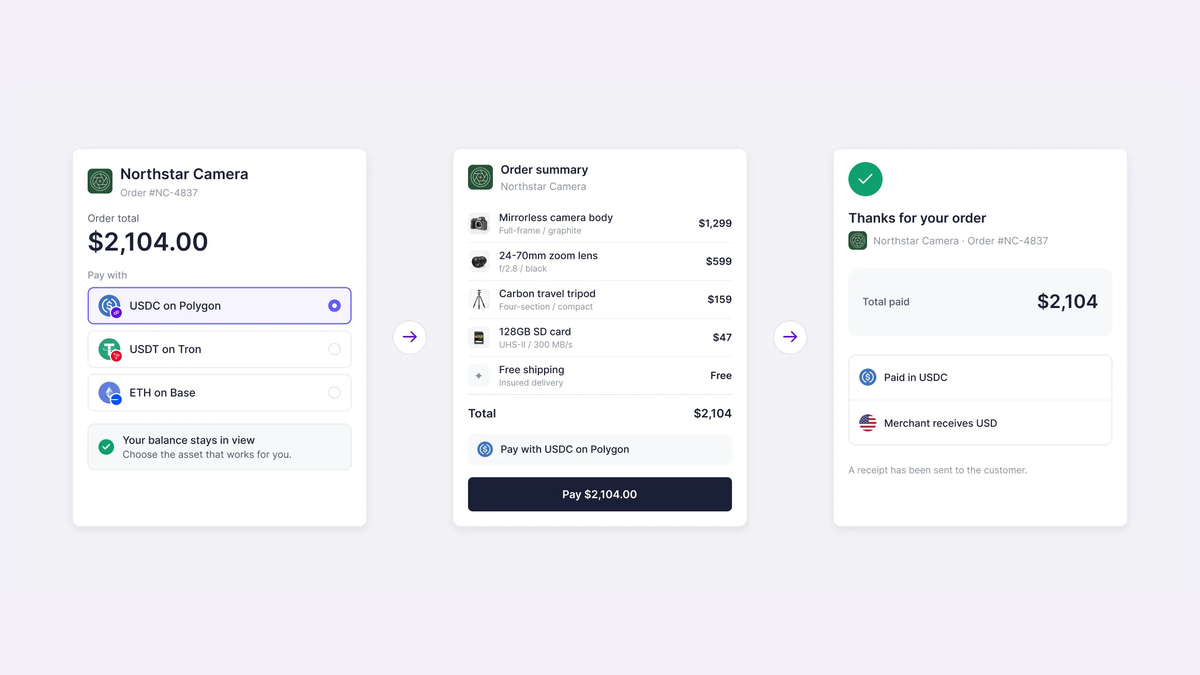
The official demonstration used a camera order priced at $2,104 to show the options that customers see on the checkout page as well as the asset conversion process. This is a illustrative case to explain how the product works, not an actual transaction that has been verified. When reporting on such products, it is easy to confuse smooth interaction diagrams with large-scale transactions. What really needs to be tested is whether the assets in the users' hands have sufficient liquidity, whether the exchange quotes are transparent, whether the network fees are reasonable, and whether the merchants can receive the payment on the agreed amount and time.
One less currency exchange step for the front end, but several more layers of responsibility for the back end.
The process outlined by Polygon includes generating payment requests, displaying the customer's available balance, confirming transactions, and verifying payments before the merchant fulfills their obligations. It also provides a mode that includes “Pay with Crypto” placed next to the merchant’s existing payment methods, with the intention of reducing the cost of modifying the checkout page. For users, the experience should be similar to selecting a payment method, rather than having to buy a certain token from an exchange first and then transfer it across chains. For merchants, the key considerations are not which chain the customer uses, but rather easy final settlement and stable income.
But hiding complexity does not mean that it disappears. The system may need to identify balances across multiple chains, estimate routes and fees, and protect the amount received by merchants in the face of price fluctuations. If a user's transaction has been initiated but confirmation is slow, merchants cannot assume that the funds have been credited just based on a wallet pop-up. If a quote expires or the exchange route fails, it is also important to clearly inform the user of the order status and avoid duplicate deductions. Checkout is a high-frequency process with very low tolerance for errors; the quality of the product is ultimately determined by exceptional scenarios.
The statement that consumers "can use any asset to make payments" must also be understood within the scope of supported options. Not all tokens, wallets, and blockchains in the world are already integrated, and the liquidity and security of the same asset can vary across different networks. While the product copy emphasizes freedom of choice, it is still necessary to publicly list each available asset, region, blockchain, and settlement method when the service is launched. Especially when involving fiat currency settlements, there will be additional requirements such as cooperating with payment institutions, bank accounts, identity verification, and local regulatory compliance, which cannot be automatically fulfilled solely by on-chain protocols.
Official materials also compare encrypted payment settlement with bank card chargebacks. Transactions confirmed on the blockchain generally cannot be directly chargebacked by the cardholder like some card transactions, but this does not mean that merchants are exempt from refund obligations, dispute resolution, or consumer protection responsibilities. Issues such as undelivered goods, fraud, or duplicate deductions still need to be addressed; it's just that the mechanisms and allocation of responsibilities differ. Treating "irreversibility" as a reason for merchants to avoid after-sales service can harm the long-term trust in payment products.
Whether a product can move beyond the demonstration stage depends on four key financial aspects for merchants.
The first item is the total cost. What merchants are concerned about is not only the Gas fees on the blockchain, but also the exchange rate differences, routing service fees, payment collection channel fees, and the time required for financial reconciliation. If encrypted payments merely replace bank card fees with more difficult-to-estimate hidden costs, then the motivation to use such systems would be weak. The second aspect is the certainty of funds arriving: whether merchants can obtain a reliable confirmation before shipping, whether they have to bear any changes in asset prices, and who will compensate in case of network congestion.
The third point is customer experience. If the processes of wallet connection, signing, and network switching are too complicated for consumers, the conversion rate may decrease. Compared to existing card payments or local transfers, the advantages should be reflected in the proportion of actual users who complete the payment, rather than just in the number of steps displayed on the page. The fourth point is compliance and risk control: merchants need to be aware of who is responsible for verifying the source of funds, adhering to sanctions rules, handling refunds, and managing tax records. Big brands will not overlook these responsibilities just because of a single demonstration.
Polygon has previously released other products related to payments and stablecoins. The difference with this new Checkout is that it is specifically aimed at the merchant front-end checkout process, attempting to decouple consumer asset preferences from merchant payment collection preferences. It will be a new tool in the competition for payment infrastructure, rather than an announcement that cryptocurrencies have become the mainstream payment method for e-commerce. The next valuable pieces of evidence would be the actual merchants adopting it, the success rate of real transactions, as well as data on processing times and fees. For now, what is certain is that the product and its process have been announced; however, the extent of market adoption remains to be verified.
Merchants also need to integrate the checkout process into their existing business operations. The order system must be able to match each blockchain transaction with the corresponding order, the finance department needs to handle exchange rates and refunds, and customer service should be able to explain the reasons for payment failures or waiting for confirmation. If these back-end steps still require manual verification for each transaction, even if the front-end user experience is smooth, it may not be possible to scale up the business. For consumers, the best payment experience is not about seeing more technical jargon, but rather having a clear understanding of how much to pay, when the payment will be completed, and how to get assistance if problems arise.
In addition, the tax and accounting treatments for encrypted asset payments vary from country to country. Even if customers see prices listed in US dollars, when making a payment by selling another type of token, individuals may need to record the disposal of assets, and merchants must also record the exchange rate at the time of the transaction. Products that can provide clear documentation will be more valuable than simply increasing the number of supported tokens. The flexibility of technical approaches ultimately needs to be reflected in financial statements that ordinary financial personnel can verify.