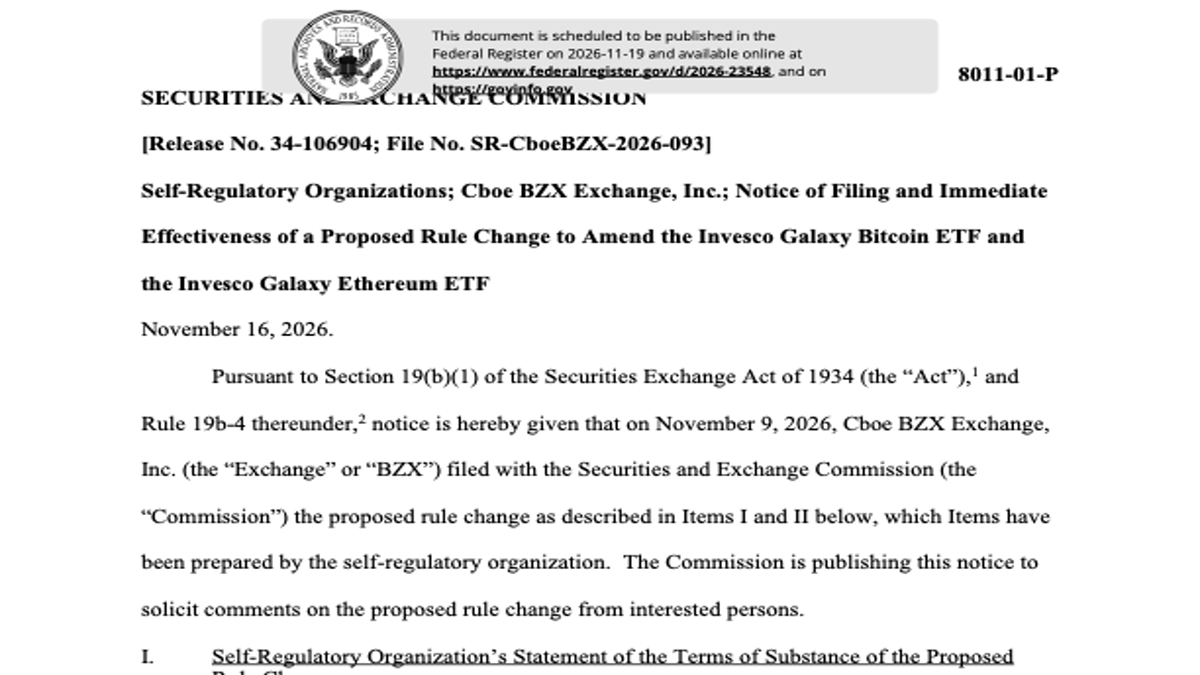


Invesco Galaxy Bitcoin and Ethereum ETF will be changing their listing rules, rather than launching two new funds. A regulatory announcement published on November 19th in the United States indicates that Cboe BZX will adopt common listing standards for the two existing products, and SEC has been exempted from the waiting period for implementation.
The document number for this announcement is SR-CboeBZX-2026-093. BZX was submitted on November 9th, SEC marks the announcement date of November 16th, and the publication date in the Federal Gazette is November 19th. These three dates correspond to submission, announcement, and publication, respectively, and cannot be combined as "first approved on the 19th".
The same rule, but the basis for listing has changed.
Two products were previously listed in accordance with individual approval orders under rule 14.11(e)(4) of BZX, corresponding to Bitcoin and Ethereum exchange-traded products approved in 2024, respectively. The announcement states that they are now traded on that exchange, and the new documents address the transition from individual approval orders to revised general standards.
The general standards refer to a set of common listing conditions applicable to qualified commodity trust shares. For these two funds, what has changed is which set of regulations they will rely on to continue to be listed; the text does not announce any new fundraising, nor does it provide information on net asset value, share price, or net capital inflow.
The announcement cited two revisions to the rules: in September 2025, the adoption of common listing standards for commodity trust shares was approved, and in July 2026, revision 14.11(e)(4) was made. This application utilizes these existing standards and does not create a new category specifically for these two funds in November.
This point is related to how we should interpret regulatory news. There have been instances where ETF has transitioned from one listing basis to another, which is different from the process of a new cryptocurrency obtaining its first listing permission or a fund starting new investment activities; these are distinct factual scenarios. Just by looking at the phrase “immediately effective” in the title, one might easily mistake a procedural change for an expansion of the product’s capabilities.
Effective immediately, there is also a window that can be paused.
The documents are submitted in accordance with Article 19(b)(3)(A) of the Trading Regulations and Rule 19b-4(f)(6). It is announced that such rule changes usually have a 30-day implementation grace period. The exchange has requested an exemption to implement them immediately.
SEC agrees to this exemption in this document on the grounds that it allows the shares to continue to be listed and traded without introducing new regulatory issues, and believes that it is in line with investor protection and the public interest. Therefore, the change is designated to be implemented upon submission and cannot be described as still awaiting SEC's initial decision on whether to allow listing.
However, the implementation does not end the regulatory process. SEC retains the power to temporarily suspend changes for up to 60 days after submission, under circumstances such as public interest, investor protection, or the needs of transaction law; if a suspension is initiated, a procedure for deciding whether to approve or reject it will be commenced.
The 60-day period mentioned here is calculated from the date of submission. The publication date of the announcement is merely the time when the public becomes aware of it in the Federal Register. For readers who are tracking the status of the regulations, it is more reliable to first verify the document number and submission date, and then check for any suspensions or subsequent procedures, rather than relying solely on the news release date to determine the timing.
The continuous listing requirements do not disappear with the switch.
It has been announced twice that each trust will meet the requirements of the revised rules and must comply with the continuous listing standards. The exchange cites reasons such as ensuring the continued trading of shares, promoting competition among exchange-traded products, and protecting the interests of investors and the public market.
These claims about competition and the public interest are statutory justifications provided by the exchanges. The document does not estimate how much cost savings new standards will bring to investors, nor does it link these savings to higher returns. To discuss costs or benefits, additional information regarding the corresponding products would need to be disclosed separately.
For readers who already hold these two ETF, the most practical point to note is that this announcement does not authorize any new pledging services, nor does it promise to reduce the fund fees. The main focus of this announcement is on listing criteria and ongoing compliance; one cannot infer from the phrase "Ethereum ETF" that the pledging earnings have already been incorporated into the fund.
Similarly, the announcement does not specify that the fund has begun to hold new crypto assets, nor does it provide the scale of spot buy orders, nor does it disclose any changes in investor subscriptions and redemptions. From this, it can be seen that the role of this document in assessing holdings is primarily to clarify the regulatory status of the product; it cannot be directly converted into an increase in demand for Bitcoin or Ethereum.
Public comments are open until December 10, 2026. Written data, opinions, and arguments can be submitted. It is required that the documents have the same identification number, and one submission method should be chosen to improve processing efficiency. The exchange stated that no comments were sought or received prior to submitting this change; however, this does not prevent SEC from subsequently seeking public opinions through announcements.
Announcement: It should also be noted that any comments submitted will be made public, so please do not include any personally identifiable information that you do not wish to make public. We also reserve the right to edit or not publish any content that is considered obscene or copyrighted. Participating in the discussion of the rules is a separate action from trading ETF. There is no need to include your account or identification information in the public comments.
What has changed this time is the regulatory framework on which the trading of these two existing products continues to rely; what remains unchanged are the obligations to remain listed and the subsequent review rights associated with SEC. While the products can continue to be traded, there is no guarantee of any additional benefits for the funds provided by this document.