

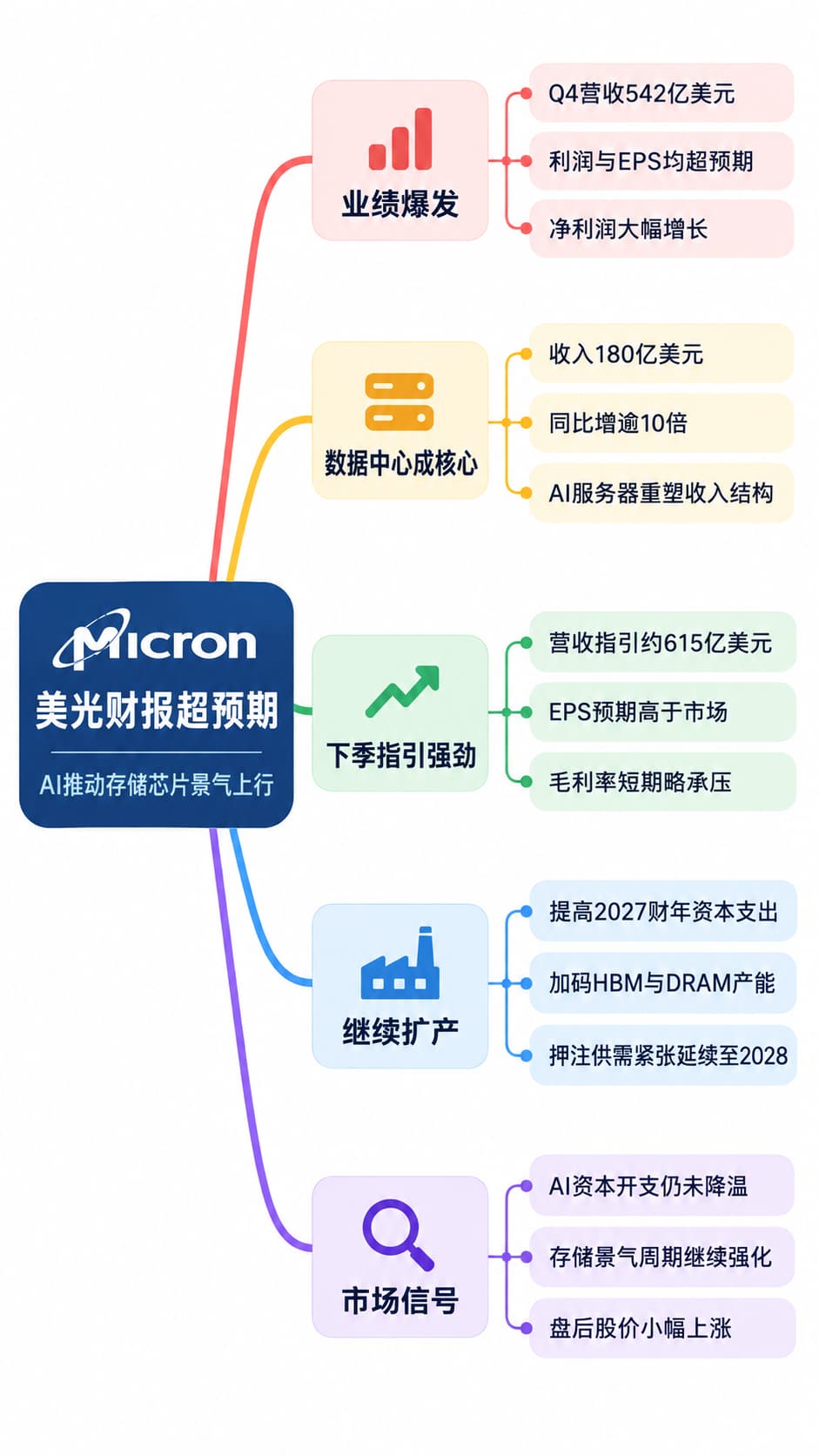
Micron Technology (MU.O)'s latest financial report shows that the construction of artificial intelligence infrastructure continues to drive up demand for storage chips. The company's revenue and profits in the fourth fiscal quarter exceeded market expectations, and it also provided performance guidance for the next quarter that is stronger than Wall Street's forecasts. Revenue from core data center business rose to $18 billion, more than a tenfold increase year-on-year, further indicating that AI servers are reshaping Micron's revenue structure.
In the fourth fiscal quarter as of September 3, Micron achieved revenue of $54.23 billion, which is significantly higher than the $11.32 billion in the same period last year and also exceeded the market expectation of $51.07 billion as surveyed by LSEG; adjusted earnings per share were $33.42, surpassing the expected $31.61. Net profit rose from $3.2 billion in the same period last year to $37.7 billion, with earnings per share at $32.87.
The company's CEO, Sanjay Mehrotra ( Sanjay Mehrotra ), stated that Micron set a record in the fiscal year 2026 and expects its performance to further improve in fiscal year 2027. After the financial report was released, Micron's stock price rose slightly.
Data centers have become the largest business sector.
The most prominent change this quarter comes from the data center business.
Micron's core data center business revenue reached $18 billion, a month-on-month increase of 56%, accounting for about one-third of the company's total revenue. Data shows that the revenue for this business in the same period last year was approximately $1.58 billion, a year-on-year increase of about 1041.5%, which is equivalent to a nearly 11-fold increase from before.
Cloud storage business revenue also reached $16.28 billion; mobile and client business revenue was $13.11 billion, while automotive and embedded business revenue was $6.82 billion.
Micron is currently the only major manufacturer of high-bandwidth memory ( HBM ) with its headquarters in the United States. HBM consists of multiple layers of DRAM stacked together, and it is a key component for NVIDIA, AMD, and other AI accelerators in processing large model training and inference tasks. Major suppliers around the world still find it challenging to fully meet the needs of AI customers at present.
This supply shortage has clearly been reflected in prices and profit margins. Micron's adjusted gross margin in the fourth fiscal quarter reached 87%, compared to 45.7% in the same period last year; adjusted operating profit amounted to $44.64 billion, whereas it was $3.96 billion in the same period last year.
Over the past year, Micron's stock price has risen by more than 500%, and its market value has exceeded $1.2 trillion. Previously, there were concerns in the market that large cloud computing companies might cut back on AI capital expenditures, but cloud service companies such as Microsoft continued to report revenues above expectations, alleviating investors' fears of a slowdown in AI infrastructure investment.
Guidance for the next quarter continues to exceed market expectations
Compared to the already released fourth-quarter data, the market is more concerned with Micron's forecasts for the first quarter of fiscal year 2027.
The company expects revenue of approximately $61.5 billion in the next quarter, with a fluctuation of $1.5 billion up or down, which is higher than the market's forecast of around $57 billion to $57.4 billion; adjusted earnings per share are expected to be about $38.15, with a range of $37.15 to $39.15, also exceeding analysts' previous forecast of around $35.4 to $35.5.
However, the gross margin guidance is slightly lower than market expectations. Micron expects an adjusted gross margin of 86.3% for the first fiscal quarter, while the market previously anticipated around 86.7%.
The company explained that the first fiscal quarter may represent the low point for gross margin in the 2027 fiscal year. Part of this is due to the increase in employee incentive compensation in the fourth quarter of the 2026 fiscal year, which resulted in related manufacturing costs being accumulated in inventory and will be reflected in sales in the following quarter. As this impact diminishes, the company expects gross margin to improve again.
This is also one of the reasons why the stock price did not rise significantly after the market closed, as in the previous fiscal quarter: although the revenue and earnings guidance clearly exceeded expectations, the market had already formed high expectations regarding the rising prices of memory chips and the continued strong demand for AI.
Continuing to expand production, betting that the storage shortage will persist until 2028
Faced with a persistent supply shortage, Micron is further increasing its capital expenditures.
The company expects its operating expenses to increase by approximately $2.5 billion in fiscal year 2027, mainly for research and development investments and employee incentives; capital expenditures are expected to be around $11.5 billion in the first fiscal quarter, and are projected to reach $25 billion in the first half of fiscal year 2027, with further increases in the second half of the year.
Micron stated that due to the increased demand for DRAM cleanroom space, coupled with the long-term strategic agreements signed with customers that provide better visibility into future needs, the company plans to raise its capital expenditures for the fiscal year 2027 above the previously planned level.
The company expects that server shipments will maintain high growth of over ten percent in both 2026 and 2027, and believes that the supply and demand situation for storage in 2027 and 2028 will be significantly stronger than in 2026.
Micron is currently advancing a manufacturing expansion plan in the United States worth approximately $250 billion, which includes a new campus in Clay in New York State and a new wafer factory in Boise in Idaho. Meanwhile, SK Hyundai Electronics and Samsung Electronics are also significantly expanding their HBM production capacity in South Korea.
Before the financial report was released, Morgan Stanley analysts pointed out that the debate in the storage chip market had shifted from "how strong the prosperity can be" to "how long this strong state can last." The latest financial reports at least show that, as of now, the AI capital expenditures of large technology companies have not yet shown a significant cooling down, and the tight supply of storage continues to translate into growth in Micron's revenue, profits, and cash flow.