


The yield gap between bonds and stocks has reversed to its most favorable level for bonds in 25 years, and this structural shift is forcing investors to re-examine their asset allocation logic.
The yield on 10-year U.S. Treasury bonds has broken through 5%, making bonds more attractive than stocks at the highest level in about 25 years. The earnings yield of stocks, measured by the reciprocal of the price-earnings ratio of the S&P 500 index, is now lower than the yield on 10-year U.S. Treasury bonds, which means that bonds have clearly outperformed stocks in terms of returns.
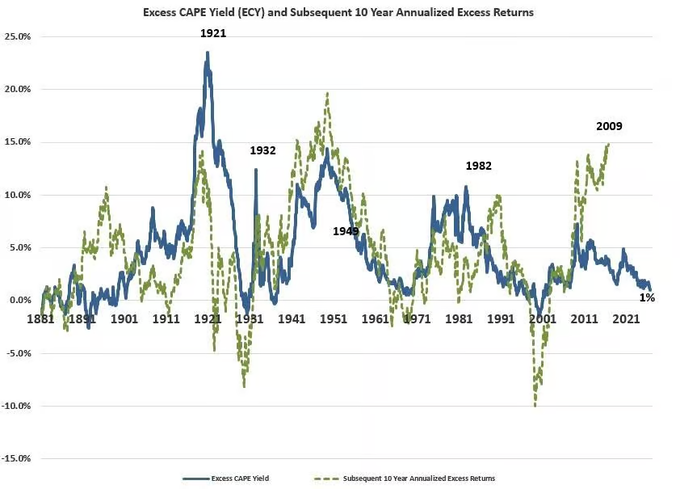
This pattern poses potential downward pressure on the stock market. The cyclical adjustment excess yield model of Robert Shiller, an economist from Yale University, indicates that over the next decade, the S&P 500 index may only outperform bonds by about 1% annually. Investors' tolerance for errors in corporate earnings forecasts has significantly narrowed.
Long-term debt investors suffer heavy losses; signs of a bubble bursting are evident.
High yields are, to some extent, a reflection of economic resilience – U.S. stocks are near historical highs, the U.S. economy is performing better than expected, and the impact of rising long-term interest rates has not yet fully manifested at the macro level.
However, it is the investors who had bet on long-term bonds that are bearing the brunt of the pressure first. Referring to the TLT ETF that tracks 20-year and longer-term U.S. Treasury bonds, these investors have already suffered significant losses.
Looking back, the bond bull market that emerged over the decade following the crisis, fueled by low inflation and government intervention, as well as the sharp price increases during the pandemic, exhibit characteristics of an asset bubble when viewed in retrospect.
Market rules indicate that the bursting of a bubble often signifies the arrival of a buying opportunity. The current yield on 10-year government bonds, which is over 5%, is a level that has been rare in recent decades, and the allocation value of bonds has been substantially re-evaluated.
The logic of inverted yield curves has come to an end, and the paradigm that stocks have outperformed bonds over the past twenty years has been shattered.
In the past, conventional market wisdom held that stocks, due to their potential for growth, should enjoy a valuation premium over bonds, meaning that the earnings yield on stocks would naturally be lower than that of bonds.
However, for approximately two decades following the global financial crisis, this logic was completely overturned – stock returns have consistently been higher than bond yields, making stocks an undisputed superior asset class.
Today, this pattern has reversed once again. When comparing the stock profit yield with the yield of 10-year U.S. Treasury bonds, the relative attractiveness of bonds has returned to levels seen about 25 years ago.
This means that even though the price-earnings ratio of the stock market has narrowed to absorb higher bond yields, the outlook for the stock market still faces certain pressures.
The Shiller model issues a warning, but its historical limitations also deserve attention.
The Robert Shiller excess CAPE yield indicator predicts the future ten-year excess returns of stocks by comparing the actual profit yield adjusted for cycles with the yield of 10-year government bonds.
Historical data shows that this indicator has a significant predictive power for stock excess returns over the next decade, while the current reading suggests that the S&P 500 index is expected to outperform bonds by about 1% per year over the same period.
However, the prediction accuracy of this model has declined in recent years – the actual performance of the stock market has far exceeded its expectations, which may be related to the continuous policy intervention in the market.
Nevertheless, the core signal is still clear: the alternative value of bonds is at its highest level in a generation. Against this backdrop, investors need to assess the earnings growth forecasts for the S&P 500 with more stringent standards, because once corporate profits fall short of expectations, the bond market will no longer provide any cushion.