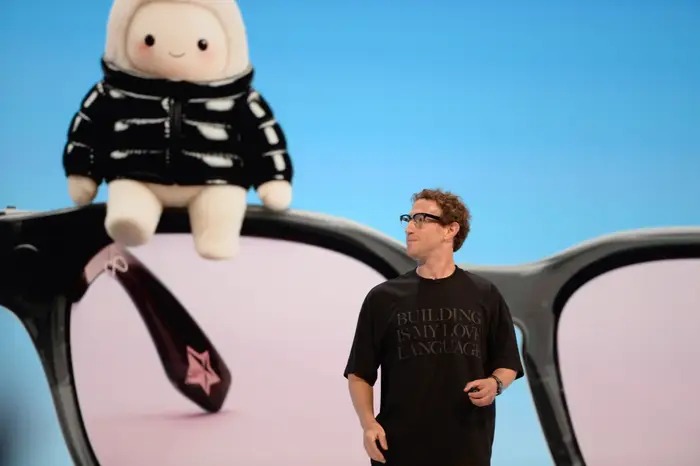
The Muse of Meta expects you to use it for shopping, but it could also just be another platform for Zuckerberg to sell ads on.
Businessinsider
1h ago
Ai Focus
The article discusses whether AI agents can complete shopping on behalf of users, suggesting that such services may need to be widely adopted if they are to truly make a profit. Analysts from MoffettNathanson believe, however, that individual agents may not disrupt e-commerce as some investors imagine.
Helpful
No.Help

Would you like AI to complete all your shopping for you?

Do you want AI to complete all your shopping for you?

The reason I ask this is that the answer will become the key to the success or failure of a new type of AI agent: for example, Meta's Muse, or the popular startup Instinct that didn't exist a few weeks ago but is now valued at one billion dollars.

This agency industry promises to handle various tasks for you, but its most core purpose seems to be: "Our agents will help you find and purchase whatever you want, so you won't have to worry about shopping anymore."

Investors are interested in this because they envision a world where the value of e-commerce websites, especially Amazon's, will disappear, to be replaced by ruthless agents that search for the best deals on the internet without any loyalty to any retailers. Mark Zuckerberg, the head of Meta, stated that in such a scenario, Meta would make money by charging a small fee from each transaction.

But it's also possible that Amazon and other retailers don't need to worry as much as those who support proxies think. Even though many people are willing to let AI purchase something for them – not to mention letting AI handle most of their shopping – there might not be that many opportunities for such proxies to play a role.
This is the view of the analyst MoffettNathanson in a new report. They believe that 'we do not expect personal agents to become the disruptive force in e-commerce that some investors imagine.'

In my opinion, their core argument can be illustrated by this chart: The chart assumes that ordinary consumers make 47 payments per month (according to the Federal Reserve of Atlanta), and attempts to determine which of these payments would be suitable for an agent like Muse to handle.
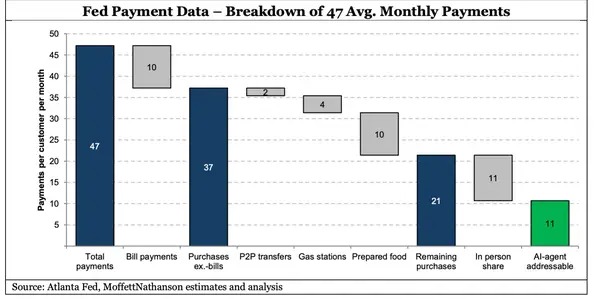
The conclusion is: once scenarios where proxies are not very useful are excluded—such as automatic payments, gas station transactions, and shopping in physical stores—there are only about 11 payments per month that proxies might be willing to handle.

Moreover, it is quite possible that you would indeed be willing to let Muse, Instinct, or some kind of proxy that Google may launch in the future, help you handle these 11 payments.

(I've been playing around with Muse and Instinct for the past few weeks. I've gone from "I would never hand my credit card to a robot" to "It turns out that the Stripe and Link services already have my credit card information, and I have no problem with Stripe, so I can accept using Link to complete a Instinct transaction." That's why I spent $17 using Bounce when I went to San Francisco last week—it was a luggage storage service I'd never heard of before. Instinct helped me plan my trip and recommended Bounce.) They even paid the service fee for me, and I didn't take the Visa card out of my pocket the entire time. It worked perfectly. I think my information is safe?

But if one can only get a share from these 11 transactions assisted by agents – and assuming consumers are willing to pay for them, which means these transactions themselves have to be of a relatively small scale – then it would be very difficult for Muse, Instinct, or any similar services to actually make a large profit, unless they can achieve widespread adoption.

As long as these things are still free, I’ll spend a lot of time playing with them. As for what will happen afterwards, I don’t know either.

Tip
$0
Like
0
Save
0
Views 20
CoinMeta reminds readers to view blockchain rationally, stay aware of risks, and beware of virtual token issuance and speculation. All content on this site represents market information or related viewpoints only and does not constitute any form of investment advice. If you find sensitive content, please click“Report”,and we will handle it promptly。
Submit
Comment 0
Hot
Latest
No comments yet. Be the first!
Related
AMD acquires World Labs for approximately $8.2 billion, with Li Feifei set to take on the role of Chief Scientist
AMD stated on Monday that it has agreed to acquire San Francisco-based startup World Labs in a all-stock transaction, with a valuation of approximately $8.2 billion. The company was co-founded in 2024 by Stanford University professor Fei-Fei Li, and focuses on creating and reconstructing interactive 3D environments from text, images, and videos using "world models." According to the agreement, Fei-Fei Li will join AMD as Executive Vice President and Chief Scientist, reporting to CEO Su Zifeng.
Businessinsider
·2026-09-29 05:56:01
7
Close on September 29: U.S. stocks fell on Monday, dragged down by the surge in Treasury yields at the start of this week
U.S. stocks fell on Monday, with major indices dragged down by soaring Treasury yields. The Dow Jones, S&P 500, and Nasdaq all closed lower, while tech stocks showed mixed performance. Meanwhile, Morgan Stanley, Goldman Sachs, and JPMorgan Chase each expressed their views on U.S. Treasury yields, the breadth of the U.S. stock market, and the flow of funds into tech stocks.
The Block
·2026-09-29 05:44:04
13
Tesla's new Roadster release postponed due to weather conditions
Tesla announced that the outdoor launch event for the new Roadster model, originally scheduled for Thursday, has been postponed due to bad weather conditions. The new date is set for October 15th. This vehicle represents Tesla's second generation of Roadster; Musk showcased a prototype in 2017 and claimed it would go into production in 2020, but the company has missed that target several times since then.
Businessinsider
·2026-09-29 05:33:23
11
A Clever RSA Attack Outwitted a Hardware Safe – What Does This Mean for the Crypto Industry?
Researchers from the University of California, San Diego, and a French INRIA institution forged the signatures of 1,024-bit RSA keys within a hardware security module without extracting the keys themselves. They used approximately 4 billion signature requests and around 1,380 CPU core years of processing power. The study was specifically focused on RSA and did not involve the elliptic curve signatures used by Bitcoin or Ethereum. The authors stated that this does not pose an immediate threat to most modern, padded RSA implementations.
Decrypt
·2026-09-29 05:33:19
10
Michael Burry believes that the bubble of AI "may burst" sooner than he previously anticipated
In the latest investment newsletter, Michael Burry stated that he is moving up the timeline for his bearish view on the artificial intelligence boom and converting some of his short positions into put options in order to achieve more cost-effective leverage. He believes that the bubble in AI “may burst earlier than expected” and disclosed adjustments to his positions in Micron, Nebius, SOXX, and Palantir.
CNBC
·2026-09-29 05:24:42
13
View More