






On September 7, the German Federal Statistical Office announced that industrial production in July 2026 decreased by 1.1% month-on-month and by 1.6% year-on-year after adjusting for prices, seasonality, and calendar effects. The month-on-month data for June was revised from a preliminary figure of 0.2% growth to no change. The monthly decline indicates that Germany's industrial recovery is still unstable, but the average growth over the three months from May to July (0.4%) does not simply suggest that industry has entered a downward trend.
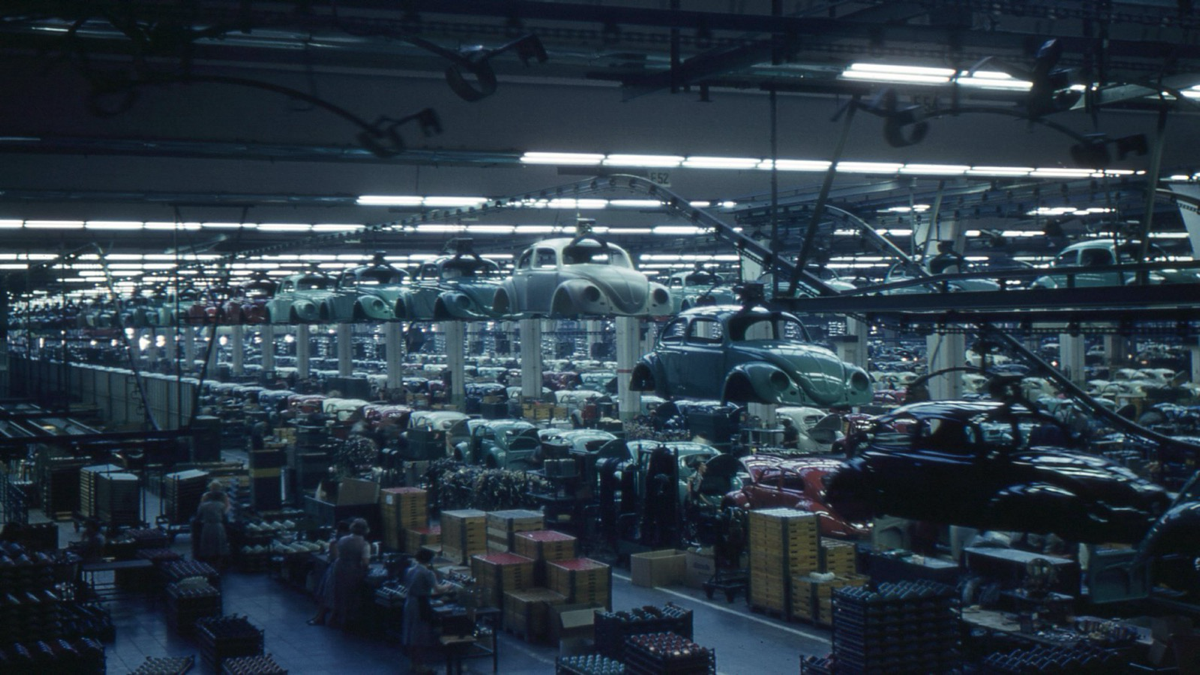
In July, the main drag came from the automotive industry, with production declining by 9.2% month-on-month. The German Association of the Automotive Industry stated that several weeks of production halts could be a significant reason for this. Meanwhile, energy production increased by 4.7%, and the construction industry grew by 0.9%. There are significant differences in industry trends; the overall decline of 1.1% is more likely due to fluctuations in the automotive sector dragging down the total, rather than a simultaneous contraction across all industrial sectors.
Automobiles fell by 9.2%, making the monthly total seem even weaker.
Automobile manufacturing holds a significant weight in German industry, with long supply chains. A concentrated halt in production at factories can quickly affect the overall index. Summer maintenance, model changes, or adjustments in parts supply can lead to substantial fluctuations in monthly data. If production resumes afterward, some of the declines may be offset; however, if the halt in production reflects demand and competitive pressures, the effects will continue to impact parts supply, logistics, and employment.
Excluding energy and construction, industrial production in July fell by 2.2% month-on-month. Capital goods declined by 3.4%, consumer goods by 2.2%, and investment goods by 0.2%. These sub-items indicate that the weakness is not limited to the overall index, but the significant decline in automobiles remains the most prominent single factor. When assessing underlying demand, it is necessary to consider new orders, inventory of orders, and business surveys.
Energy growth of 4.7%, mainly driven by wind and solar power generation. The increase in energy production has a positive contribution to the overall industry, but it has not been able to offset the decline in manufacturing. Renewable energy is greatly affected by weather conditions; high levels of power generation in one month are not necessarily sustainable, nor does it mean that the cost pressures on energy-intensive enterprises have disappeared.
Energy-intensive industries saw a month-on-month decline of 1.7% in production, while the three-month average remained flat compared to the previous three months, with a year-on-year decrease of 0.5%. This comparison indicates that companies are still under pressure, but there is no continuous acceleration in contraction. The five high-energy-consuming industries defined by officials accounted for 77% of industrial energy consumption in 2021, yet they only contributed 17% to industrial added value. Changes in energy prices are particularly sensitive for them.
On a year-on-year basis, industrial production excluding energy and construction decreased by 3.3%, which is a weaker decline than the 1.6% decrease in total industrial production. This indicates that the energy and construction sectors have buffered the pressure on manufacturing. If investors only look at the overall volume, they may underestimate the weakness in core industries; if they focus solely on the automotive sector, they may overlook the fact that other industries are not in as poor a state, nor is the trend over the past three months as dire.
Whether the rebound in orders can translate into increased production depends on the fulfillment after the suspension of production.
Germany previously announced that new manufacturing orders in July increased by 2.5% month-on-month, but after excluding large orders, the base orders decreased by 2.5%. The opposite trends in orders and production are not contradictory: orders precede actual production, and large projects may also take several months or even longer to be delivered. Whether production can recover in August and September is key to testing the authenticity of the improvement in orders.
Enterprises also need to manage their inventory. If there is a large amount of finished product inventory accumulated beforehand, even with an increase in orders, factories may prefer to sell off the inventory first rather than immediately expanding production. Conversely, once the supply disruption ends, production may quickly recover in the short term. Orders, inventory levels, and delivery times should all be presented on the same chart for better visibility.
The production index uses the average value of 2021 as 100 and applies X13 JDemetra for seasonal and calendar adjustments. Starting from 2026, Germany's production statistics will adopt a new version of product classification, but official explanations indicate that the aggregation at higher levels of industry remains comparable. When readers see month-over-month figures, they should understand that these represent changes in the index, not a reduction in factory output value by the same amount of euros.
Price adjustments are also crucial. The nominal sales volume of industrial enterprises may increase due to price hikes, but the actual production volume may decrease. The 1.1% figure released by the Federal Bureau of Statistics represents the actual change after price adjustments and is more in line with the trend in production volume. When analyzing corporate revenue, it is also necessary to consider the ex-factory prices and profit margins; one cannot simply equate the actual production volume with revenue.
Foreign demand is another window for observation. German machinery, automotive, and chemical industries are highly dependent on exports. A slowdown in investment from major trading partners will first affect orders, which will then impact production. Changes in exchange rates can improve price competitiveness, but they cannot fully offset a decline in global demand for equipment or reorganizations of supply chains. The volume of exports in the coming months will help determine whether the decline in July was due to domestic production halts or broader demand pressures.
The structural problems faced by German industry have not changed despite a month of data. The automotive industry needs to cope with electrification, software capabilities, and international competition; high-energy-consuming industries must adapt to energy costs and investment demands; while machinery and equipment companies rely on global capital expenditure. Cyclical recoveries can improve production, but they cannot replace long-term transformation.
The impact on employment usually lags behind. When facing short-term production halts, companies first reduce working hours, utilize holidays, or make temporary arrangements; only when demand remains insufficient for an extended period is layoffs more likely to occur. A decline in production in July does not necessarily imply a corresponding decrease in employment, but if capital goods and core manufacturing sectors remain weak for several months in a row, pressure on the labor market will increase.
In terms of macroeconomic assessment for Europe, Germany's GDP still grew by 0.3% in the second quarter, yet industrial production weakened in July, indicating that quarterly aggregates and monthly sector data are based on different time periods. Services, consumption, and construction may partially offset the fluctuations in industry. To predict the entire third quarter using a single monthly industrial indicator, it is necessary to allow for sufficient margin of error.
The most reasonable conclusion for July is that Germany's industry has been significantly dragged down by the multi-week shutdowns in the automotive sector, and core manufacturing also appears weak. However, there was still a slight growth over the three-month period, which is not yet sufficient to confirm a new overall recession. Moving forward, it will be important to see if automobile production can catch up, whether new orders can be converted into actual deliveries, and whether energy-intensive industries can stabilize. Only if a single month of decline spreads to more industries and persists for several months can such a fluctuation be considered a trend.