

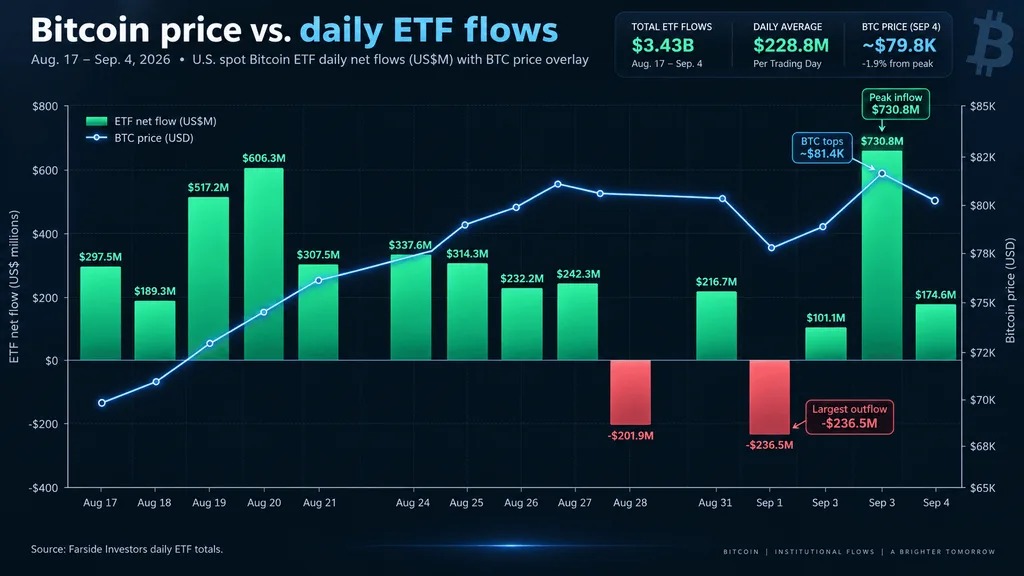
Bitcoin fell back after rising to around $81,400 and hovered in the range of $79,000 to $80,000 on Friday. The forces driving up prices have not disappeared, but stronger-than-expected U.S. employment data has raised interest rate expectations again, pulling the market back and forth between capital inflows and macroeconomic pressures.
ETF Sets a New High for One-Day Inflows
U.S. spot Bitcoin ETF saw a net inflow of $730.9 million on Thursday, the largest single-day inflow since January 14 this year. Prior to that, throughout August, such funds attracted a total of about $3.52 billion in capital, achieving the strongest single-month performance since 2026.
Explanation of capital flow: Institutional buying orders are still supporting the market, which is also one of the important reasons why Bitcoin approached $80,000 earlier on. Against the backdrop of continuous capital inflow at ETF, the market's demand for Bitcoin has clearly rebounded.
Employment data suppresses risk appetite
However, the macro environment quickly cooled down the market. In August, the United States added 162,000 new jobs, which was higher than market expectations. After the data was released, market bets on the Federal Reserve raising interest rates in September rose back to around 60%.
Affected by this, U.S. Treasury yields temporarily rose, with the 10-year Treasury yield later returning to around 4.77%. An upward trend in interest rate expectations usually suppresses liquidity-sensitive assets, and as a result, Bitcoin also saw a short-term surge followed by a decline.
Previously, Federal Reserve Governor Lael Brainard stated that if inflation continues to cool down, he might support keeping interest rates unchanged. This statement once led to a decline in the US dollar and US Treasury yields, and pushed Bitcoin back above $81,000. However, after the release of employment data, this trading logic was partially reversed.
September 11th CPI becomes the next focus
In addition to the ETF funds, recently the US Treasury Department expanded its supportive repurchase programs for long-term government bonds, which also contributed to a weakening of the dollar and increased market demand for scarce assets. Both Bitcoin and gold benefited from this.
The focus of the market next will shift to the U.S. CPI for August, which was announced on September 11, as well as the subsequent Federal Reserve interest rate decisions. If inflation continues to slow down, concerns about the continuation of tightening measures may ease; if the data is stronger, it may become more difficult to maintain a level above $80,000.
Judging from the current trend, institutional funds are still providing support, but whether Bitcoin can hold above $80,000 in the short term still depends on changes in inflation and interest rate expectations.