

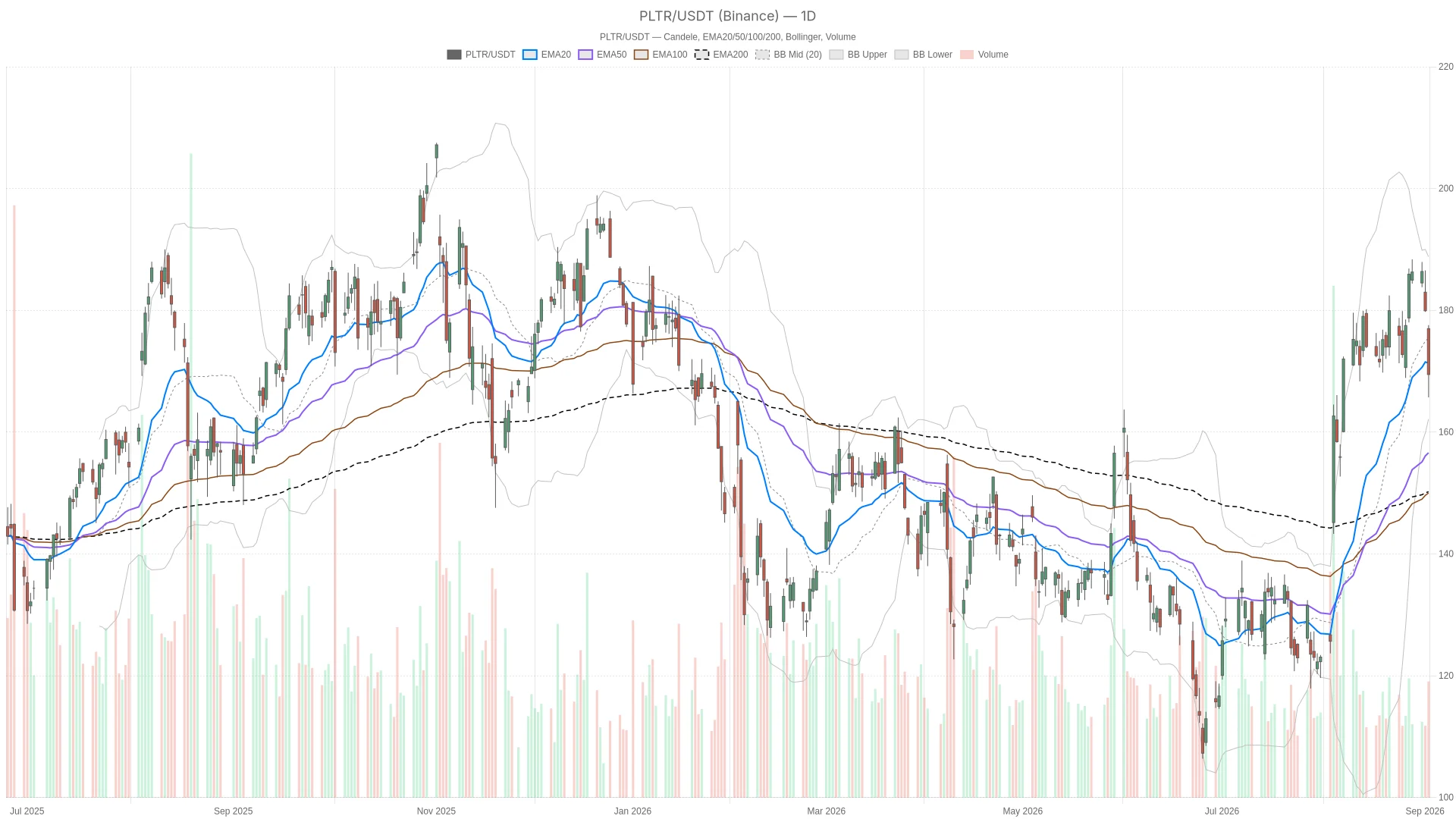
Foreign media reports that Palantir has seen a significant decline after a period of rapid rise, closing at $169.46 on September 2, a marked drop from the intraday high of $177.57 on that day. The article suggests that short-term selling pressure has begun to emerge, but over a longer time frame, the stock price is still within an upward trend that has not been completely disrupted.
Closed below the 20-day moving average
According to the data cited in the text, Palantir is currently still above the 50-day moving average of $156.61 and the 200-day moving average of $150.21, which indicates that the medium-term upward trend is still in place. However, the closing price has fallen below the 20-day moving average of $171.33, suggesting that the short-term momentum has significantly weakened.
The article mentions that the daily RSI is around 52.2, which is in a neutral range, reflecting the strength after the previous rise and the current round of selling pressure. At the same time, the MACD has shown bearish signals, indicating that the upward momentum is weakening.
The weakening at the hourly level is even more apparent.

In a shorter time frame, the article suggests that the negative signals are more apparent. The stock price has fallen below both the 20-hour and 50-hour moving averages, but it is still above the 200-hour moving average of $166.20, indicating that the short-term trend is weakening, although the medium-term structure has not yet completely collapsed. Palantir
It is mentioned in the text that the hourly level RSI has dropped to 28.04, entering an oversold zone, and the negative value of MACD is also expanding. This indicates that selling pressure is still being released, and there are no clear signs of stabilization in the market yet. The position of the Bollinger Bands also shows that the stock price is approaching the lower band, with increased short-term volatility.
$164.26 becomes a key support level
The article regards $164.26 as the most important daily support level at present. If the price falls below this level, it may further decline to around $162.14. If the selling pressure persists, the 50-day moving average of $156.61 could also become the next testing area.
On the contrary, if the stock price reclaims the daily pivot point of $170.91 and also recovers above the 20-day moving average, the market's interpretation of this round of adjustment might shift to a "correction after an upward trend," rather than a reversal of the trend.
Fundamentals are still regarded as supporting factors.
In addition to the technical aspects, the article also mentions that the fundamentals of Palantir are still supportive. According to a view cited by Seeking Alpha, the company has seen rapid revenue growth, strong cash flow profit margins, and possesses approximately $9.4 billion in net cash.
However, it is also mentioned in the text that after a significant increase in stock prices, some institutional views began to turn cautious. The article quotes comments stating that the market may have already incorporated a lot of growth expectations in advance, which is also one of the reasons why stock prices still fell after the positive news was announced.
Overall, this comment suggests that Palantir is currently in a somewhat sensitive position: the daily trend has not yet been completely broken, but there has already been a noticeable decline at the hourly level. In the short term, market attention will focus on whether the support level can be maintained and whether the stock price can return above $170.91.