

Foreign media reports that CRV has recently broken free from months of downward pressure, with its price rising from less than $0.30 at the end of August to around $0.38. Synchronized with this upward trend is an increase in the activity of Curve in decentralized trading, lending, and stablecoin services.
DEX and lending data rise in tandem
The article mentions that Curve DEX has seen a trading volume of $1.1 billion in the past week, representing a weekly increase of 91.2%; the total locked-up value has risen to $1.54 billion, with a weekly increase of 4.7%; the number of exchanges within the week has increased to 618,000, and the transaction fee revenue has reached $347,000.
Lending business has grown even faster. The total locked-up value of Llamalend has risen to $243 million, a weekly increase of 33.4%; the lent assets have increased to $131 million, a weekly increase of 32.6%; and the mortgaged assets have risen to $215 million, a weekly increase of 40.2%. The article argues that this indicates that the revenue sources and liquidity foundation of Curve are no longer limited to the stablecoin trading scenario.
crvUSD Expansion and reduction of issuance proceed in parallel
In addition to trading and lending, Curve is also advancing the deployment of stablecoins on the mainnet. The article states that Llamalend V2 has been extended to the Ethereum mainnet, and in July, the minting volume of crvUSD increased by 29% to reach 36.7 million US dollars, while the average borrowing rate also significantly decreased.
Changes have also occurred on the token supply side. The latest data shows that 851 million CRV tokens have been locked, with a circulation of approximately 781 million veCRV tokens. After Curve entered its sixth mining cycle in August, the daily issuance of CRV tokens decreased from 316,563 to 266,197. At the current rate, the annual increase in issuance is about 97.2 million tokens, which accounts for approximately 4.03% of the total supply.
$0.40 becomes a short-term focus
The article argues that, against the backdrop of stablecoin projects competing for liquidity, the demand for lock-up related to governance rights may enhance the strategic value of CRV, while the slowdown in the new circulation speed also provides support on the supply side.
In terms of price performance, after breaking through the long-term downward trend line at the end of August, CRV once again rose above the $0.35 to $0.36 range. On September 2nd, it reached around $0.39, before then falling back to the vicinity of $0.37 to $0.38.
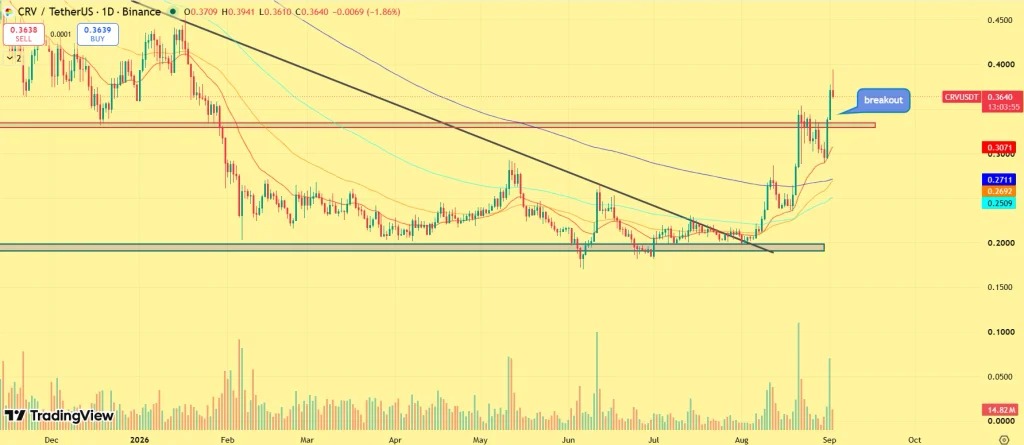
The article points out that $0.40 is the current most direct observation level. If the daily chart continues to stay above this level, the market will further focus on the $0.45 and $0.50 regions. If there is a decline, $0.35 to $0.36 will become the first levels that need to be held; once it falls below again, prices may look back at $0.30, or even the $0.27 to $0.28 range.
Additional information:This article is primarily based on market commentary, with a core focus on the recent changes in DEX, lending, and crvUSD data of the Curve protocol, as well as adjustments to the lock-up and issuance schedule of CRV.