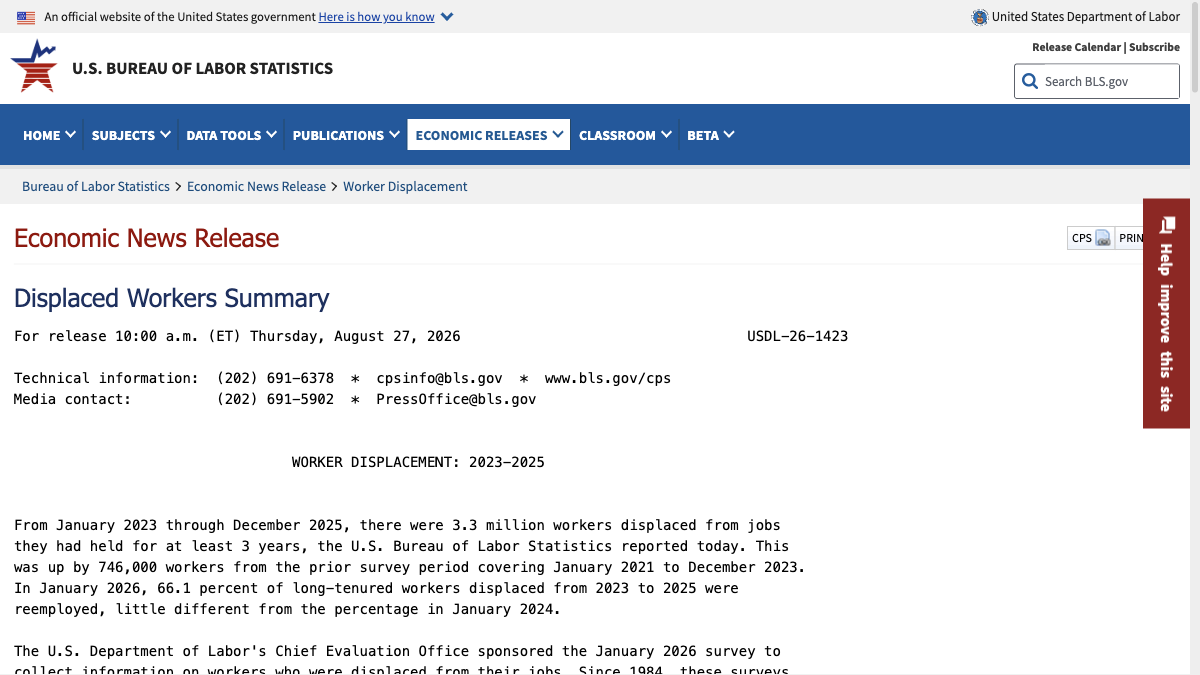

















The U.S. Bureau of Labor Statistics released a survey on unemployed workers for the period 2023 to 2025 on August 27th. Over the course of these three years, a total of 7.4 million workers aged 20 and above lost their jobs or left their employment due to the closure of factories or companies, insufficient work, or the cancellation of positions or shifts, which is higher than the 6.3 million recorded during the 2021 to 2023 survey period. Among them, 3.3 million people had worked for their original employers for at least three years and were defined as long-term unemployed workers, an increase of 746,000 compared to the previous survey period; another 4.1 million people lost jobs that they had held for less than three years.
As of January 2026, 66.1% of long-term unemployed workers have found re-employment, which is not statistically significantly different from the 65.7% reported in the survey from January 2024; 18.3% are still unemployed, and 15.7% have withdrawn from the labor market. From this, it cannot be simply concluded that the labor market has not deteriorated. Although the re-employment rate remains stable, the number of people losing their jobs has increased, indicating that the scale of job turnover and the capacity to re-absorb workers need to be considered separately.
The survey is a biannual supplement to the current population surveys, asking respondents about their experiences over the previous three years. It is not a monthly statistics of layoffs, nor does it cover all those who resigned voluntarily, had their temporary contracts end, or are seeking employment for the first time. The periods from 2021 to 2023 and from 2023 to 2025 overlap by one year, so the numbers from these two groups cannot be directly added as if they represent non-overlapping consecutive periods. Its proper use is to observe the characteristics of job losses and re-employment in structural positions.
The cancellation of positions has become the main reason, with the manufacturing industry bearing the largest long-term loss of talent.
Among the long-term unemployed workers, 44.4% lost their jobs due to the cancellation of positions or shifts, 32.6% because factories or companies closed down or relocated, and 22.9% due to a shortage of work. The highest proportion of job losses was due to the cancellation of positions, indicating that corporate reorganizations, process adjustments, and organizational streamlining are more common than simply a lack of demand. However, the survey did not determine individually whether the reasons were due to automation, AI, trade, or management decisions, and therefore it is not possible to attribute all job cancellations to any single technology.
By industry, 642,000 long-term manufacturing workers have lost their jobs, an increase of 215,000 from the previous survey period, accounting for 19% of all long-term unemployed individuals; of these, 447,000 are from the durable goods manufacturing sector. Professional and business services account for 16%, and retail accounts for 10%. These proportions describe the industries from which the unemployed individuals came, but they do not indicate that the same rate of layoffs is occurring in these industries currently, nor does it mean that all the lost jobs have permanently disappeared.
The coverage of written advance notice remains limited. Approximately 45% of long-term unemployed workers received written notice before termination; about 58% of those whose factories were closed or relocated received notice, 42% of those whose jobs or shifts were canceled, and 32% of those with insufficient work. The survey found no statistically significant difference in re-employment rates between those who received and did not receive notice within each group of reasons. However, advance notice may still affect family budgets, training preparations, and the quality of job hunting, and a single re-employment indicator cannot measure these effects.
The age gap is quite evident. The re-employment rate for the group aged 25 to 54 is 72.9%, for those aged 55 to 64 it is 57.3%, and for those over 65, it is only 38.6%. The lower rates may reflect difficulties in skill matching, health issues, retirement choices, and regional opportunities. Once elderly workers withdraw from the labor market, they are no longer counted as unemployed, so focusing solely on the unemployment rate can easily underestimate the permanent departure of workers after job losses.
Re-employment does not equate to restoring the original salary and career trajectory.
66.1% of those re-employed answered whether they had found a job, without automatically addressing issues such as salary, working hours, benefits, stability, and career fit for the new job. Individuals who have worked for the same employer for a long time usually accumulate specialized skills and qualifications, and upon changing positions, they may be willing to accept lower salaries, part-time work, or different careers. Assessing the impact requires considering factors such as the new and old salaries, the proportion of full-time employment, industry transition, and commuting distances.
The re-employment rates for men and women are 68.0% and 64.0%, respectively, with no significant changes compared to the previous survey. However, at the time of the survey, the unemployment rate for women was 21.7%, which is 15.1% higher than that for men. Different groups are also affected by caregiving responsibilities, industry distribution, and regional employment opportunities. There are also differences in the point estimates for racial and ethnic subgroups, but the sample error is relatively large. BLS emphasizes multiple times that there are no significant changes from the previous period.
The policy implications are not merely about providing short-term unemployment relief. The cancellation of jobs and the closure of businesses require earlier information, transferable benefits, rapid skill certification, and cross-regional recruitment; for employees who have been employed for a long time, training should take into account their existing experience rather than requiring them to start from scratch. Regions where manufacturing jobs are being lost in large numbers also need to coordinate with local industrial investment and policies related to transportation and housing; otherwise, job vacancies may exist in places where workers are unable to relocate.
There are also measures that companies can take in advance at the corporate level. Internal job markets, skill profiles, and retraining programs can help match employees with new positions before formal layoffs; supply chain companies can share regional labor demands to mitigate the concentrated impact of contraction within the same industry. In terms of policy evaluation, in addition to tracking re-employment rates, it is also important to monitor wage recovery, welfare coverage, and the duration of employment one year later. Otherwise, finding a job in the short term may mask long-term income losses.
This survey presents a labor market characterized by "stable absorption rates and an increasing number of people affected." In the United States, 7.4 million workers lost their jobs between 2023 and 2025, among whom 3.3 million were long-term employees; by January 2026, about two-thirds of them had found new employment. It is neither a complete collapse nor is nothing happening at all. What truly needs to be tracked is whether new jobs can restore income and stability, as well as whether differences in age, industry, and region are causing some people to remain outside of the recovery process for a longer period.