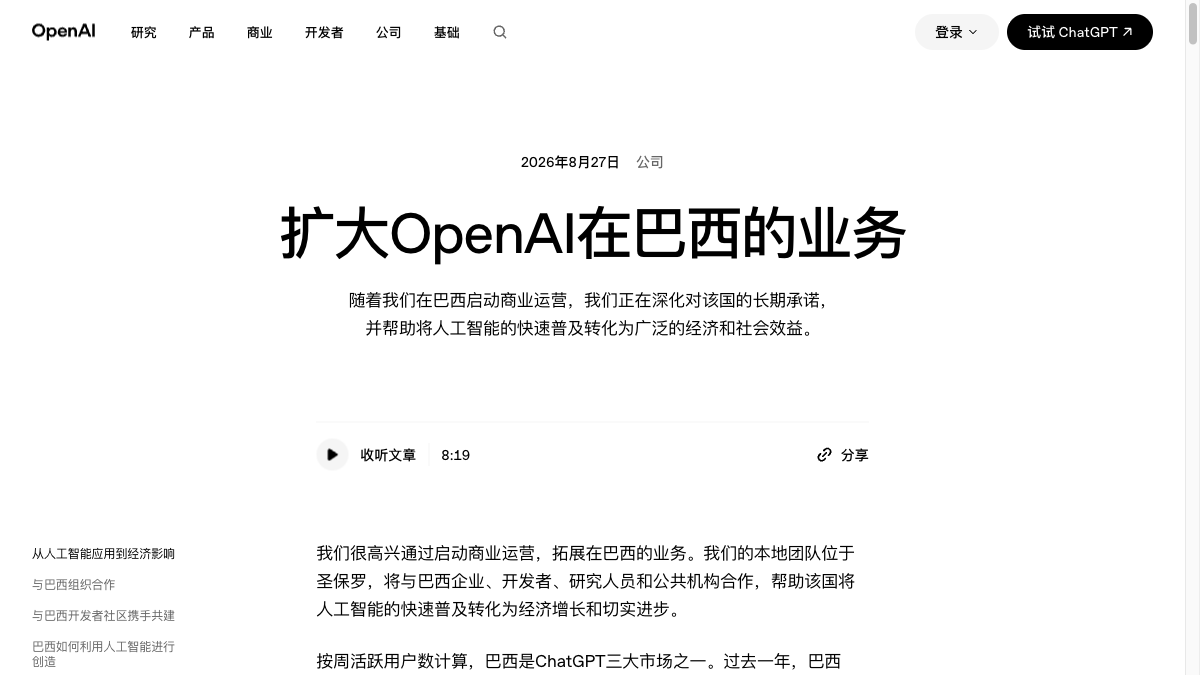


















On August 27th, OpenAI officially announced the launch of its commercial operations in Brazil. The local team is based in São Paulo and will collaborate with enterprises, developers, research institutions, and the public sector. The company stated that Brazil is already one of the three markets with the highest number of active users per week for ChatGPT, and the user base has nearly doubled over the past year, with approximately 215 million messages sent daily. Based on the number of API developers, Brazil ranks second in the world and is also the largest market for Codex in Latin America.
These data indicate the scale of usage, but they cannot be directly equated with commercial revenue, labor productivity, or social benefits. 215 million messages cover work, learning, entertainment, and repetitive interactions; although the number of users has nearly doubled, the absolute base figure has not been disclosed. National-level usage analysis provided by OpenAI shows that in June 2026, 35% of the messages in Brazilian personal accounts were related to work, which is higher than the global average of 30%; among these, 53% of work-related messages required models to complete tasks or produce results. The classification method, unclassified information, and the criteria used by the platform itself all need to be taken into consideration when interpreting these data.
Business operations mean that OpenAI has begun to localize sales, customer support, training, and institutional partnerships, rather than serving Brazilian users solely through a global website. The company disclosed that the number of ChatGPT Enterprise accounts in Brazil has increased fivefold year-on-year and has entered its top ten markets in terms of corporate customers; since the beginning of 2026, the weekly user base of Codex in Brazil has grown by more than 11 times, with daily interactions approaching 30 times. The high growth rate may stem from a lower starting point, but it is sufficient to indicate that there is a rapid demand for development tools forming.
From user scale to actual output, it is necessary to complement language capabilities, talent, and governance.
The Portuguese language product experience is the first level of localization, but it is far from everything. Enterprises need models that conform to Brazilian industry terminology, local billing and contracts, data processing guidelines, customer support time zones, as well as implementation teams that understand the regulatory environment. The financial, medical, and public service sectors also require clear regulations regarding data storage, cross-border data transmission, audit logs, and manual review processes. Simply translating the user interface is not enough to address these issues.
The cooperation listed in OpenAI reflects different approaches. It will provide ChatGPT Edu accounts and inference models with the College of Aeronautical Technology ITA, as well as Codex quotas; it supports IMPA research institutions in transforming AI access into scientific research progress; the affiliated hospital of the Medical School of the University of São Paulo will evaluate the prototype of clinical information infrastructure for the Brazilian public health system, while retaining doctors' judgment and manual supervision. The key terms here are “provide”, “research”, and “evaluate”; it should not be written as if scientific research or medical effects have already been achieved.
In terms of vocational training, OpenAI has collaborated with the Brazilian law firm AI and the company ENTER to develop a national AI literacy program. They have also designed free mobile courses for micro- and small business owners in partnership with Est and mulo, covering areas such as marketing, sales, customer service, finance, and management. Furthermore, through Prodam, they signed a memorandum of understanding with the city of São Paulo to explore ways to provide AI services to more public management institutions. The memorandum of understanding represents a intention and framework for cooperation, but it does not imply that the government system has already fully implemented these services.
Brazil's large number of small and medium-sized enterprises (SMEs) and mobile internet users provide a real-world scenario for low-threshold AI tools. Official cases include jewel designers using ChatGPT for handling advertising, pricing, inventory, and production, as well as food service operators developing menus and communicating with customers. While these individual cases illustrate potential uses, they cannot represent the average effectiveness of such tools for businesses. To measure the success of a project, it is important to record savings in man-hours, error rates, sales changes, employee training costs, and ongoing usage rates, rather than just the number of registered users.
The potential contribution of nearly 1 trillion reais is a scenario estimate, not a definite result.
OpenAI cites independent research funded by it and completed by RegLab, which estimates that by 2030, this could add nearly 1 trillion reais to the Brazilian economy. Such a large figure relies on assumptions regarding adoption speed, capital investment, labor retraining, productivity transmission, and policy environment, among others. The funding relationships should also be disclosed transparently. It is suitable for describing potential scenarios and cannot be presented as something that has already been created or is certain to be achieved GDP.
Economic benefits are also likely to be unevenly distributed. Technology companies, large cities, and highly skilled workers may benefit first, while small businesses, areas with poor connectivity, and repetitive jobs may face higher transformation costs. If the Brazilian team wants to turn "market expansion" into widespread value, they need to support education and retraining, provide products suitable for low-bandwidth and mobile devices, and allow Portuguese-language content creators and businesses to control the use of data.
Local business presence also raises expectations for accountability. Users need to be clearly informed about who handles complaint channels, account disputes, and security incidents; corporate clients require service levels, notifications of data deletion, and changes to models; public sector projects should have open procurement processes, evaluation criteria, and manual appeal mechanisms. In medical, legal, and government contexts, one cannot rely solely on suppliers' self-evaluations; independent testing is necessary.
The competitive environment also affects the effectiveness of localization. Brazilian companies can choose from multiple international models, local startups, and open-source solutions. Procurement parties should retain the ability to export data, replace models, and evaluate multiple suppliers. Only when there is continuous comparability in terms of price, Portuguese language accuracy, latency, security, and industry effectiveness can market expansion not lead to a lock-in on a single platform. The local teams of OpenAI represent not only service capabilities but also a business commitment that needs to be tested through transparent indicators.
OpenAI's establishment of commercial operations in Brazil marks a step towards shifting from a globally applicable product to a regionally focused organization. With an average of 215 million messages per day, and API developers ranking second in the world with a fivefold increase in corporate presence, the Brazilian market is clearly of considerable scale; however, the opening of offices and cooperation announcements are just the beginning. Whether reliable value can be created in the future depends on the quality of Portuguese language services, institutional governance, the widespread adoption of relevant skills, independent effectiveness evaluations, and whether local accountability can keep up with the pace of usage.