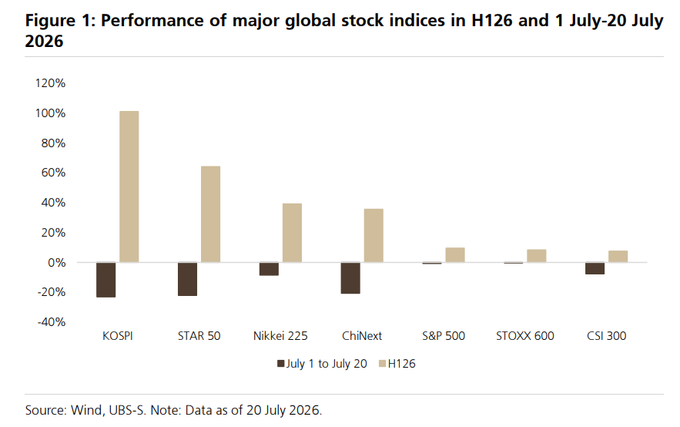


In its A-share strategy report released on July 22, UBS stated that the recent pullback in the A-share technology sector was mainly due to volatility in global technology stocks, short-term profit-taking, and increased trading congestion. The bank believes that while short-term selling pressure is evident, the overall trend of improving profitability remains unchanged.
Earnings forecasts continue to be revised upwards
UBS projects that the year-on-year earnings growth of all A-shares will rise from 3.9% in 2025 to 11% in 2026. First-quarter reports for 2026 already released show that non-financial A-shares net profit increased by 11.8% year-on-year, compared to only 0.8% growth for the whole of 2025.
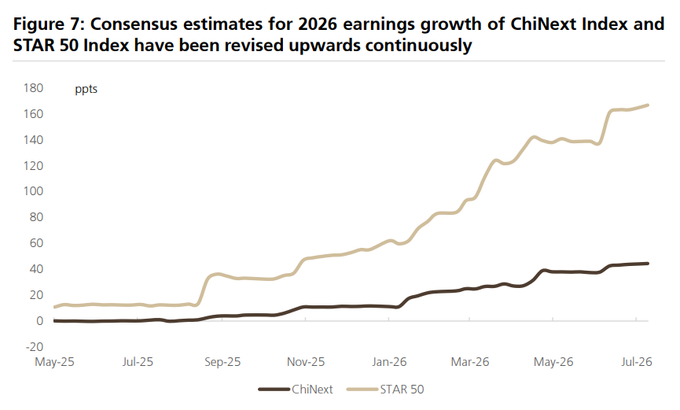
The upward revision of earnings expectations is even more pronounced in the technology sector. The market consensus forecast for the 2026 earnings growth rate of the ChiNext index has been revised upward by 33 percentage points year-to-date; the upward revision for the STAR Market 50 has reached 112 percentage points. UBS stated that global AI is still in a phase of rapid development, and the upward trend in related earnings revisions continues.
ETF funds continue to flow in
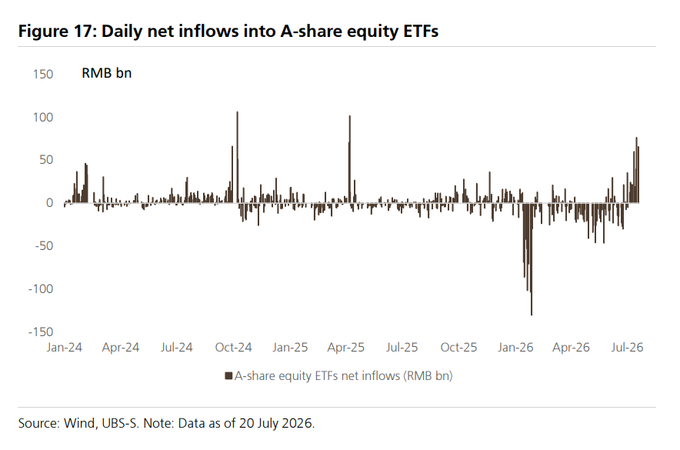
During the market downturn, funds did not withdraw in one direction. UBS data shows that from July 6 to 20, all A-share equity ETFs saw a net inflow of over 367.4 billion yuan, and the daily trading volume of many broad-based ETFs also increased significantly.
Unlike the previous round of capital inflows, this time the funds are more widely distributed. The CSI 300 ETF, ChiNext ETF, and STAR Market 50 ETF all recorded large-scale net inflows. On the evening of July 19th, China Chengtong and China State-owned Assets Holdings Co., Ltd. successively expressed their optimism about the Chinese capital market and their intention to increase their holdings of A-shares. Several insurance companies also stated their commitment to maintaining market stability.
Margin trading balance falls rapidly
UBS believes that the leverage risk that the market is most worried about is easing. As of July 20, the total margin financing balance of all A-shares was 2.70 trillion yuan, a decrease of 312.4 billion yuan from the peak of 3.01 trillion yuan on June 25.
Looking at different sectors, the margin financing balance of the large-cap technology sector decreased by 152.7 billion yuan to 944.9 billion yuan from 1.1 trillion yuan on June 26. UBS pointed out that the ratio of margin financing balance to circulating market capitalization for the large-cap technology sector, the ChiNext board, and the STAR Market is not significantly higher than the overall market level. The ratio for the STAR Market is 5.8%, which is still within a reasonable historical range.