

On the evening of May 21st, Alaska Republican Representative Nick Begich and Maine Democratic Representative Jared Golden formally submitted the American Reserve Modernization Act of 2026 (ARMA) to the House of Representatives, co-sponsored by 17 original signatories.
The core objective of ARMA is straightforward: accumulate 1 million Bitcoin within five years, with annual purchases capped at 200,000 BTC, subject to a 20-year prohibition on selling — unless proceeds are used to repay national debt.
A Path Already Paved by Executive Order
This legislation did not emerge in a vacuum. On March 6, 2025, President Trump signed an executive order establishing the Strategic Bitcoin Reserve and U.S. Digital Asset Stack. The executive order vulnerability is that future administrations can overturn it with a stroke of the pen. Senator Cynthia Lummis' previous Bitcoin Act attempt made only limited Congressional progress. ARMA's strategic shift: elevating the framework from presidential executive order to binding Congressional statute — written into law with mandatory constraints.
Funding Mechanism: Gold Revaluation
ARMA's funding design is radical: the Federal Reserve and Treasury hold gold at historical cost — far below current market prices. Revaluing this gold to current market levels would generate the fiscal space to fund Bitcoin purchases without tax increases, bond issuance, or money printing — satisfying the "budget-neutral" requirement. Future Bitcoin sale proceeds are restricted solely to reducing U.S. national debt (currently approximately $39.04 trillion), making this restriction far from decorative.
The 20-Year Provision: Historic Precedent
The 20-year Bitcoin holding mandate is the most unprecedented provision in modern Congressional history. Since the gold standard's abandonment over 50 years ago, no asset class has received a mandated minimum holding period. The sponsors understand that political promises in Washington dissolve easily — unless codified into law. Twenty years conveniently spans two to three Congressional cycles, making a Bitcoin reserve extraordinarily difficult to dismantle once established.
Digital Property Rights Protection
ARMA also explicitly prohibits the federal government from interfering with citizens' rights to lawfully own, transfer, or self-custody digital assets. This clause in a Bitcoin reserve bill is deliberate: while government begins accumulating Bitcoin, it must simultaneously protect citizens' ability to do the same — preventing a situation where public accumulation justifies private restriction.
Oversight: Transparent and Accountable
The oversight structure is notably transparent: quarterly "reserve proof" public reports, independent third-party audits, and Congressional oversight operating in parallel. All federal agencies must submit complete accounts of currently held digital assets — currently fragmented across multiple departments without unified management.
The World's Largest Sovereign Bitcoin Holder — Without a Policy
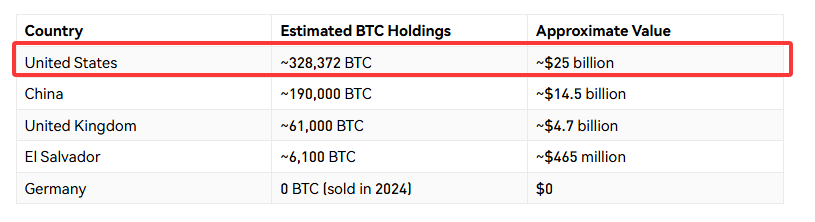
Through law enforcement seizures, the U.S. government already holds approximately 328,372 Bitcoin — worth over $25.5 billion — making it the world's largest sovereign Bitcoin holder. Yet Congress has never established unified policy for managing these assets.
Strategic Implications
If ARMA succeeds in placing Bitcoin on the Treasury's balance sheet, a national finance ministry systematically accumulating Bitcoin transforms it from an optional allocation into a strategic imperative. The United States needs a permanent framework — not ad hoc decisions by executive branches — determining Bitcoin's fate.
Two Variables, One Global Race
ARMA's passage depends on two factors: Congressional bipartisan dynamics (19 co-sponsors remains far from the threshold for passage) and gold revaluation's operational feasibility (involving Federal Reserve accounting rules beyond Congressional control). Meanwhile, Brazil is pursuing a similar path: its RESBit Act, resubmitted in February 2026, would allow up to 5% of foreign reserves in Bitcoin with an identical one-million-coin target over five years.
Regardless of ARMA's ultimate fate, the competition among sovereign nations to add Bitcoin to their balance sheets has unequivocally begun.
以上内容是关于《U.S. Legislators Submit Bitcoin Strategic Reserve Bill: 1 Million BTC in 5 Years, 20-Year HODL Mandate》的解析,了解最新资讯请关注币界网。
免责声明:请读者严格遵守所在地法律法规,本文内容基于市场公开资料整理仅供参考,不构成任何投资建议。