

Foreign media analysis suggests that Zcash (ZEC) has been trading within a narrow range recently, with the price gradually approaching the $500 level. The article argues that the current trend is less about determining a single direction and more about the significant leveraged positions accumulated on both the upper and lower sides. A breakout could trigger a chain reaction of liquidations, further amplifying volatility.
$463 remains a support level.
From a price structure perspective, ZEC has been consistently raising its lows since March, but has repeatedly encountered resistance in the $500-$540 range, resulting in lower highs. The article states that this converging trend has led to a consolidation phase nearing its end, making further high-volume price movements more likely.
The article mentions that $463 is a key support level. If the price holds above this level, the existing upward trend can continue; if it can effectively break above $500 and the current downward trend line, market attention may shift to the $540 area.
Heavy short covering above $500
The 24-hour liquidation heatmap shows a large number of short positions concentrated in the $498 to $514 range. This means that if the price rises back above $500, it could trigger a series of liquidations, thereby pushing up short-term gains.
The article argues that such price movements are not entirely dependent on spot buying; passive covering of leveraged positions could also be a driving factor. If short sellers trigger stop-loss orders in large numbers, the price surge could be faster than a typical rebound.
$466 to $475 is another level to watch.
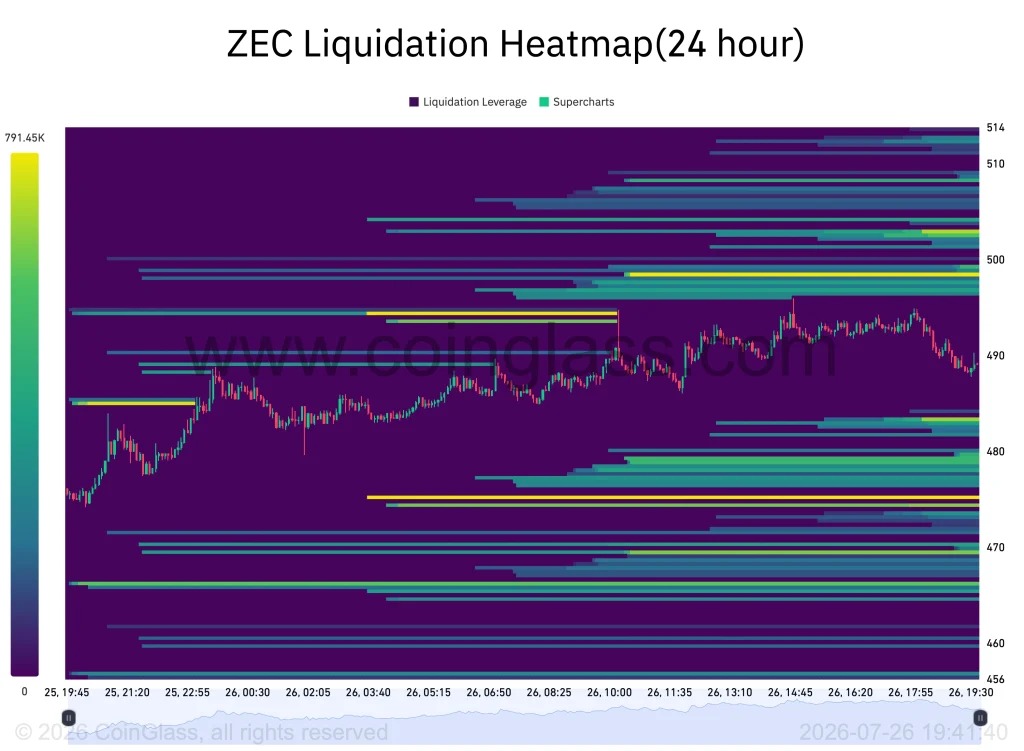
On the downside, there is also significant liquidity accumulation around $475 and $466, which are close to the current upward support line. If the price breaks below this area, long positions may be liquidated, and selling pressure will increase accordingly.
Overall, the article considers the $466 to $514 range as a key short-term fluctuation zone. Foreign media believe that ZEC is currently in a consolidation phase with an uncertain direction; what truly needs to be observed is the price's reaction after touching these liquidation zones, rather than simply betting on whether it will rise or fall.