Bank of America’s chief investment strategist, Michael Hartnett, recently released a forecast for 2027, setting three scenarios for the S&P 500 index: a “soft landing” driven by broad-based factors with a target of around 7,777 points, a “full-blown bubble” scenario driven by AI and government intervention with a target of around 8,888 points, and a “hard landing” scenario where the market is utterly unprepared, with a target of around 6,666 points.
Hartnett believes that there is a serious mispricing of the macroeconomy in the current market, with particularly insufficient pricing for a hard landing. A November survey of global fund managers by Bank of America showed that only 3% of investors expect a hard landing, while the proportions expecting a soft landing and no landing are 50% and 42%, respectively.
The core basis for his judgment is the allocation of positions versus expectations: Asset managers generally over-allocate to stocks and commodities while under-allocating to cash and bonds. In 2026, the annual inflow into equity funds reached $1.5 trillion, setting a historical record; at the same time, sellers unanimously expect nominal GDP to grow by 5% to 6%, and global earnings per share to increase by 15% to 20%. These judgments are based on two main drivers: the K-shaped wealth effect and AI capital expenditure. However, Hartnett believes that these two drivers are weakening.
At the operational level, the strategy suggested by Hartnett is to preserve capital in the coming months and wait for the spring interest rate hike cycle to peak along with the dollar. Once Wall Street's narrative shifts from interest rate hikes to cuts, then it is time to buy cyclical “C” class assets—chips, commodities, cryptocurrencies, especially consumer stocks. At the same time, “GRAB” is used as a hedge: government bonds, real estate, AAA grade assets, and precious metals. Currently, the allocation of these four types of assets by institutions is extremely low.
Hartnett also notes that the official forecasts of its parent institution, Bank of America, are on the hawkish side: the Federal Reserve is not only not expected to cut interest rates in 2027, but is expected to raise them three more times, with the federal funds rate remaining between 4.50% and 4.75% by the end of the year, which is higher than the forecasts of Goldman Sachs and Morgan Stanley; the so-called "21 interest rate cuts" are associated with other central banks.
Baseline scenario and three possible outcomes: soft landing at 7777, bubble at 8888, hard landing at 6666
The report indicates that between the three scenarios, there is a difference of 2222 points between a bubble and a recession. This means that for every 10 percentage point shift in probability from a "soft landing" to a "hard landing," it corresponds to approximately a 220-point change on the S&P index.
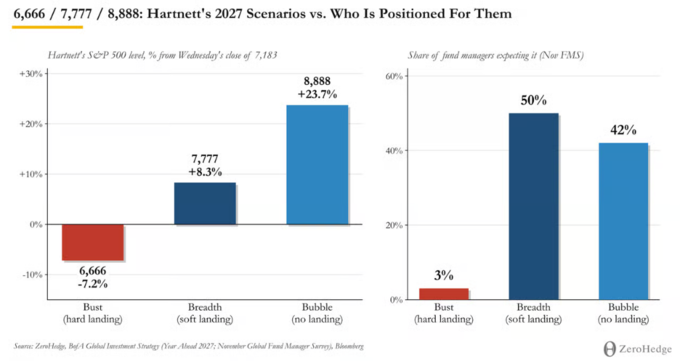
Broadness ( Breadth ) / Soft Landing (around 7777 points) – Waiting for interest rate cuts, buying “C” class assets. This is the camp of Hartnett; its characteristic is that both credit and the stock market will record positive returns in 2027, with the bull market continuing, but the driving force shifting from concentration to breadth.
The two key questions are “when will the interest rate hikes end” and “will they end before a recession?” His answers are next quarter of this year and “yes,” respectively. The reasoning is that inflation will fall before unemployment rates do, and policymakers are too concerned about the social consequences to allow a recession. In this scenario, earnings growth is expected to be around 10%, and risky assets will start to rebound after the interest rate hikes end in March or April; valuations such as the S&P 500 at 16 times, mid-cap stocks at 14 times, global equities at 14 times, and global equities excluding the U.S. at 11 times are no longer considered expensive.
Bubble ( Bubble ) / Failure to land (S&P around 8,888 points) – To achieve this scenario, ultra-large cloud vendors will need to further increase their current capital expenditure budget of $1.3 trillion in 2027, while the current free cash flow of tech giants is negative $283 billion.
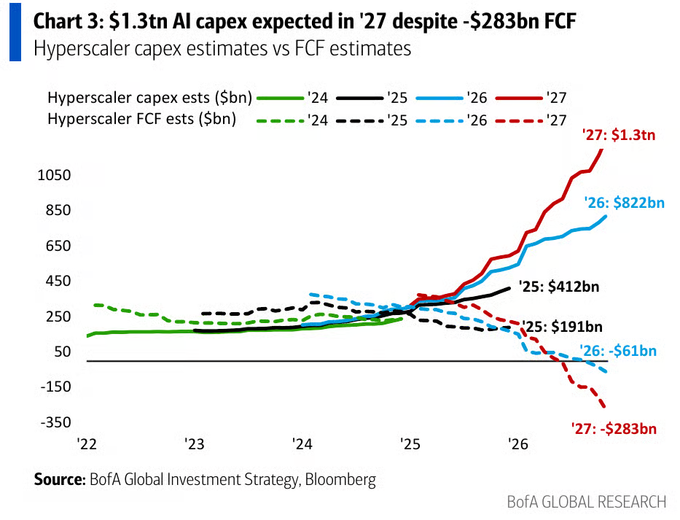
Triggering conditions include (brought about by Washington): U.S. government intervention in the bond market to reduce financing costs and credit spreads for the tech industry; mid-term elections not hindering the expansion of data center capacity by about 100 gigawatts over the next two years; the Democratic-controlled Congress exchanging support for the AI industry for universal healthcare legislation; falling commodity prices reducing the cost of data center construction; Generation Z and Generation X maintaining their habit of buying on dips.
Hartnett believes that before a credit event occurs or there is a large-scale outflow of funds from tech stocks, the pricing for this scenario is too high. The bubble scenario is extremely bullish on technology and extremely bearish on bonds.
Rupture ( Bust ) / Hard landing (around 6,666 points) – This represents a risk of complete mispricing in the current market. Hartnett presents three arguments in the report: First, it is unexpected; only 3% of fund managers anticipate a hard landing. Second, predictions are too high, with a consensus expectation of nominal GDP growth of 5% to 6% and global profit growth of 15% to 20%, yet the K-shaped household wealth and AI capital expenditure that support these projections are weakening. Third, positions are already full, with allocators over-allocating to stocks and commodities and under-allocating to cash and bonds, with annual stock inflows reaching a record level of 1.5 trillion US dollars in 2026.
Bank of America believes that once credit spreads widen and unemployment rates rise, piercing through the prosperity, a real bear market will arrive. The hedging tools are: government bonds, real estate that is negatively correlated with AI, defensive AAA grade assets, and precious metals, including gold and silver, which are the most convenient tools for policymakers to end the recession.
The report also indicates that 6,666 points is only 7% lower than the close on Wednesday and less than 4% lower than the close on last Friday, which is 666 points higher than Morgan Stanley's bearish forecast of 6,000 points, making it appear more modest as a "true bear market."
Monetary Policy Expectations: The Fed is not expected to cut interest rates this year, with terminal interest rates higher than those of its Wall Street peers.
The tactical judgment of Hartnett is based on the narrative shift from interest rate hikes to cuts next spring. However, a forecast by Bank of America indicates that the federal funds rate will be between 4.00% and 4.25% by the end of this year, and between 4.50% and 4.75% by the end of next year; starting from the current rate of 3.75% to 4.00%, this corresponds to three interest rate hikes, with no interest rate cuts by the Federal Reserve in 2027. Twenty-one interest rate cuts will come from other central banks; for example, the European Central Bank reduced its rate to 2.25% after one hike.
Among the three investment banks, Bank of America has the most hawkish view on the Federal Reserve. Goldman Sachs expects interest rate hikes in December and March next year, with the first rate cut in December 2027; Morgan Stanley predicts that the Fed will stabilize rates between 4.25% and 4.50% in March next year and maintain that level until 2028; Bank of America projects rates to be 25 basis points higher than both forecasts and to remain at that level.
The differences among the three in other aspects are also evident: Bank of America has the lowest stock price, the lowest profit forecasts, is the most hawkish towards the Federal Reserve, and is the only one that wants to go long on the euro.
For comparison, Goldman Sachs and Morgan Stanley have previously issued their outlooks: Goldman Sachs recommends buying bonds, shorting the euro, and hedging against the “AI hangover,” with a target of 8700 for the S&P; Morgan Stanley, on the other hand, recommends a maximum overweight in stocks and zero cash position, also targeting 8700 for the S&P. Both banks have the same index target. Moreover, the “base case” mentioned by Goldman Sachs and Morgan Stanley is 188 points lower than what Bank of America’s chief strategist refers to as a “bubble.”
The only consensus among the three is that Brent crude will close in the $70 range next year, and gold, which is currently unattended, is expected to rise by 30% to 47%. Bank of America predicts that Brent crude will fall to $76; the dollar will peak in the first quarter; gold will soar to $5,000, and copper prices will rise to $16,000.
In addition, as shown in the chart placed on the cover by Hartnett, analysts from the seller's perspective (from bottom to top) have not considered these projections: market consensus expects global earnings growth of 17% next year and 37% this year. Bank of America suggests a figure below 10%, while Goldman Sachs refers to this as a "major halving," anticipating that S&P earnings will grow by 11%; Hartnett's own soft landing scenario requires about 10%.
Reversals and Pauses of the Four Major Trading Themes in the 2020s
The report summarizes four major trading themes that will define the 2020s and predicts that their fates will diverge next year.
The trades that are about to reverse include: ABB (buy everything except bonds), which was previously driven by debt and deficits, resulting in a 30-year U.S. Treasury yield of -62% from high to low; this trend is expected to reverse next year; ABC, where Bank of America predicts that the Chinese stock market will reverse next year.
The transactions that will be paused include: ABD (buy everything except US dollars), which was fueled by concerns about currency devaluation; Bitcoin and gold each achieved annual gains of 44% and 23% before reaching their peaks. This transaction will be paused in the first half of next year; AI (full position in AI), driven by disruptive technologies, with NASDAQ's market value increasing by $26 trillion since March 2023. This transaction will also be on pause in the first half of next year.
Potential surprises and shocks in 2027
The report lists tail events that could disrupt the baseline scenario, among which bearish surprises are particularly worthy of vigilance.
Bullish surprises include: peace replacing war, leading to a collapse in oil prices and inflation, thereby allowing the Federal Reserve to cut interest rates in the second half of the year; significant policy improvements in housing and healthcare affordability, triggering a surge in consumer spending among the general public.
Bearish scenarios include: AI credit events, where a sharp drop in DRAM/chip prices leads to a reduction in the value of collateral, triggering a credit crisis, with a large amount of debt currently secured by the chips themselves; debt-induced recession, where as the U.S. economic growth slows down, concerns about debt cause interest rates to rise instead of fall, pushing the economy into recession; and "the Fed gets serious," where Wall Street is shocked to discover that the Fed is serious about its 2% inflation target and will not intervene to rescue the market.
A year is a long time: The list of accidents is more readable than the baseline scenario.
The report indicates that looking back at 2026, the best trades were: going long on oil and short on cryptocurrencies, going long on energy and short on discretionary consumption, going long on semiconductors and short on telecommunications, going long on small-cap value and short on large-cap growth, and going long on cybersecurity and short on national defense. The winning themes of 2026 included: war prevailing over peace, prosperity over recession, a K-shaped recovery over a C-shaped one, interest rate hikes over cuts, greed over fear, and AI issuance prevailing over AI unemployment, as well as IPO over share repurchases, and concentration over breadth.
A year ago, the market consensus was to "run at full speed": global profit expectations were projected to grow by 9%, the upward trend in the first half of the year CPI to 2%, the 10-year yield rate to 3.5%, and the Federal Reserve's policy was considered loose. In reality, the actual profit growth rate was about four times what was anticipated at that time, while all other variables moved in the opposite direction.
Hartnett's prediction in December 2025 that "all commodity charts will show the best counter-trend trades in 2026, just as gold and oil did," has been validated. He also advised selling short the bonds of ultra-large cloud service providers before the market realized it.
But the lesson is this: In August 2025, he pointed out that historically, bull markets peaked in September 2027, with the S&P reaching 9,914 points; today, the upper limit of his bubble scenario is about 1,000 points lower than that level, and the baseline scenario is about 2,000 points lower.
The report concludes that among the three scenarios, a hard landing is the only one that has not been priced; there is only one path for 8888 points – and it is brought about by Washington.