Newsletter
Researchers from the London Business School and the University of Cambridge estimate that the probability of a bubble in the artificial intelligence stock market in September is as high as 97%.
This study used artificial intelligence to analyze nearly 800,000 articles from The Economist and examined 22 historical financial bubbles.
Researchers have found that abnormally strong media warnings can predict weaker market returns, despite financial media typically overestimating the risk of collapse.
The research, which was highlighted by the London Business School on Wednesday, is based on an analysis of 170 years of financial news reports. Researchers used artificial intelligence to determine whether the language used by journalists when describing financial markets could help identify speculative bubbles before they burst.
Do you know?
You can now take immediate action based on the news you're reading: use Decrypt Money Account to go long or short on ANT through perpetual contracts.
The readings in September were comparable to, or even higher than, the levels during the peak of the Internet bubble in March 2000. Subsequently, the market value of NASDAQ evaporated by approximately 77%.
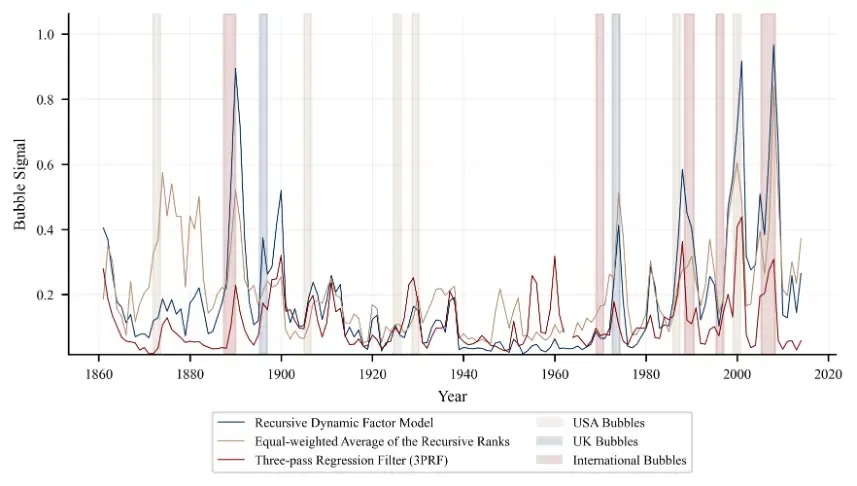
This research, titled “Crying Wolf”, was jointly conducted by Marco Grotteria, a professor of finance at the London Business School, and researchers Afonso Monteiro and Constantine Yannelis from the University of Cambridge.
The research team analyzed 795,964 articles published by The Economist between 1843 and 2013, of which approximately 486,000 were related to financial markets. Subsequently, they extended this index to September 2026.
Instead of simply counting the number of times the word “bubble” was mentioned by journalists, researchers used large language models to identify language related to excessive speculation, concerns about asset valuations, regulatory warnings, and investor frenzy. Subsequently, they compared the monthly readings with 22 recorded financial bubbles in 10 countries.
When financial media "cry wolf"
One of the more interesting findings is the high frequency of mistakes made by financial journalists. Historically, their reports suggested an average probability of a major market crash within the next six months of 20%, yet the actual frequency of such crashes was only 5.7%.
What is truly useful is to measure by how much more concerned journalists have become compared to their usual reporting. During the financial bubble period, this index was higher than 74% in regular months; in the case of the internet bubble, this proportion rose to 94%.
November NVDA High Points
However, the widely cited figure of 97% represents the most pessimistic estimate among researchers. There are two other alternative calculations that yield probabilities of around 40%.
This index has also proven to be useful in predicting stock market performance. When used for out-of-sample testing, it reduced the mean squared error of NASDAQ's 12-month return predictions by 11% compared to predictions based on historical average returns.
Even if investors may not succeed, AI could still succeed.
Acadian Asset Management Portfolio Manager, former Professor of Finance at the University of Chicago Owen Lamont Previously skeptical about whether there was a bubble in AI, he also revised his judgment and recently raised the probability of the U.S. stock market being in a bubble to 70%.
Researchers have distinguished between the economic potential of artificial intelligence and how much money investors expect to earn from it. For example, the internet has fundamentally transformed the global economy, although many companies that attracted huge investments during the internet bubble ultimately did not survive its collapse.
Marco Grotteria indicates: "This technology could be very productive, but investors are still figuring out exactly how much it's worth."
The study also found that if central banks and regulatory authorities incorporate this index into their decision-making and believe that the cost of failing to identify a bubble is much higher than the cost of issuing a false alarm, then their expected losses can be reduced by 20% to 33%.
For policymakers who assign the same cost to these two types of errors, researchers have found that using this index is not beneficial.