


The production cost of Bitcoin has risen to around $86,000, which is significantly higher than its current market price.
As of November 25th, US spot Bitcoin ETF recorded a net outflow of $5.39 billion.
Glassnode considers $58,500 as a key closing level and $53,200 as the next major downward area.
As BTC hovers around $60,000, which is approximately $26,000 lower than the production cost estimated for JPMorgan, Bitcoin miners are experiencing one of the most difficult periods in recent years. The network's computing power has also decreased by 8% year-on-year, marking the first annual decline since 2021.
This forces miners to rethink whether continuing to produce Bitcoin is still economically viable.
Miners are now mining at a loss.
JPMorgan It is estimated that the average production cost of Bitcoin in late November was around $86,000. As the price once fell to $57,300 before rebounding to nearly $60,400, this gap has become significant enough for high-cost miners to not be able to ignore.
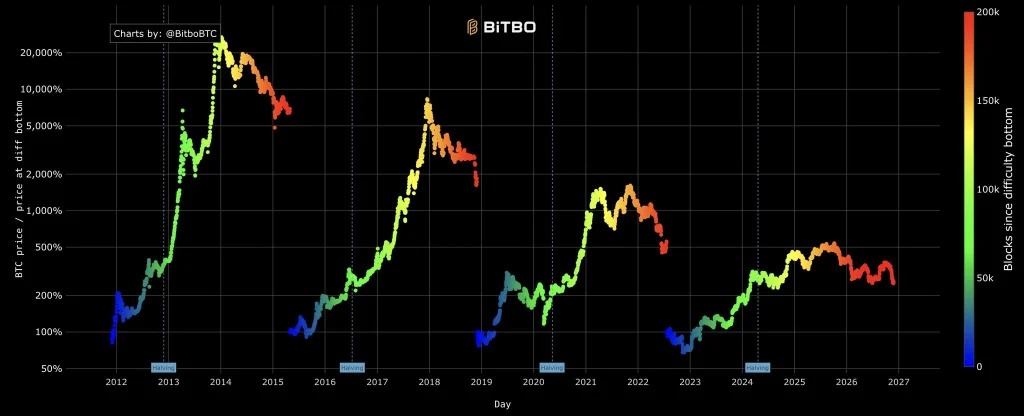
As shown by Hashrate Index of Luxor, as of November 23, miners' daily income was only 29.36 US dollars per hash per second. Meanwhile, Glassnode recorded a year-on-year decline of 8% in Bitcoin computing power, which is the first annual decline since China's mining ban in 2021.
Looking at Bitcoin's previous cycle charts, this change is quite evident. Historically, mining difficulty and price have often risen in tandem during major bull markets, but the current cycle has seen a significant decline from the highs reached in 2025.
For miners, the problem is not just the weakening price of Bitcoin. Electricity costs, equipment expenses, debts, and operating costs continue to rise, while the income generated per unit of computing power is decreasing.
Miners are selling coins, reducing their exposure, and shifting towards AI.
Pressure has forced mining companies and corporate treasuries to sell their Bitcoin reserves. In 2026, 14 tracked listed companies sold a total of 108,247 BTC, worth approximately $8.08 billion, to cover expenses, reduce debt, and fund operations.
Some companies are also shifting their power production capacity towards artificial intelligence and data centers; when mining revenues come under pressure, the returns from power contracts in these types of businesses may be superior to those from Bitcoin mining.
Wider markets also show similar pressures. As of November 25th, US spot Bitcoin ETF has recorded a net outflow of $5.39 billion.
Prolonged block generation intervals increase mining pressure
According to Alex Thorn of Galaxy Research, Bitcoin recently had an interval of 98 minutes and 19 seconds between blocks 977,967 and 977,968, which is the longest interval since July and the 69th longest interval since 2011.
However, this does not mean that there is a network failure. The target average block time for Bitcoin is 10 minutes, so longer intervals are naturally expected to occur.
At the same time, Glassnode considers $58,500 to be a key closing level for Bitcoin and $53,200 to be the next major downward area.