Barclays: The massive overseas selling has not yet reached a stage of complete surrender; the market is more like a tightening of liquidity.
Wallstreetcn
12h ago
Ai Focus
Barclays' latest report states that global markets are experiencing a significant reset of positions, but investors have not yet reached a stage of complete surrender where they can "buy with their eyes closed." Systematic investors and hedge funds have significantly reduced their risk exposure, and retail investor sentiment has dropped to record lows. However, mutual funds continue to buy on dips, with about $310 billion in capital inflows in November. The report suggests that the current cross-asset volatility is more akin to a liquidity squeeze than concerns about economic growth.
Helpful
No.Help

The global market is experiencing a significant reset of positions, but investors have not yet reached a stage of complete surrender where they can "buy with their eyes closed."

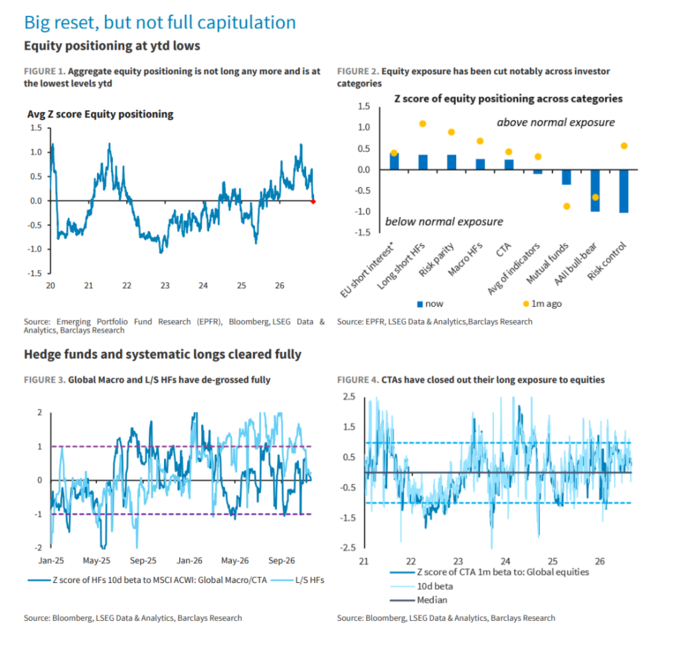
According to the Zuifeng Trading Desk, Barclays' latest report indicates that significant risk-aversion actions by systematic investors and hedge funds have pushed overall position indicators to their lowest levels in a year. At the same time, retail investor sentiment has also dropped to a historical low, which in the past has usually indicated an attractive entry point.

However, mutual funds continue to actively buy on dips, with capital inflows in November reaching a record amount of about $310 billion. This incomplete state of surrender makes the stock market still vulnerable in the face of potential economic growth or panic over policy mistakes.

Cross-asset capital flows indicate that the current market turmoil is more due to liquidity constraints rather than concerns about economic growth. Against the backdrop of the Federal Reserve's bearish options remaining unpredictable, Trump's bearish options seem to be making a comeback, becoming a potential factor supporting risk appetite.
Liquidity squeeze dominates cross-asset performance

Cross-asset positions have shifted to a more cautious stance, but there has been no complete avoidance of risk.

Liquid assets such as gold, Bitcoin, and copper were sold off, the US dollar was sought after, and bonds once again outperformed stocks. Barclays pointed out that an incomplete surrender makes the stock market vulnerable to shocks from growth or policy mistakes that could cause panic, similar to what happened in December 2018.

However, it seems increasingly contradictory that the market is pricing both a slowdown in artificial intelligence development and aggressive tightening by the Federal Reserve, especially considering that falling oil prices are cooling inflation.

US assets continue to attract funds

The weakness of tech stocks has not changed the relative advantage of U.S. assets.

Regional demand still strongly reflects a preference for U.S. assets, with capital inflows in November approaching record levels. The high level of dollar holdings continues to squeeze out broader allocation to other regions around the world.

Although the European market performed better than the broader market, the flow of funds was still mixed. The appetite for short-term investments remained low, and the weak euro as well as poor economic data failed to boost market sentiment. Emerging markets and Asia continued to attract strong bullish demand, led mainly by the domestic markets of South Korea and China. There was a moderate return of funds to India, while the flow of funds to Japan lagged behind.

Semiconductor sell-offs intensify, with a growing defensive rotation in the market

As tech stocks performed poorly, the breadth of the market improved in November. Although capital flows into the tech sector remained resilient, both long-position funds and systematic investment portfolios reduced their exposure to semiconductors.

In Europe, defensive rotation has been more profound, with the allocation to cyclical stocks dropping to a three-year low, while positions in essential consumer goods and pharmaceutical sectors appear crowded.

Barclays stated that a defensive bias supported the fund's performance, but a lighter exposure to cyclical stocks made investors increasingly vulnerable in the face of market reversals, especially when the market lacks certainty and a rebound may encounter selling pressure.

Tip
$0
Like
0
Save
0
Views 73
CoinMeta reminds readers to view blockchain rationally, stay aware of risks, and beware of virtual token issuance and speculation. All content on this site represents market information or related viewpoints only and does not constitute any form of investment advice. If you find sensitive content, please click“Report”,and we will handle it promptly。
Submit
Comment 0
Hot
Latest
No comments yet. Be the first!
Related
Deutsche Bank expects the S&P 500 to rise to 9,000 points by 2027, while also anticipating the Federal Reserve will raise interest rates three more times
In its 2027 global outlook, Deutsche Bank expects the S&P 500 index to rise to 9,000 points by the end of 2027, but the Federal Reserve may still raise interest rates three more times, for a total of 75 basis points. The bank believes that AI capital expenditure can support growth and profits, but it may also drive up inflation and financing costs, as well as increase risks in the credit market.
Wallstreetcn
·2026-11-27 09:01:58
19
Bitcoin Core Privacy Alert: Vulnerability Allows Exposure of Wallets for Just a Few Cents IP
According to Bitcoin core contributor Abubakar Sadiq Ismail, attackers can send low-fee "dust" transactions and take advantage of Bitcoin core's automatic rebroadcast mechanism to obtain the IP addresses of Bitcoin wallet users with a success rate of 100% in 30 simulations, at a cost of approximately $0.18 to $0.34 each time. This vulnerability has not yet been patched and affects wallet software such as Sparrow, Spectre, Liana, Bitcoin Knots, and Electrum Personal Server. The price of BTC has not yet been affected.
Coinpedia
·2026-11-27 08:55:44
19
The Fed's preferred inflation indicator rose to 3.8% in October, increasing policy pressures for 2027
In October, the U.S. Personal Consumption Expenditures Price Index rose 3.8% year-on-year, in line with expectations but up 0.1 percentage points from September; the core PCE excluding food and energy was 3.3%. Meanwhile, the third-quarter GDP was revised to an annualized growth of 4.3%, and the initial jobless claims fell to 189,000, with the market continuing to bet that the Federal Reserve will raise interest rates by 25 basis points in December.
CNBC
·2026-11-27 08:51:34
21
Bitcoin price decline deepens, with inflation and tech stock sell-offs putting pressure
On November 25th, Bitcoin fell to $57,300 for a time, with tech stock sell-offs and higher-than-expected U.S. inflation data weighing on market sentiment. Galaxy retracted its judgment that the bear market had ended, while some investors were reluctant to buy at lower levels due to security concerns and reduced liquidity.
The Cryptonomist
·2026-11-27 08:05:29
25
The smart contract balance of NOX FUND on BNB Smart Chain has exceeded $432,000, with a user base of 1,268.
NOX FUND indicates that its active balance of smart contracts on BNB Smart Chain has exceeded $432,000, covering 1,268 unique wallets. The protocol claims to be an immutable, custodian-free USDT revenue protocol that has remained offline-free for 41 days and will continue to process revenues and unlock them in a publicly verifiable manner before the first 45-day unlocking cycle arrives.
Decrypt
·2026-11-27 07:29:53
33
View More