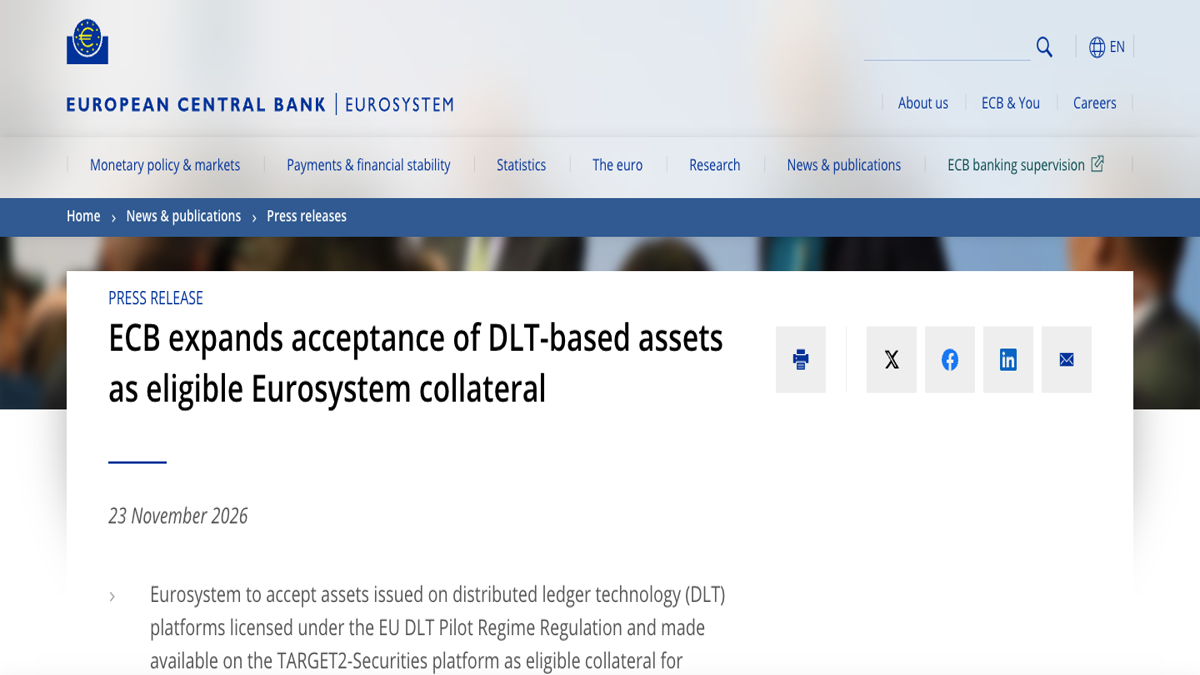


The European Central Bank Council approved the expansion of the collateral range within the euro system on November 23. Some tradable assets issued on licensed distributed ledger platforms can be included, but they must meet the requirements of the euro system and be connected through qualified channels T2S. The implementation plan is set for June 2027.
T2S is an abbreviation for TARGET2-Securities, which refers to a securities settlement platform. The announcement separates the location of asset issuance from the process of pledging those assets with the central bank: Issuance can occur on licensed distributed ledger platforms, but the pledging process must still comply with the existing securities settlement arrangements. The decision made in November confirmed the qualification framework, while the detailed rules and implementation will have their own timelines.
The platform has obtained a license, but securities still need to go through two layers of inspection.
The first level of verification is to check the assets themselves. The objects approved by the council are tradable assets, and the issuing platforms must obtain permission in accordance with the EU's distributed ledger pilot system. The assets must also meet all the standard collateral requirements of the euro system. The announcement does not publish a list of qualified securities one by one. For those who trade securities on the blockchain, it is necessary to first check the EU pilot license used by the issuing platform, and then to verify whether the securities can be delivered through the qualified securities custody link. Having only the platform license still does not answer the second question.
Second-level verification of delivery: Institutions holding assets must provide them to the euro system by connecting through a qualified link to a central securities depository that operates a qualified securities settlement system. The central securities depository is responsible for the registration, custody, and settlement of securities in this process. The announcement stipulates that the settlement system must also comply with EU regulations on central securities depositories and provide settlement services at T2S. For the same security, the ability to transfer it on the issuance platform and to use it as collateral through a qualified link are two separate capabilities that need to be confirmed separately.
The platform also has additional requirements. The European Central Bank specifically cited two examples: the determination of settlement finality, and the outsourcing of key functions. The former relates to when a transaction is legally considered final, while the latter concerns which steps of the process can be handed over to external institutions without compromising operational security requirements. Schneider, a member of the Executive Board of the European Central Bank, mentioned the integration of new technologies alongside maintaining risk assessment standards in the announcement. At the time of obtaining the pilot license, institutions were still unable to determine how the euro system would assess the finality of settlements based on these criteria.
The policy timeline is also divided into two phases. The euro system is expected to announce the details of these additional requirements in the spring of 2027, with implementation planned for June of the same year. The details provided in the spring will be the next piece of information used to determine whether a particular link, platform, or outsourcing arrangement meets the requirements. The November communiqué did not provide a list of the first batch of participating platforms or securities, nor did it specify the exact mortgage discounts under these new arrangements; therefore, it is not possible to calculate how much central bank credit can be obtained by holding certain on-chain securities using this information.
From the custody institution's ledger to re-taking over after issuance on the chain
On January 27th of this year, the European Central Bank announced that it would accept assets issued by central securities depositories that use distributed ledger technology as collateral. In November, it was decided to expand the scope of issuance to include platforms that have been licensed under the EU pilot rules, such as DLT. Securities can be issued in other places, but when provided to the euro system, they still need to go through qualified depositary and settlement arrangements. The options for issuers have expanded, but whether the collateral can actually be delivered depends on the connection between the two systems.
The announcement also mentioned two longer-term initiatives. The euro system is studying how to incorporate and manage assets that are issued and settled entirely through distributed ledger networks.
Appia is an initiative to study the tokenized financial market. The official page states that it will evaluate how different ledger networks can provide central bank money and collateral services, with the goal of forming a blueprint by 2028. The timeline for creating this blueprint is separate from the implementation plan for these collateral rules; therefore, complete on-chain settlement cannot be rushed into the arrangements set for June 2027. The Appia page also mentions that they will research ledger infrastructure that operates according to European governance and common standards, and assess different configurations in conjunction with the market, legal, and regulatory environments. The currently approved collateral pathways clearly require the use of custody processes that comply with current regulations.
For issuers, the actual change decided in November is that the issuance formats on the licensed DLT platform can now enter the qualification assessment for the euro system. For institutions that use collateral financing, they still need to meet the asset standards, delivery pathways, and additional platform requirements together. After the detailed rules are announced in spring, the first thing to check is whether their own platforms and custody links meet these conditions.