The Taiwan stock market in China is experiencing a wave of deleveraging. Last Friday, the balance of short-term financing plummeted by NT$49 billion in a single day, marking the largest one-day decline in nearly 30 years. Consequently, Goldman Sachs downgraded its rating of the Taiwan stock market from "overweight" to "neutral" and significantly reduced its target price targets.
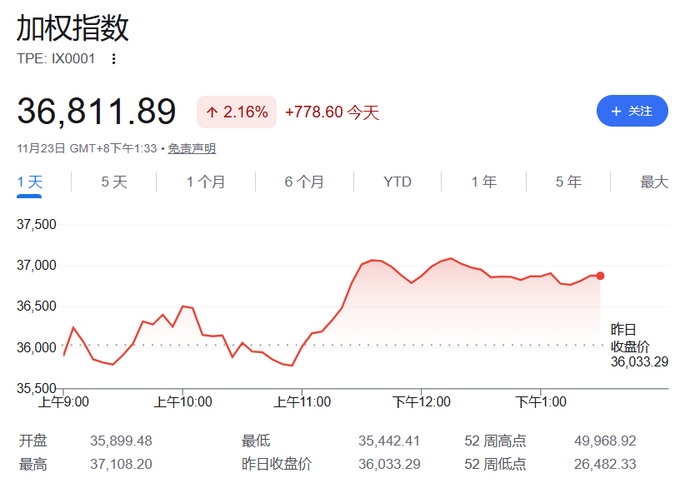
China's Taiwan benchmark weighted index tumbled 17.5% last week, recording the largest single-week decline since 1991. On Monday, the index rebounded with a gain of 2.16%, but market sentiment remains fragile.
According to Bloomberg, the financing balance of listed stocks tumbled by NT$49 billion (about $1.5 billion) on Friday alone, marking the largest single-day decline since Bloomberg began tracking such data in 1996. The financing balance has now fallen by more than 30% from its record high of around NT$653 billion set in October.
Goldman Sachs' strategist based in Hong Kong, Alvin So, stated bluntly in a research report released on Saturday: "Retail leverage has significantly decreased, but the risks of margin calls and forced deleveraging are still relatively high." He pointed out that the overall market financing maintenance rate has dropped to 132%, approaching the 130% margin call threshold, and "currently, 53% of stocks are below this level."
Goldman Sachs downgrades rating, target level significantly reduced
In a report released on November 21, Goldman Sachs downgraded Taiwan, China's rating from "Overweight" ( Overweight ) to "Neutral" ( Marketweight ) in its Asia region allocation, and also lowered the target index level for the end of 2027 from 57,500 points to 50,000 points.
Based on the index level of around 36,034 points last Friday, a target of 50,000 points would represent a potential upside of about 40%. However, Goldman Sachs also pointed out that the current implied volatility of the Taiwanese stock market, which is 40%, has significantly reduced the attractiveness of risk-adjusted returns.
The report states: "Strong profit growth (expected to increase by 32% in 2027 and 25% in 2028) remains supportive, but AI capital expenditure risks, high market concentration, relative valuation premiums, and persistently high volatility collectively weaken the attractiveness of risk-adjusted returns."
Goldman Sachs also maintains a core position in “high-quality tech stocks,” supplemented by a “dividend-supported AI diversified allocation” as a tactical supplement.
Foreign capital continues to sell net, while retail investors take over against the trend.
Foreign selling pressure is the core driving force behind this round of decline. According to a Goldman Sachs research report, foreign investors ( QFII ) sold a net $5.8 billion worth of equities last week, with TSMC alone seeing a net sale of $3.8 billion in that same period. Since the beginning of the year, foreign investors have sold a total of about $95 billion worth of equities, of which TSMC alone accounts for approximately $74 billion.
At the same time, retail investors bought against the trend. Data shows that ETF attracted approximately $4.8 billion in net inflows last week, of which broad-based passive ETF saw $2.5 billion in inflows, dividend-oriented ETF had $900 million in inflows, and leveraged and active ETF each saw around $700 million in inflows. Despite a significant reduction in financing, retail investors continued to maintain a net buying position.
However, the leverage exposure of retail investors cannot be ignored. Data shows that the scale of leverage ETF is still as high as $11 billion, accounting for 0.8% of the market's freely tradable shares. Alvin So warns in the report that this exposure still poses a potential risk of forced deleveraging in the event of a continued market decline.
Short selling restrictions are being tightened layer by layer.
In the face of continuous declines, Taiwan, China, has tightened short-selling rules three times this month.
Taiwan, China, announced on Saturday that it would completely ban short-selling operations below the closing price of the previous trading day, covering both short-selling with borrowed securities and short-selling with borrowed shares. The new regulations will take effect on November 23. This is the third time this month that restrictions on short-selling have been introduced.
Previously, on November 9th, the intraday limit for short selling with borrowed securities was reduced from 30% to 3% (based on the 30-day average trading volume), and the margin requirement for short selling was increased from 90% to 130%. On November 20th, further restrictions were imposed, reducing the limit to 1%, and it was stipulated that for stocks whose price fell by more than 3.5% on that day, short selling below the previous closing price was not allowed the following day. The latest measures also raise the margin requirement for short selling to 150% and suspend the acceptance of applications from securities firms for new put warrants.
The fundamental profitability is still stable, but the valuation premium limits the room for improvement.
A Goldman Sachs research report indicates that the fundamental earnings of the Taiwan stock market are still supportive. Overall earnings in Taiwan, China, increased by 71% year-on-year in the third quarter, and the consensus forecast for earnings per share in 2027 has been raised by 0.3%. The technology sector is expected to achieve earnings growth of 32% and 25% in 2027/2028, respectively.
However, the pressure at the valuation level cannot be ignored. Data shows that the current 12-month forward price-earnings ratio of the MSCI Taiwan Index is 12.7 times (1.3 standard deviations below the historical average), and the 24-month forward price-earnings ratio is 10.0 times (2.2 standard deviations below the historical average). Although the absolute valuation has declined, Taiwanese tech stocks still have a 21% premium over their global counterparts in terms of price-earnings ratio (15% when TSMC is excluded), which is at a historical high and limits their relative attractiveness in global portfolios.
The report also indicates that the proportion of the technology sector in Taiwan's overall profits has risen from around 50% in the early 2010s to an expected approximately 85% by 2027, significantly increasing the sensitivity of the Taiwanese stock market to AI and the fundamentals of semiconductors.
High retail leverage and foreign capital positions; the pressure to reduce these remains.
A Goldman Sachs research report reveals deep-seated contradictions in the current market structure: while foreign capital is selling on a large scale, retail investors and ETF continue to take over the positions, yet both parties hold positions at historically high levels, and the pressure to reduce these holdings has not been fully relieved.
On the foreign capital side, despite having net sold approximately $95 billion from the beginning of the year to date, foreign investors still hold a 69% stake in TSMC, and their shareholding in other tech stocks remains around 46%. The report points out that hedge funds are still significantly over-weighted in the Asian information technology sector. If the uncertainties and market volatility represented by AI continue, there is room for further reductions in their positions.
On the retail side, although the financing balance has dropped from a peak of $28 billion to $17 billion, the leverage level is still as high as $11 billion. The bank warns that 53% of stock financing maintains a ratio below the 130% margin call threshold, which represents 44% of the freely tradable shares in the market (excluding TSMC), indicating that "the risk of financing digestion is widespread."