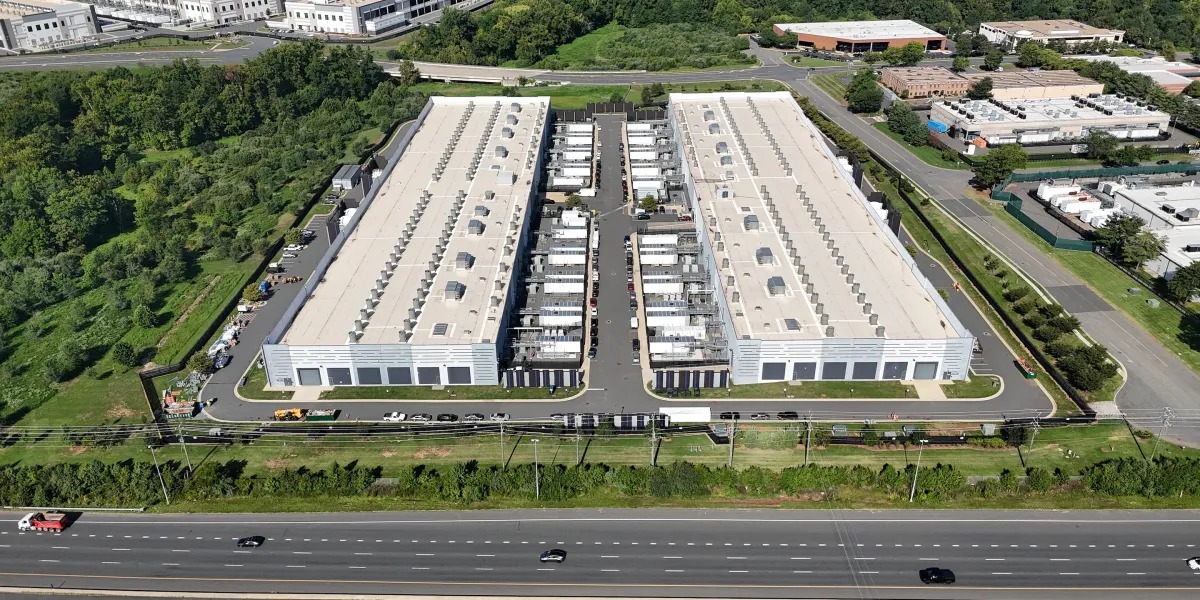


The tech industry is known for its speed, while the power grid is not so fast. Today, this clash is at the heart of the AI construction boom, and this project is expected to cost trillions of dollars: Citigroup estimates that large tech companies will spend over $2.8 trillion on AI infrastructure by 2029; a study by the Brookings Institution estimates that related investments in the United States will reach $10.3 trillion between 2025 and 2032.
The power grid is not suited for such a pace. Analysis by the insurance brokerage company Howden shows that since 2000, the electricity consumption of data centers has been increasing by an average of 19% per year, while the capacity of the US power grid has only expanded by 2% annually. The growth rate of electricity consumption in data centers is ten times that of the power supply system.
This gap has become one of the biggest bottlenecks faced by the AI industry. Moreover, following the mid-term elections this month, and with voters rejecting proposals for data center projects in nearly all cases, electricity has now also become a political issue.
The power grid has lagged behind demand for many years.
In 2025, data centers will account for approximately 5% of the U.S. power grid capacity. Howden estimates that if this proportion is to be maintained by 2030 at the current growth rate, data centers would have to obtain as much as 58% of their power from sources other than the power grid, which amounts to about 110 gigawatts; however, the company itself also believes that this level is unlikely to be achieved.
From the perspective of electricity consumption, the situation is the same. Lawrence Berkeley National Laboratory estimates that by 2028, data centers may consume as much as 12% of the United States' electricity, which is about six times the 1.9% share in 2018, before the AI craze.
The president of consulting firm Grid Strategies, Rob Gramlich, stated in September to Fortune that there is a clear “mismatch in timing” between the speed at which data centers need to obtain power and the speed at which the power grid is expanding. He mentioned that the slow construction of power grid capacity is due to the fact that thousands of interconnected components must work together, which requires “careful research and planning,” and this often takes several years.
He also mentioned that he has become unfamiliar with this industry as well. After approximately 25 years of virtually no growth in electricity demand, utility companies “are no longer accustomed to building new infrastructure.”
Insurance company Marsh is responsible for the growth of special energy and power in the United States. Kathryn Burke told Fortune that she expects about 50% to 60% of the data center projects to be completed later than the 1 to 2-year schedule anticipated by the developers.
Voters are opposing the increase in electricity prices.
Public backlash against the pressure on the power grid and rising electricity prices for residents has added another obstacle. On November 3rd, voters rejected data center development in 40 out of 41 local voting proposals; on the same evening, the Democratic Party gained control of both houses of Congress.
Opposition is strongest among young people. A survey conducted this summer by the Annenberg Center for Public Policy at the University of Pennsylvania found that 70% of adults under the age of 30 oppose the construction of new data centers in their areas, compared to 61% of all adults.
Voters' concerns are not unfounded. Northern Virginia is home to the world's largest cluster of data centers, and the state of Virginia sells 59% of its electricity to commercial customers, including those in the data center industry. By 2025, the commercial energy demand in 23 states and the District of Columbia has surpassed that of residential consumers.
Researchers Cheng Feng and Fengqi You from Cornell University found in a study published in Nature Energy that data centers can disproportionately drive up wholesale electricity prices. In the South Bay region of California, the study estimates that data centers will raise wholesale electricity prices by nearly 20% by 2025; in the Dallas-Fort Worth area, this increase is close to 17%.
Among the four power grids studied, researchers found that in 2025, data centers were only responsible for 38% of the infrastructure costs related to their growth, which amounts to $3.12 billion out of a total bill of $8.25 billion.
The subsidized electricity price only accounts for about 30% to 50% of a household's bill, but experts say that residents will ultimately still bear a part of the costs associated with the construction of AI. Researchers at Cornell University have found that these costs hit low-income and rural households the hardest, and they refer to this phenomenon as a "paradoxical mismatch."
"I can't say I'm very excited about the idea of having to grow and compete with a tech company in terms of water and energy prices right now," said 18-year-old Voters of Tomorrow, the organizer of Elijah Lee, to Fortune before the mid-term elections. Voters of Tomorrow is an initiative group initiated by Generation Z.
Large technology companies are beginning to venture into the power industry.
Tech companies are adapting to this change by entering the energy sector, and the industry refers to this model as "self-powered."
Some states now require this to be done. In August, Delaware became the first state to enact legislation implementing a "bring your own power" policy, requiring large energy users such as data centers to produce or ensure they obtain 100% of the electricity they use within 10 years of starting operations, including a portion from renewable energy sources.
U.S. President Donald Trump's "Paying Rates Protection Promise" requires signatories to "build, bring in, or purchase" the new generation of energy resources and electricity they need. Amazon, Google, Meta, Microsoft, OpenAI, Oracle, and xAI signed in March, followed by more than 200 utility companies, cooperatives, developers, and Republican governors. This promise is not binding.
The on-site power generation capacity is still not large, but it is growing rapidly. BloombergNEF statistics show that as of March, there were only 2 gigawatts of on-site gas-fired power generation capacity in operation in data centers worldwide. Since then, the organization has tracked 181 gigawatts of gas-fired power generation projects that are planned to support data centers, with over 90% of these projects located in the United States.
Taking SpaceX as an example, the company proposed to build a supercomputing facility and a gas power plant worth approximately $24 billion in Starbase, Texas. This shift also comes with climate costs: According to a Bloomberg News analysis published by Fortune, the gas power plant planned for the data center could lead to a 20% increase in emissions for the US power sector.
However, this is not a universal solution. Experts in data center development indicate that this model is not a long-term fix, as the significant fluctuations in the power demand of the AI data center could lead to power outages and damage to on-site power generation equipment.
The next round of challenges is just around the corner. The Democratic Party will take over congressional committees in January. Texas' incoming governor, Gina Hinojosa, has proposed a moratorium on the development of new data centers, and Ohio already has 125 local data center moratoriums, with more expected to be added.
As these construction plans are being advanced, none of them are set in stone.