










Tesla today announced the launch of FSD v15 in the US market, bringing along a brand-new visual interface called “Tesla Reality View” (Tesla Real-View).
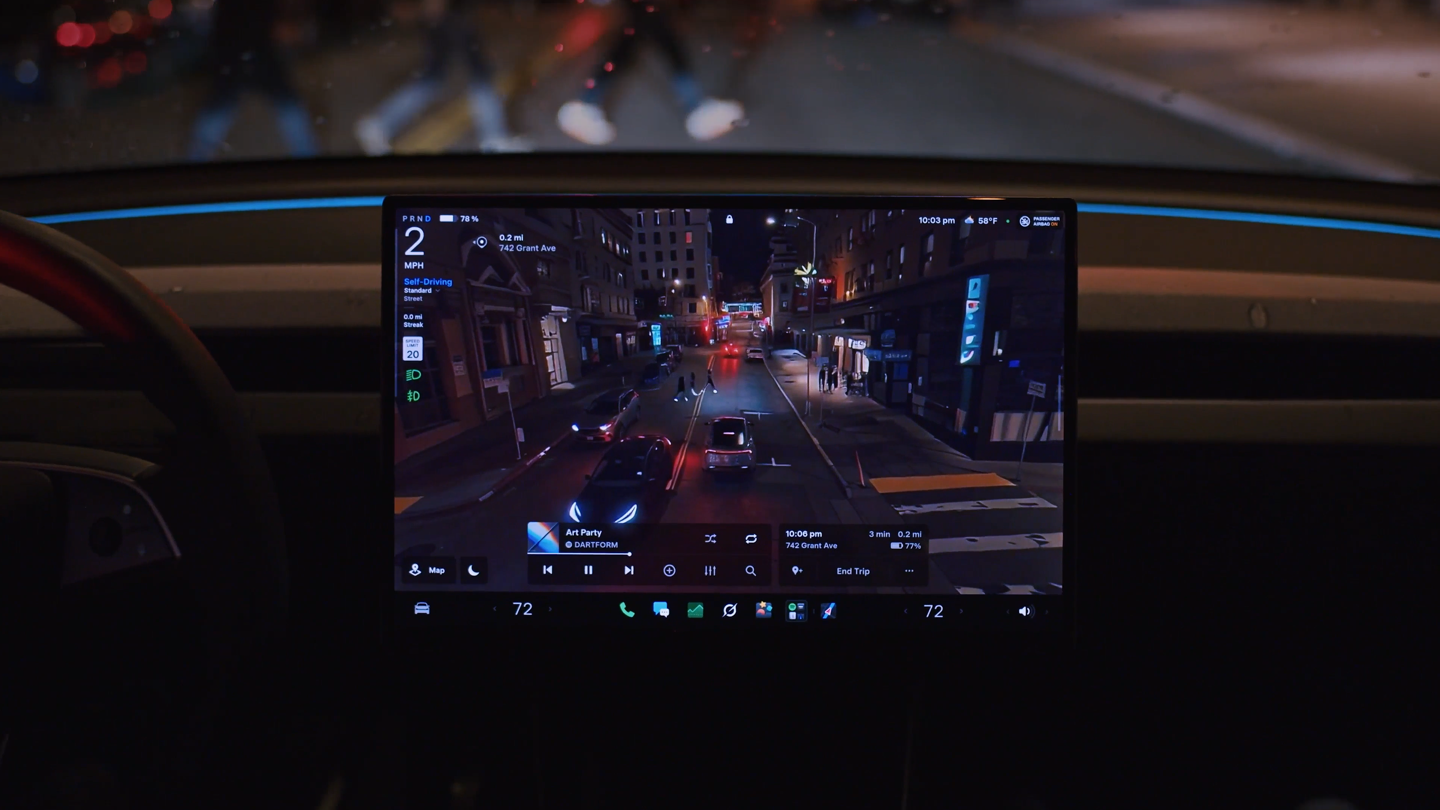
Subsequently, the brand-new “Tesla Reality View” quickly sparked heated discussions among netizens. Blogger @JingqiSuperIntelligent analyzed that Tesla managed to achieve 3D Gaussian full-scenario reconstruction despite having a hardware disadvantage. He stated that he carefully checked the specifications of Tesla’s FSD second-generation chip today and found it to be inferior to the self-developed chips of many new competitors.
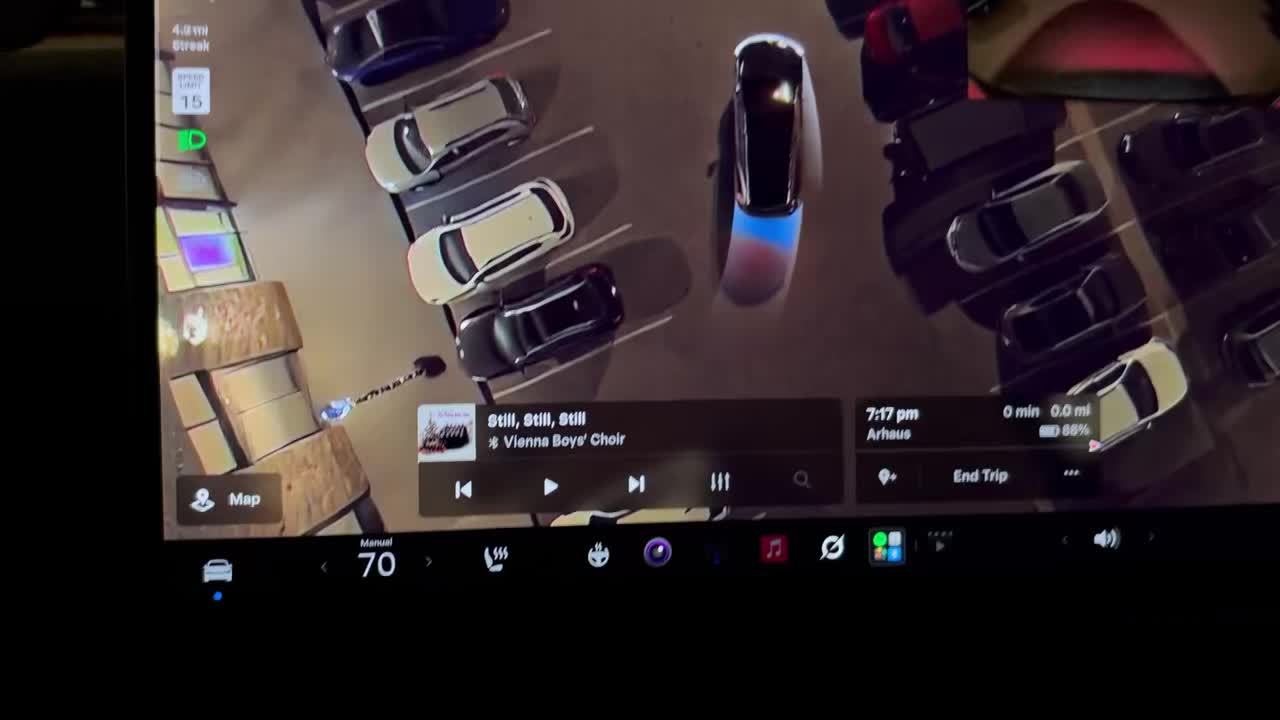
Elon Musk also posted an explanation for this feature today. He revealed that the “Tesla Reality View” in FSD v15 is generated by real-time AI video, without the need for a game engine, and only uses half of the computing power of one TRIP accelerator of the AI4 chip.
Related Reading:
- Tesla's FSD v15 new visualization UI has sparked heated discussions; it is said that 3D Gaussian full-scenario reconstruction was achieved despite hardware disadvantages.
- Tesla Launches FSD v15 Overseas: Safety Critical Scenario Handling Capability Increased by 25 Times, with a New Visual UI
For further reading, according to Ashok Eluswamy, the person in charge of AI at Tesla, the number of neural network parameters for FSD and v15 has increased from about 1 billion to about 10 billion, making the connection between prediction and control even closer. Tesla positions v15 as a performance leap on par with that achieved by V13 to V14. They also claim that the upgraded visual encoder is shared among the FSD, Robotaxi, and Optimus humanoid robots and has been trained using millions of internet videos.
The same software that runs Tesla's Robotaxi fleet is also used by FSD and v15. Eluswamy disclosed during the second-quarter financial report conference call in 2026 that Robotaxi equipped with the early version of v15 had completed over 380,000 miles of unsupervised driving in six cities across two states, without any major accidents occurring during that period.
Regarding “Tesla Reality View”, Tesla released a description explaining that it uses an in-vehicle AI computer to generate real-time images of the surrounding road environment from a virtual perspective above the vehicle. This interface supports full-screen, map, or split-screen views, and users can even click on target locations on the visualized screen to guide the vehicle there. Musk described it as “presenting real roads in a way similar to video games”.
The so-called AI4 mentioned in the text refers to Tesla's fourth-generation autonomous driving hardware platform, HW4. Since FSD V13, Tesla has changed the naming convention for its chip platforms from HW4 to AI4. This platform is designed for FSD V13 and subsequent versions, offering approximately a 5-fold increase in computing power compared to HW3. According to previously disclosed specifications, the number of CPU cores in HW4 has increased from 12 to 20, with a maximum frequency of 2.35GHz; its TRIP deep neural network accelerator has been upgraded from dual-core to triple-core, with the maximum frequency rising from 2GHz to 2.2GHz, resulting in an estimated total computing power of about 300-500 TOPS.
The "3D Gaussian reconstruction" mentioned in the text refers to 3D Gaussian Splashing (3D Gaussian Splatting, 3DGS), which is a method of reconstructing the radiation field from a new perspective by explicitly representing the scene with a large number of 3D Gaussian ellipsoids and then rasterizing it for real-time rendering. The scene is explicitly represented by many elliptical Gaussian particles, which are projected onto a two-dimensional screen to form an image, capable of generating new perspectives at a rate of over 30 frames per second at 1080p resolution. During training, a smaller number of particles are used, and their positions, shapes, and colors are adjusted by continuously comparing them with real photographs, with particles being copied or deleted as needed. During the rendering phase, the visible particles are laid out on the screen like small color spots; since they are only distributed in areas where there are actual objects, the computing power can be focused on the visible parts. Compared to neural radiation fields that require multiple layers of neural networks to query color and density point by point, the rasterization process is faster on graphics processors.