Key Points
- After being suspected of being exploited, the Monero token price plummeted by 99.8%
- Attackers sold tokens worth $13.5 million to 420 buyers on Hyperliquid.
- Wagyu claims to be suspected of private key leakage and promises a refund
According to blockchain intelligence company Bitquery, on November 20th, a Monero token packaged on Hyperliquid plummeted by 99.8% after attackers allegedly breached the account of its deployer, and they sold tokens worth approximately $13.5 million.
The token, named XMR1, plummeted from around $500 to $1 within 30 minutes, causing hundreds of buyers to suffer significant losses. Investigators traced the funds and found that they were transferred through Arbitrum and Ethereum; meanwhile, the service behind XMR1, namely Wagyu, attributed this incident to a suspected private key leak.
This collapse affected XMR1, not the native Monero coin XMR, which highlights the differences in security between underlying cryptocurrencies and their encapsulated tokens.
Hyperliquid attacked, Monero price plummeted by 99.8%
According to the investigation on November 20th by Bitquery, approximately 5.2 million XMR1 tokens were transferred from the account of the token deployer to a newly created wallet through three transactions.
Subsequently, the receiving wallet sold 369,623 XMR1 to 420 buyers, cashing out approximately $13.51 million, which overwhelmed the existing order book of Hyperliquid.
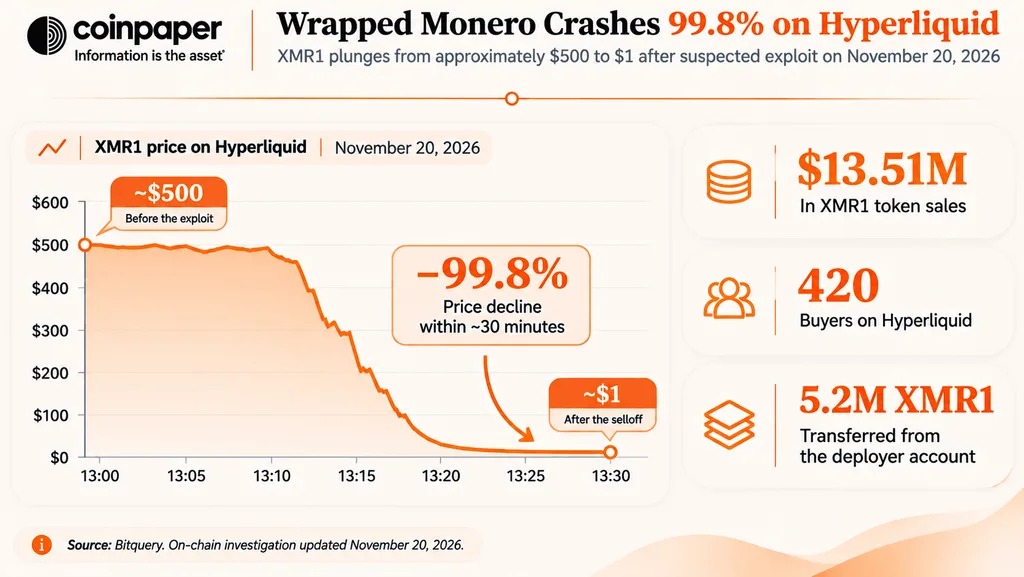
Approximately 76% of the proceeds from selling were obtained within the first 11 minutes after the sale began, demonstrating the speed at which the attackers took advantage of the existing liquidity.
Only one buyer paid approximately $3.56 million, while market-making orders accounted for the majority of trading activity.
Where did those 13.5 million US dollars go?
Bitquery tracking revealed that approximately $13.28 million of USDC was transferred from Hyperliquid to Arbitrum through 11 transactions.
Subsequently, the attacker used CoW Protocol to exchange $13.22 million of USDC for approximately 7,467 ETH, and then transferred most of these cryptocurrencies to Ethereum through multiple cross-chain bridge services.
The investigation also identified that approximately $6.6 million of funds that purchased XMR1 earlier were related to the profits from different attack incidents that began on November 4th. However, Bitquery stated that no evidence on the blockchain was found to indicate a connection between these attackers and the incident on Friday.
This incident is similar to the broader DeFi security incidents: when management credentials or privileged accounts are compromised, cryptocurrency users may face significant financial losses.
Wagyu blames the incident on a hack by the hosting service provider and promises a refund
Wagyu Operators PerpetualCow attribute this incident to a cyberattack involving the Icelandic hosting service provider 1984. hosting.
According to him, the deployer key for XMR1 was once stored on an old server, which has since been deleted. However, it is claimed that the relevant files can still be accessed through that hosting service provider.
The company, as well as Iceland's cybersecurity authorities, have acknowledged that a serious cyberattack occurred. However, investigators have not yet independently confirmed how the XMR1 signature key was obtained.
PerpetualCow promised to cover the costs of compensating affected users out of their own pocket and stated that Wagyu would eventually be brought back online, but no specific timeline for compensation was announced.
This incident has once again raised questions from the outside world about the security of managed keys, especially after previous attacks on encrypted infrastructure that involved compromised encapsulated assets and systems.
The report also pointed out that this incident highlights the importance of controlling private keys in preventing unauthorized token transfers.
Maya Bennett is a financial journalist who has reported on cryptocurrencies, stocks, and broader market trends. Her coverage focuses on Bitcoin, major digital assets, the stock market, monetary policy, as well as economic developments that influence investor sentiment.