















The recovery momentum of Target ( Target Corp ) is accelerating, and its stock price has risen by nearly 80% this year.
On Wednesday, November 18th, before the opening of U.S. stock markets, this large retail company announced its financial results for the third quarter ending October 31st. Same-store sales increased by 5.6%, and both revenue and earnings per share exceeded analysts' expectations. The company also raised its full-year performance forecast for the third time.
Analyst Max Rakhlenko wrote in a report on Wednesday that Target's overall performance was 'quite solid, with continuous improvement in all departments, laying the foundation for further adjustments to come.'
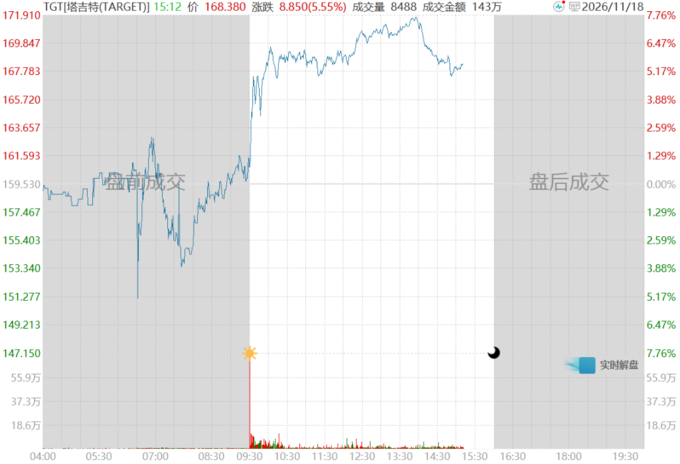
After the financial report was released, Target's stock price fell before the market opened, but then reversed and soared by more than 7.7%. So far this year, the stock has risen by about 78%, significantly outperforming the S&P 500 index, which has gained about 7.2% during the same period.
However, the improvement in performance is not across the board. Sales in the apparel and accessories segment declined by 3.8% this quarter, making it the only major category to record negative growth. Management acknowledges that the transformation of the two core categories, home products and apparel, still requires time, with women's clothing and footwear lagging particularly behind.
Quarterly core data: Both revenue and foot traffic have accelerated.
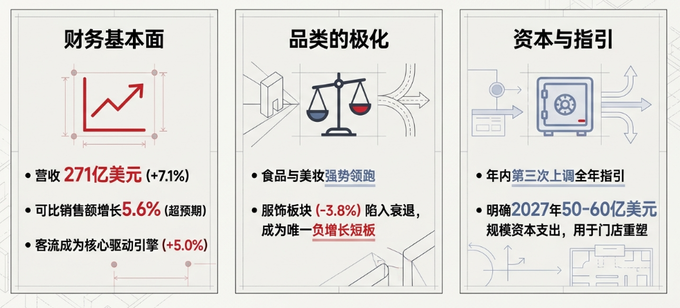
Target's revenue in the third fiscal quarter reached $27.1 billion, a year-over-year increase of 7.1%, exceeding analysts' estimate of $26.5 billion. Same-store comparable sales grew by 5.6%, higher than FactSet's forecast of 3.7%, with a 5.0% increase in customer traffic being the main driving factor.
The adjusted earnings per share are $2.65, which is higher than analysts' expectations of around $2.07 to $2.08. It is worth noting that this quarter's results include a tariff refund benefit of $0.50 per share; excluding this factor, the adjusted earnings per share still increased by 21% year-over-year.
Gross profit margin expanded by 2.3 percentage points to 30.5%, of which tariff refunds contributed 1.1 percentage points. Operating profit margin rose to 6.2%, higher than the 3.8% in the same period last year.
Looking at different categories, entertainment and general merchandise products (such as toys, electronic products, and sports goods) saw a growth of nearly 27%, the beauty category grew by over 9%, and the food and beverage category grew by nearly 7%.
Divided by channel, the comparable sales of online digital channels increased by 9.8%, while those of offline physical stores increased by 4.6%. In addition, non-commodity revenues driven by the company's own digital advertising business and paid membership services performed exceptionally well, with a substantial year-on-year increase of nearly 20%.
Annual guidance raised again, capital expenditure plan clarified
Target has raised its full-year net sales growth forecast for the fiscal year 2026 to approximately 6%, up 1 percentage point from its previous guidance, and this is also the third time the company has raised its full-year outlook for the year.
The annual earnings per share guidance range is $10.65 to $11.40, including the approximately $2.14 in tariff refund benefits that have been confirmed so far. The median guidance of $11.03 is higher than the analysts' consensus forecast of $10.55.
In terms of capital planning, Target expects its capital expenditures to reach $5 billion to $6 billion in 2027, which will be used for store renovations, new store expansions, and technological upgrades.
Food and beauty products are reshaping the market, driving a rebound in customer traffic.
The reshaping of the food and beverage sector is a key focus of this round of transformation.
Target has increased the area of its food sections by more than 20% in nearly 150 renovated stores, and by more than 50% in over 300 new stores. At the same time, the company has reduced the presence of certain basic product categories that consumers are less inclined to purchase or that can be obtained through other channels, such as canned soups and cereal foods.
In terms of the beauty department, after the cooperation with Ulta Beauty expired, Target completed a comprehensive renovation of the beauty area, introduced new exclusive products, and expanded its brand lineup. More than 600 stores added 'Beauty Experience Zones'.
To cope with inflationary pressures, Target implemented price cuts on nearly 2,000 products this quarter and stocked over 8,000 new items for the holiday season, among which thousands are priced at no more than $5.
Clothing and home furnishings remain areas of weakness in transformation.
Despite an overall improvement in sales, the apparel and accessories category saw a year-on-year decline of 3.8% in the third quarter, making it the only major business segment to record negative growth.
Chief Product Officer Cara Sylvester stated during an analyst conference call that the company plans to reduce the number of women's clothing styles by 20% and implement price cuts on "hundreds of individual products." She said:
"We have lost focus on the basic models that some customers rely on, and there is also a lack of consistency in cutting, fabric, and quality."
Although the comparable sales volume of the home department in the same store increased by about 2.5%, management admitted that the full recovery of this department will be "a multi-year process."
GlobalData, the director general of market research firm Neil Saunders, pointed out in the report that the Target clothing area "still appears too fragmented" and that the display method is "slightly chaotic." He also stated that the company has the opportunity to improve this situation by leveraging foot traffic and further unleash its growth potential by enhancing conversion rates.
According to Bloomberg, an analyst from UBS also pointed out earlier this month that the home and apparel sectors will be key drivers of Target's growth in the next phase, but these two categories are more significantly impacted by the trend of consumers returning to more basic consumption.
Meanwhile, competitors such as Walmart and Amazon continue to attract price-sensitive consumers, further squeezing Target's market share.